
Storage planning depends on what you need to store, not just the number of bedrooms. For a three-bedroom household, first decide whether storage will hold most of your belongings or only selected items during a move.
That choice affects how you pack and plan access. If you’ll need some belongings before others, mark them in your inventory so you can reach them without moving everything else. A clear inventory also makes it easier to compare your needs with available unit dimensions.
This guide explains what affects a storage estimate, compares common unit sizes, and uses UK household estimates as context for readers in South Africa. To work out how much storage space a three-bedroom house needs, focus on the items you’ll store and how storage fits into your move.
Key Takeaways
- List the furniture, appliances and boxes going into storage so you can estimate the volume of the items you’re actually keeping.
- Disassemble bed frames, tables and chairs where possible, then stack heavier boxes beneath lighter, fragile ones.
- Compare unit dimensions with your inventory: a 10×15 ft unit offers 150 square feet, while a 10×25 ft unit offers 250 square feet.
- UK household estimates vary, so use the contents of the home and any garage, loft or shed items to refine the space needed.
How Much Storage Do You Need for a 3 Bedroom House?
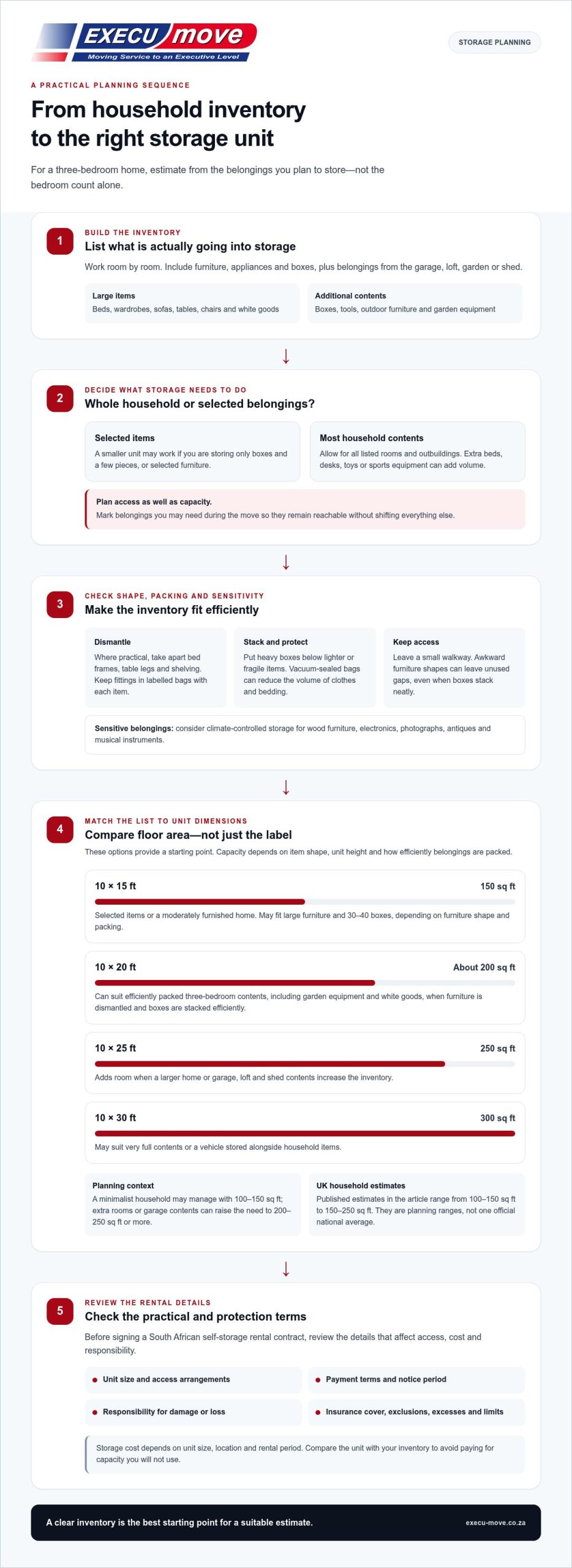
A useful starting point is 150 to 250 square feet for the contents of a three-bedroom home. The right size depends on whether you’re storing the entire household or selected belongings, plus how much furniture can be dismantled. A 10×15 ft unit provides 150 square feet and may suit a moderately furnished home or selected items. A 10×20 ft unit offers about 200 square feet, while a 10×25 ft unit provides 250 square feet.
Count the items you plan to store, not just the bedrooms. Include wardrobes, beds, sofas, dining tables, chairs, appliances, boxes and any garage or garden belongings. A 10×15 ft unit can fit large furniture and 30-40 boxes, depending on the furniture’s shape and how efficiently everything is packed. If you’re storing only boxes and a few pieces, you may need less space than for an entire household.
Taking apart large furniture can make better use of storage space. Where practical, dismantle bed frames, table legs and shelving, and keep the fittings in labelled bags attached to each item. Cover furniture appropriately, and use vacuum-sealed bags for clothes and bedding to reduce their volume and help protect them from moisture. Put heavy boxes at the bottom, lighter or fragile items above, and leave a small walkway for access.
Consider climate-controlled storage for wood furniture, electronics, photographs, antiques and musical instruments. These items can be more sensitive to temperature and humidity changes than everyday household goods.
Before signing a South African self-storage rental contract, review the unit size, access arrangements, payment terms, notice period, and responsibility for damage or loss. Read the insurance policy for covered events, exclusions, excesses and limits, and check which belongings may need separate cover.
How household size and property features affect storage needs
Bedroom count alone won’t tell you how much space you need. The belongings you own and the features of your home matter too. A room-by-room inventory helps identify what will determine the unit size.
Household and Property Factors
Household size and home layout affect how much furniture and equipment needs storing. A family with children may have extra beds, desks, toys and sports equipment, while a couple in the same three-bedroom layout may have fewer belongings. Reception rooms, a garage, loft or garden shed can add tables, tools and outdoor furniture. Include these areas in your inventory before estimating the space required.
Short-term storage during a move is different from storing belongings long term. For a temporary move, consider what you’ll need to access during the transition. For longer storage, sorting out items you no longer need can reduce the volume and make better use of the available space.
Unit Size and Capacity
A storage unit’s capacity depends on its floor area, height and how efficiently belongings are packed. A 10×15 ft unit provides 150 square feet, while a 10×20 ft unit provides about 200 square feet. A 10×25 ft unit offers 250 square feet. Measure large items, including wardrobes and tables, and consider whether they can be dismantled.
Boxes can stack, but awkward furniture shapes may leave unused gaps. Place large pieces together and pack smaller belongings into the spaces between them. Keep a clear route to items you may need, rather than filling every square foot. A minimalist household may manage with 100-150 square feet; extra rooms or garage contents can raise the requirement to 200-250 square feet or more.
Storage costs depend on unit size, location and rental period. A larger unit generally costs more than a smaller one, and the overall quote can also reflect how long you need storage. Compare unit dimensions with your inventory to choose a suitable space, rather than paying for capacity you won’t use.
Recommended storage unit sizes for a three-bedroom house
Choose a unit by matching its floor area to the belongings you plan to store. Consider everything, including garage or loft contents, rather than relying on bedroom count.
Choosing a Unit for Household Belongings
Unit size should reflect the volume and shape of your household contents. A 10×15 ft unit provides 150 square feet and may suit selected furniture or a moderately furnished home. A 10×20 ft unit offers about 200 square feet, while a 10×25 ft unit provides 250 square feet. These dimensions help you compare options against your inventory.
Before moving, group belongings by room and identify large pieces that can be dismantled. A disassembled bed frame may fit more neatly beside boxes than one that is assembled. Include outdoor equipment and garage contents, which may make a smaller unit unsuitable.
Comparing Unit Sizes
A 10×15 ft unit is the smaller option for a partial household or carefully selected belongings. A well-packed 10×20 ft unit can hold a three-bedroom home’s contents, including garden equipment and white goods, when furniture is dismantled and boxes are stacked efficiently. A 10×25 ft unit adds room for larger homes or garage, loft and shed contents.
Compare the floor area with the shape and height of your items. A 10×30 ft unit provides 300 square feet and may suit a very full home or combined household. It may also be needed when storing a vehicle alongside furniture and boxes. Choose extra space only where your inventory calls for it.
- 10×15 ft: 150 square feet for selected items or a moderately furnished home.
- 10×20 ft: about 200 square feet for efficiently packed household contents.
- 10×25 ft: 250 square feet when larger rooms or outbuildings add belongings.
- 10×30 ft: 300 square feet for very full contents or a vehicle with household items.
To choose a suitable unit, list each item and note which furniture can be dismantled. Then compare the inventory with the unit’s dimensions, including space for garage or garden contents.
Average storage space for a UK three-bedroom household
Market estimates for UK three-bedroom homes range from 100 to 150 square feet in one estimate, and 150 to 250 square feet in another. These are planning ranges rather than a single official national average. The difference reflects the belongings included in each estimate, not bedroom count alone.
The lower range may suit a household storing selected belongings after decluttering. For example, spare bedroom furniture, kitchen appliances and packed boxes take less room than the contents of every room. The higher range allows for a fuller household inventory, including larger furniture or garage items.
These figures are UK estimates, so treat them as context, not a direct measure for a South African home. The space you need depends on your inventory and how you pack. Storing selected belongings requires a different amount of space from storing most of a household’s contents.
- 100 to 150 square feet: a possible planning range for selected contents or fewer belongings.
- 150 to 250 square feet: a broader estimate for storing more of a three-bedroom household.
To make these ranges more useful, list belongings room by room. Include kitchen appliances, beds, wardrobes, tables, boxes and garage items. Separate what you’ll store from what will travel with you or be discarded. This gives you a more relevant estimate than assuming every three-bedroom home has the same contents.
Packing choices also affect how efficiently belongings fit. Dismantled furniture and neatly stacked boxes can use space more effectively. Extra rooms or garage contents may call for a larger unit, while decluttering can reduce the amount you need to store.
Compare your inventory with the unit’s floor dimensions, and leave room to access stored belongings. Use the UK ranges as a reference, but let the items on your list guide your estimate.
Execu-Move: International Furniture Removals
Execu-Move coordinates furniture removals and secure storage when your move-out and move-in dates don’t align. If you’re relocating internationally, International Furniture Removals can form part of your move plan. Domestic Furniture Removals supports moves within South Africa.
For a three-bedroom household, start by listing the furniture and belongings going into storage. Execu-Move offers Full Packing and Wrapping, and Secure Storage Solutions can keep household contents together during a transition. This can help when your new home isn’t ready or some items need to be stored while the rest travels.
Share your inventory and moving arrangements with Execu-Move to discuss a suitable plan. Contact Execu-Move to discuss your relocation and storage needs.
Plan the next stage of your move
Before deciding how much storage space a 3 bedroom house needs, consider how storage fits into your moving timeline. Separate essentials you’ll need straight away from items that can remain packed, and think about which belongings should be easiest to access. This simple planning step can make arrival and unpacking more orderly.
When discussing your move, share your inventory, collection and delivery timing, and packing requirements. Execu-Move offers International Furniture Removals, Domestic Furniture Removals and Full Packing and Wrapping to support different relocation needs.
Contact Execu-Move about storage and your move to discuss a plan that fits your household and schedule. With the right preparation, you can move forward with greater clarity and focus on settling into your next home.
Frequently Asked Questions
How many cubic metres of storage space does a 3-bedroom house typically need?
There is no single cubic-metre figure that applies to every three-bedroom home. The estimates in this guide use floor area, while cubic metres also depend on internal height and how items are packed. For a useful volume estimate, measure the usable length, width and height, then account for gaps that bulky furniture may leave.
How much storage space is needed for a 3-bedroom house when moving?
For a move, base your estimate on the belongings that won’t go directly to your next home. A gap between move-out and move-in dates may mean storing most household contents, while a renovation may require storage only for furniture from affected rooms. Make a separate list of items you’ll keep with you, such as everyday kitchenware, clothing and work equipment.
What size self-storage unit is suitable for a 3-bedroom house in South Africa?
A 10×20 ft unit, providing about 200 square feet, is a useful starting point for a well-packed household. Consider a 10×25 ft option if your inventory includes extra rooms or garage belongings. The suitable choice depends on item dimensions and stacking, so compare your list with the unit’s usable floor area and height before deciding.
How do furniture, appliances, and boxes affect storage space estimates?
Furniture and appliances use space differently from boxes. A fridge or sofa has a bulky, fixed shape, while uniform boxes can usually be stacked closely. Measure large items at their widest points, including handles or protruding legs, and note which pieces can be dismantled. This reveals awkward gaps and avoids relying on box count alone.
How can I estimate storage space from a home inventory?
List belongings by room, then record the length, width and height of each large item. Group similar boxes and note fragile or unusually shaped items separately. Consider the footprint of items that need to sit side by side, then compare it with the unit’s floor area. Leave room to reach anything you may need during storage.