
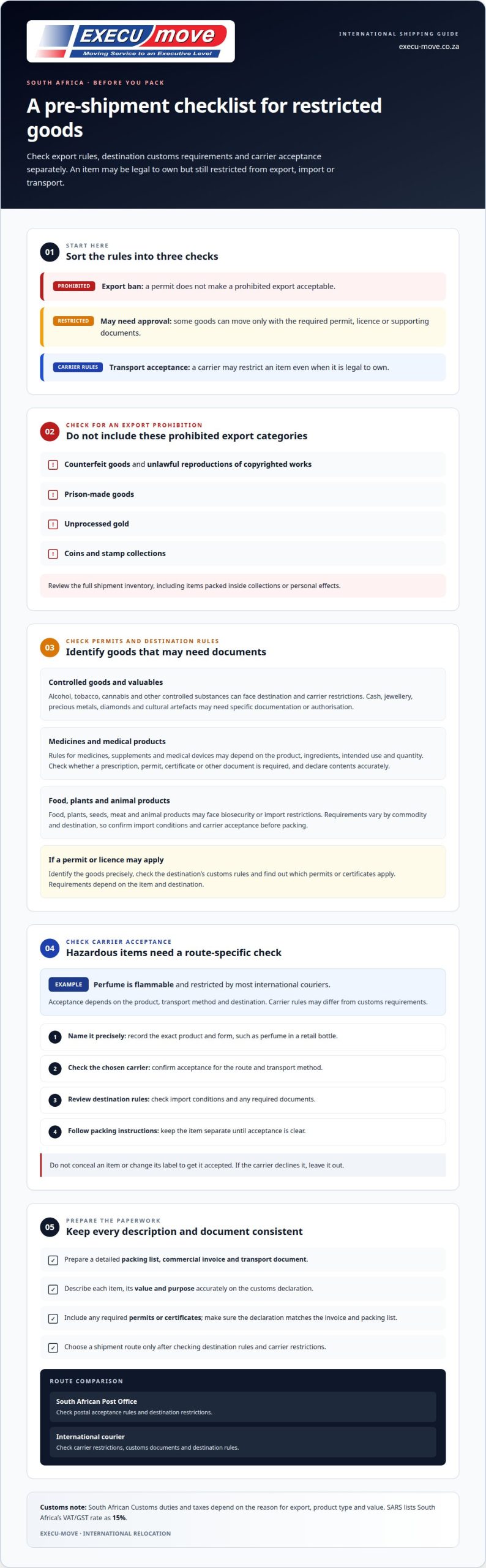
Not everything that can be packed can cross a border. To understand what you can’t ship internationally from South Africa, start by separating goods prohibited for export from goods restricted by the destination or carrier. Prohibited export categories include counterfeit items, unlawful reproductions of copyrighted works, prison-made goods, unprocessed gold, coins and stamp collections. Destination-country rules and carrier restrictions may impose further limits.
It’s understandable to want a clear answer before packing, especially when an item seems harmless. Some goods are prohibited outright, while hazardous items such as perfume, which is flammable and restricted by most international couriers, may need special handling or may not be accepted. This guide explains the difference, what to check in current customs rules, and how to plan your shipment.
Key Takeaways
- Separate goods prohibited for export from items that may need additional paperwork or a licence.
- Check both South African export rules and the destination country’s import requirements before packing.
- Recognise why perfume and other potentially hazardous goods can face carrier restrictions.
- Use the article’s decision guide to work out what to do with an item before arranging your shipment.
Restricted items and checking current customs rules
For an international shipment from South Africa, distinguish prohibited goods from restricted goods that may require permits. Check South African export rules, destination-country customs requirements and carrier acceptance rules before packing.
Prohibited export items
South African prohibited export items include counterfeit goods, unlawful copies of copyrighted works, prison-made goods, unprocessed gold, coins and stamp collections. These are different from restricted goods, which may require paperwork rather than being prohibited outright. South African Post Office and international couriers can have different acceptance rules, so check the chosen carrier’s list as well as the destination’s import rules. Requirements can vary by destination and carrier.
Alcohol, tobacco, cannabis and other controlled substances can face destination and carrier restrictions, so don’t assume they’re acceptable. Cash, jewellery, precious metals, diamonds and cultural artefacts may also require specific documentation or authorisation. An undeclared or prohibited item may be held, returned or seized, with further consequences depending on the applicable rules.
Goods requiring export permits or licences
A permit or licence is different from a blanket export ban: it may allow a restricted item to move when the required authorisation and supporting documents are in place. Requirements depend on the item and destination. Identify the goods precisely, check destination customs rules, and find out which permits or certificates apply before shipping.
Prepare a detailed packing list, commercial invoice and transport document, plus any required permits or certificates. South African Customs duties and taxes depend on the reason for export, product type and value. The South African Revenue Service lists South Africa’s VAT/GST rate as 15%.
Medicines and medical products
Medicines, supplements and medical devices can be subject to destination-country rules and carrier restrictions. Requirements may depend on the product, ingredients, intended use and quantity. Check whether the destination requires a prescription, permit, certificate or other supporting document, and declare the contents accurately. Don’t assume a product available in South Africa will automatically be accepted overseas.
Food, plants and animal products
Food, plants, seeds, meat and animal products may face biosecurity or import restrictions at the destination. Requirements depend on the commodity and country: a plant or seed shipment may need different documents from packaged food. Check import conditions and carrier acceptance before packing, and describe each item clearly on the customs declaration.
| Shipment option | What to check |
|---|---|
| South African Post Office | Postal acceptance rules and destination restrictions |
| International courier | Carrier restrictions, customs documents and destination rules |
For customs clearance, make sure the declaration matches the invoice and packing list. Describe each item, its value and purpose accurately, and include the transport document and any required permits or certificates. Choose the shipment route only after comparing the goods with destination rules and carrier restrictions.
Internationally restricted hazardous items
A hazardous item may face transport restrictions even when it’s legal to own. Perfume is flammable and restricted by most international couriers. Understanding what you cannot ship internationally from South Africa also means checking carrier rules, which may differ from customs requirements. Acceptance depends on the product, transport method and destination.
Before shipping perfume or another item flagged by a carrier, identify the product clearly. Keep its original label available and describe the contents accurately in the shipment documents. Don’t conceal an item’s name or properties to get it accepted. An inaccurate description can cause problems during handling, customs checks or delivery.
Use this practical check before booking:
- Write down the exact product name and form, such as perfume in a retail bottle.
- Check whether the carrier accepts that item on the chosen route and transport method.
- Review the destination’s import rules for the product and any required documents.
- Follow the carrier’s packing instructions, and keep the item separate until acceptance is clear.
These steps matter for household shipments as well as individual parcels. A bottle packed among personal effects still needs an accurate description; household packing doesn’t remove carrier restrictions. If a carrier declines an item, leave it out rather than changing its label or declaration. This helps keep the remaining shipment details consistent.
Tracking shows a shipment’s progress, but it doesn’t make a restricted item acceptable or replace customs clearance. Keep the tracking reference with a copy of the item description and documents. If a shipment is held, those records help show what was declared and where it was travelling. Recheck carrier rules if the route or transport method changes.
For any potentially hazardous product, decide before packing: identify it, check carrier acceptance, then review destination import conditions. This is more reliable than assuming an item can travel because it is sold openly in South Africa or has travelled on another route.
What items are prohibited from being exported or shipped internationally from South Africa?
South African prohibited export categories include counterfeit goods, unlawful reproductions of copyrighted works, prison-made goods, unprocessed gold, coins and stamp collections. These differ from goods that may move with permits: a permit does not make a prohibited export acceptable. Review each item in your shipment inventory, including pieces packed inside collections or personal effects, before writing its customs description.
- Counterfeit goods: items presented as genuine branded products when they are not.
- Unlawful reproductions: copies of copyrighted works made without lawful permission.
- Prison-made goods: goods identified as made in a prison or penitentiary.
- Unprocessed gold: gold in an unprocessed form.
- Coins and stamp collections: numismatic or philatelic collections prepared for shipment.
Start with a room-by-room inventory, then flag anything that matches these categories. For example, list a coin collection separately rather than describing its box only as “personal items”. A clear description helps prevent a prohibited item from being obscured by a broad packing label. Keep it out of the shipment while you review the applicable export and destination requirements.
Check the actual contents, not just the label on a box. A branded item, copyrighted material, gold object, coin or stamp collection may need closer identification. If an item’s status depends on what it is or how it was made, record a precise description and keep it separate from goods ready for dispatch. Don’t rely on a general label such as “collectables”.
Before finalising customs documents, compare the inventory with the prohibited categories and check that each description is accurate. Keep prohibited goods out of the shipment and treat permit-required goods separately. Paperwork for restricted goods cannot replace permission to export an item listed as prohibited. Use the inventory to identify which belongings can proceed and which must be excluded.
Which South African goods require an export permit or licence?
A permit or licence may be needed when goods are restricted rather than banned outright. The exact requirement depends on the item, its intended use and the destination country. South African export rules and the importing country’s customs conditions are separate checks, so approval on one side doesn’t automatically satisfy the other.
There is no single general list that covers every shipment. A cultural object, plant product, medicine or controlled substance can face different rules depending on its description and destination. Don’t assume these examples always require a permit. Identify the goods precisely, then check the applicable South African export conditions and destination import requirements.
Use this preparation sequence before dispatch:
- Describe the item: record its material, purpose, condition and quantity in clear terms.
- Check restrictions: establish whether it is prohibited, restricted or subject to a permit.
- Match paperwork: prepare a commercial invoice, detailed packing list and transport document.
- Attach authorisations: include any permit or certificate required for that item and destination.
A permit is not a substitute for a truthful customs declaration. The invoice and packing list should describe the same goods, with values and quantities that match the shipment. If a document uses a broad term such as “personal effects”, add enough detail to identify restricted contents accurately.
Keep permit-required goods separate from items that cannot be exported. A licence may not make a prohibited item acceptable for export. Check the rules before packing: missing authorisation can interrupt customs clearance and delay the rest of the shipment.
For a household move, include restricted belongings in the inventory before packing begins. This gives you time to separate items, assemble the right documents and plan the shipment around destination requirements. Explore international relocation planning when coordinating household goods and customs paperwork.
Execu-Move: International Furniture Removals
Execu-Move helps households plan international furniture removals when belongings need to cross borders. Once you’ve separated prohibited goods and identified items needing permits, a clear inventory helps organise the household shipment. Full Packing and Wrapping can help prepare furniture and personal effects, while Secure Storage may help if your move dates don’t align.
International furniture removals suit larger household moves, not a single restricted parcel. Keep prohibited items out of the consignment and record goods requiring permits separately so their documents can be handled appropriately. For a move within South Africa, Domestic Furniture Removals may be more suitable.
Contact Execu-Move to discuss your household move, or visit execu-move.co.za.
Plan your next move with confidence
Understanding what you cannot ship internationally from South Africa is only one part of preparing for a move. Next, turn your item list into a practical shipment plan: separate belongings, identify anything needing special documentation, and decide what should travel, go into storage or be left behind. An organised inventory gives you a clearer starting point.
Execu-Move offers International Furniture Removals for household moves across borders and Domestic Furniture Removals for moves within South Africa. Full Packing and Wrapping can help prepare household belongings for transport. Choose support that suits the size and destination of your move, and allow time to organise the documents and packing details.
Ready to discuss your plans? Contact Execu-Move about your shipment, and take the next step towards a more organised move.
Frequently Asked Questions
What items are not allowed in South Africa?
For imports into South Africa, food, plants and animals, especially endangered species, can be prohibited; other goods may be restricted. Examples listed as restricted include aerosols, dairy, fresh food, cash, perfume, tobacco and seeds. These are import rules, not a complete list of South African export bans. Keep the direction of travel clear: an item allowed to leave South Africa may still be barred from entering its destination.
Can batteries, aerosols, perfumes, chemicals or other dangerous goods be shipped internationally from South Africa?
Acceptance depends on the item, carrier and destination, so don’t assume a product can travel just because it’s sold in South Africa. Perfume is flammable and restricted by most international couriers. For batteries, aerosols and chemicals, identify the exact product and form, then compare carrier acceptance with destination import conditions before packing. A route accepted by one carrier may not suit another.
What customs forms, permits and declarations are needed to export restricted goods from South Africa?
International freight commonly uses a commercial invoice, transport document and detailed packing list, plus any permits or certificates required by the destination. Describe a restricted product by its actual name rather than hiding it under “household items”. Make sure the invoice and packing list match the shipment contents. The item and destination determine whether additional authorisation applies; paperwork cannot make a prohibited export permissible.