
The pet import requirements for New Zealand depend on your pet’s species, travel history and departure date. Cats and dogs must meet the applicable import health standard, complete the required tests and treatments, and spend at least 10 days in post-arrival quarantine.
It’s natural to wonder whether a pet passport is enough to make the journey straightforward. The important details are the health checks and official documents behind it. This guide explains which standard applies during New Zealand’s transition to its revised requirements, what dogs and cats travelling from South Africa need to prepare for, and how quarantine works after arrival. You’ll also see why the timing of veterinary visits matters, so you can plan the move around your pet’s needs rather than leave essential steps until the last minute.
Key Takeaways
- Plan for at least 10 days of post-arrival quarantine, and factor the facility booking into your preparations.
- Choose the applicable health standard based on your pet’s arrival date, especially during the transition to the 2026 requirements.
- Build South Africa-specific dog blood tests and treatments into the veterinary schedule, as several steps have tightly timed windows.
- Review your pet’s microchip, residence history, rabies preparation and identification checks before arranging travel.
Post-arrival quarantine
Cats and dogs arriving in New Zealand may need to undergo quarantine after arrival. Arrange a place at an approved facility and apply for the required permit before booking your pet’s travel.
Quarantine Requirements and Bookings
Quarantine is a supervised stay at an approved facility after an animal arrives in New Zealand. Cats and dogs must spend at least 10 days there, under requirements set by the Ministry for Primary Industries (MPI). Before applying for an import permit, obtain booking confirmation from a quarantine facility. MPI recommends applying for the permit at least six weeks before travel, so the booking needs to be arranged early.
The permit and booking are connected steps: the facility confirmation is needed for the permit application. Keep the confirmation and relevant veterinary documents together with your travel plans. If an animal arrives by yacht, cats and dogs must be collected by a quarantine facility for a minimum 10-day stay. Required tests or treatments during that quarantine can extend the stay to 3-4 weeks.
MPI-Approved Quarantine Facilities
An MPI-approved quarantine facility is authorised to hold imported animals under New Zealand’s biosecurity rules. Quarantine allows authorities to manage the required checks, tests or treatments after arrival. International airlines bring animals into New Zealand through Auckland and Christchurch, so plan arrival details alongside the quarantine facility arrangements.
Facility fees and veterinary costs depend on your pet’s care needs, required tests or treatments, and length of stay. Permit-related expenses also contribute to the total. There is no single overall cost: it varies by case, and a quote is provided after a request.
Before departure, organise the permit, facility booking, veterinary documents and arrival arrangements as one sequence. For a wider household move, international relocation planning can help coordinate the move schedule around your animal’s booked quarantine stay.
Choosing between the 2021 and 2026 import health standards
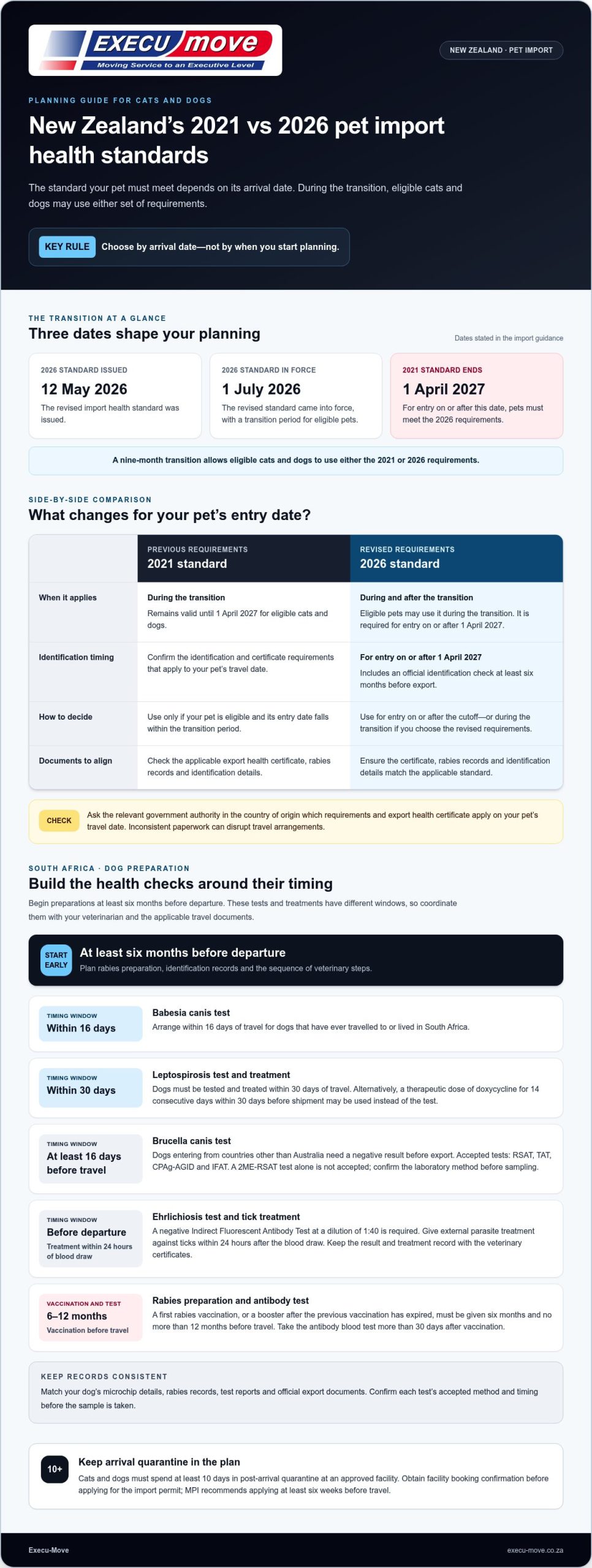
An import health standard sets the health conditions cats and dogs must meet before entering New Zealand. The revised 2026 standard was issued on 12 May 2026 and came into force on 1 July 2026.
A nine-month transition allows eligible cats and dogs to use either the 2021 or 2026 requirements. The 2021 standard remains valid until 1 April 2027. For entry on or after that date, animals must meet the 2026 requirements, including an official identification check at least six months before export. Choose based on the arrival date, not simply the date you begin planning.
An export health certificate confirms that an animal meets the destination’s import conditions. Ask the relevant government authority in the country of origin which requirements and certificate apply on your pet’s travel date. The certificate, rabies records and identification details must all match the applicable standard. Inconsistent paperwork can disrupt travel arrangements.
Some certificate rules are specific to the country of export. For dogs and cats from the mainland United States, Puerto Rico, the U.S. Virgin Islands or the Northern Mariana Islands, existing export health certificates apply before 1 April 2027. For entry on or after that date, the 2026 standard’s identification process includes an official microchip check at least six months before shipment. Under the stated United States process, the USDA identity declaration must be endorsed within two months of the second microchip scan.
Breed and species restrictions are separate from health requirements. New Zealand prohibits imports of American Pit Bull Terriers, Brazilian Filas, Dogo Argentinos, Japanese Tosas and Perro de Presa Canarios, subject to stated exceptions. A listed-breed dog requires evidence of assistance-dog certification. Live birds, ferrets, mice and rats are prohibited except for laboratory animals; snakes and other reptiles are barred except for zoos. Guinea pigs are prohibited unless they arrive from Australia.
Dog-specific blood tests and treatments
Dog-specific testing covers diseases named in New Zealand’s import conditions. If your dog is travelling from South Africa, begin preparations at least six months before departure. The schedule includes rabies steps well in advance, as well as tests and treatments timed closer to travel.
Babesia canis testing detects this parasite in dogs that have ever travelled to or lived in South Africa. Arrange the test within 16 days of travel to New Zealand. Leptospirosis testing checks for another infection; dogs must be tested and treated within 30 days of travel. A therapeutic dose of doxycycline for 14 consecutive days within 30 days before shipment may be used instead of the leptospirosis test.
Brucella canis testing screens for canine brucellosis. Dogs entering New Zealand from countries other than Australia must be tested at least 16 days before travel, with a negative result required before export. Accepted tests are RSAT, TAT, CPAg-AGID and IFAT. A 2ME-RSAT test alone isn’t accepted, so confirm the laboratory method before the blood sample is taken.
Ehrlichiosis testing checks for a tick-borne infection. The dog’s result must be negative using an Indirect Fluorescent Antibody Test at a dilution of 1:40 before departure. External parasite treatment against ticks must be given within 24 hours after the blood draw. Keep the test report and treatment record with the veterinary certificates.
Rabies antibody testing measures the immune response after vaccination. The blood test must be taken more than 30 days after rabies vaccination. A first rabies vaccination, or a booster given after the previous one expired, must be administered six months and no more than 12 months before travel. Align these dates with the dog’s microchip records and official export documents, so each certificate identifies the same animal and timeline.
Cat and dog biosecurity requirements for entry into New Zealand
Biosecurity requirements are entry controls intended to limit the spread of animal diseases and pests. For cats and dogs, preparation depends on the country of origin, the animal’s identification and its health records.
For pet owners in South Africa, the practical order is to confirm eligibility, identify the animal, complete the required health steps, and then arrange the permit and travel documents. Each step relies on consistent records from the previous one.
Approved Countries for Pet Import
An approved country is one whose cats and dogs can enter under New Zealand’s import health conditions. Australia, including Norfolk Island, is Category 1; rabies-free countries are Category 2; countries where rabies is absent or well-controlled are Category 3.
Pets generally must have lived in a Category 1 or Category 2 country for at least six months before import. Since South Africa’s category determines the applicable pathway, establish the pet’s residence history and origin before planning its move. The Ministry for Primary Industries (MPI) sets the biosecurity conditions. For entry on or after 1 April 2027, cats and dogs need an official identification check at least six months before export.
For a South African pet, the steps are: confirm the origin and residence history, ensure its 15-digit microchip meets ISO 11784 or Annex A of ISO 11785, complete the required veterinary and rabies preparation, then arrange the permit and export documents.
Border Refusal and Delays
If an animal does not meet New Zealand’s import conditions, entry may be refused, and missing or inconsistent records can cause delays. An unreadable microchip, health documents that don’t match the animal’s identification, or unmet rabies requirements can all disrupt entry.
Prohibited species and restricted dog breeds also affect eligibility. New Zealand prohibits live birds, ferrets, mice and rats, subject to stated exceptions; guinea pigs are allowed only from Australia. Certain listed dog breeds are also prohibited, subject to stated exceptions. Resolve any eligibility questions and correct document discrepancies before transport, not at the border.
Execu-Move: International Furniture Removals
Execu-Move can coordinate your household move while you manage your pet’s New Zealand entry requirements. Its International Furniture Removals service covers household contents, and Full Packing and Wrapping helps prepare your belongings for transport.
If your departure and arrival dates don’t align, Execu-Move’s Secure Storage Solutions can hold your household goods between stages of the move. This may help when your pet’s quarantine booking affects when you can settle into your new home. Keep the animal’s permit, veterinary documents and travel arrangements separate from the household shipment paperwork, with a clear plan for each.
For support with your household relocation to New Zealand, contact Execu-Move or visit execu-move.co.za.
Plan your move around your pet
As your relocation takes shape, plan for more than the travel date. Decide what you and your pet will need during the first days in your new home, and keep those essentials easy to reach. Preparing for arrival can help the whole household settle in.
Pet arrangements and household logistics often follow different timelines, so give each a clear place in your overall plan. This makes it easier to adjust one part of the move without losing track of the other.
For help planning your household move, contact Execu-Move. A thoughtful next step can help you move forward with greater clarity.
Frequently Asked Questions
What is a Pet Passport?
A pet passport is a convenient collection of identification and veterinary records, not a single document that automatically grants entry. For travel to New Zealand, treat it as an organised set of records. Keep the microchip details, vaccination history, laboratory reports and official certificates together, and use the same animal name and identification details throughout. Consistent records are easier to review and present.
What are New Zealand’s pet import requirements for dogs and cats?
Dogs and cats must meet New Zealand’s import conditions for their origin and travel date. Before booking travel, work through three linked decisions: whether the animal’s origin and residence history qualify, which health standard applies, and which records must accompany it. This helps you catch mismatches early, such as planning travel before confirming the right pathway for your pet’s history.
What vaccinations, tests, and parasite treatments are required before pet import to New Zealand?
Required veterinary procedures depend on whether your pet is a dog or cat, its origin and its travel history. Ask the attending veterinarian to record the date of every vaccination, sample collection, laboratory result and treatment. Compare the records with the applicable import conditions before completing export paperwork. A clear timeline makes missed steps easier to identify.
What import permit and veterinary certificates are required for pets entering New Zealand?
Most cats and dogs travelling from countries other than Australia need an import permit and official veterinary certificates for their applicable health pathway. Keep the permit application, quarantine booking confirmation, veterinary records and air waybill in one document set. New Zealand Customs also asks for form NZCS 231 and photo identification, with ownership evidence if available. Sending documents before arrival can help prepare the clearance process.
How long must pets stay in quarantine after arriving in New Zealand, and where?
Cats and dogs generally spend at least 10 days at an MPI-approved quarantine facility after arrival. Plan your own arrival and accommodation arrangements around the pet’s separate release process, rather than assuming you can collect the animal immediately. The facility booking should be part of the travel plan, and any required care during the stay affects when the pet can leave quarantine.