What if the success of your international relocation depends less on the quality of your packing tape and more on the accuracy of a digital screen? For many families moving to or from South Africa, the formal border declaration process feels like an impenetrable wall of bureaucracy. It’s a common concern that a single mistake on a SARS form could lead to your household goods being seized or delayed indefinitely. Your home represents years of work; don’t let an administrative oversight keep your belongings held at a port of entry.
We understand that you require care and precision during this transition. This guide provides the expert clarity required to manage the complexities of modern customs requirements with total confidence. We will walk you through the mandatory South African Traveller Management System, explain the critical role of Form DA 304 for your personal effects, and ensure your inventory list meets every legal standard for a seamless move in 2026. Gain a clear roadmap for a compliant and stress-free journey.
Key Takeaways
- Recognise that a formal border declaration is a legal contract with the state, requiring precise digital submission to protect your belongings from fines or seizures.
- Identify the specific SARS forms required for your move, such as the DA 306 for unaccompanied baggage, to ensure your furniture clears customs smoothly.
- Learn how to conduct a thorough home survey to isolate prohibited items and ensure your inventory list matches strict international legal standards.
- Discover the benefits of an integrated relocation service that manages packing and customs clearance to provide a secure, stress-free transition for your family.
Understanding the Border Declaration Process for South African Relocations
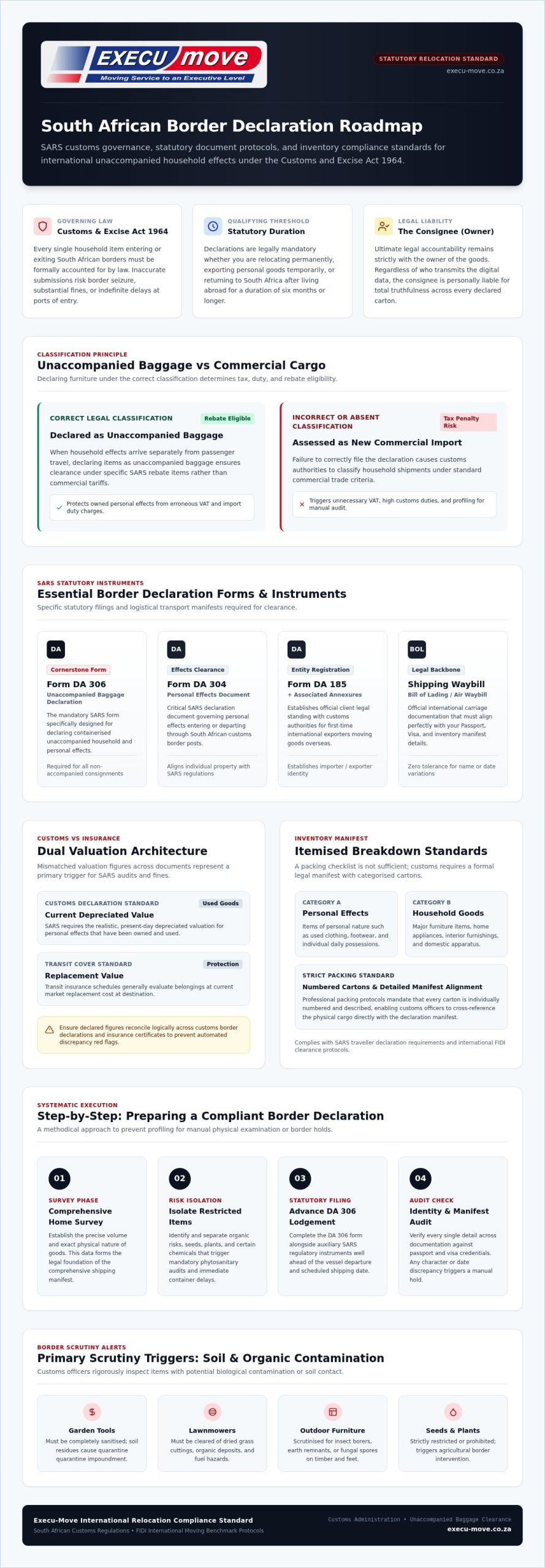
A border declaration is the formal notification to customs authorities regarding the nature and value of goods entering or leaving South Africa. While many travellers now use the South African Traveller Management System (SATMS) for personal luggage, containerised household effects require a separate, formal process. Under the Customs and Excise Act 1964, every item in your shipping container must be legally accounted for. Failing to declare these goods correctly isn’t just a minor administrative error; it can lead to heavy fines, the seizure of your life’s belongings, or months of shipping delays at the port.
When is a Border Declaration Required?
You must lodge a declaration whenever you move household effects across South African borders. This applies whether you’re moving permanently, exporting goods temporarily, or returning home after living abroad for six months or longer. It’s vital to declare these items as unaccompanied baggage if your furniture is arriving separately from your personal flight. This distinction is critical. It ensures your goods are processed under specific rebate items rather than being taxed as new commercial imports. Without this classification, you might face unnecessary VAT and duty charges on items you’ve owned for years.
The Legal Responsibility of the Consignee
Ultimately, the legal responsibility for the accuracy of a border declaration rests with the consignee, or the owner of the goods. Even if you aren’t the one physically typing the data, you’re liable for the truthfulness of the inventory. International standards for customs declaration regulations require precise valuations and descriptions for every carton. Professional international relocation services mitigate this risk by providing expert oversight. We ensure your paperwork matches your physical inventory, protecting you from the legal pitfalls of filing complex customs documents without professional guidance.
Essential Customs Forms and Documents for Moving Overseas
How do you ensure your paperwork withstands a SARS inspection? The cornerstone of your relocation is the DA 306 form, specifically designed for declaring unaccompanied baggage. For first-time exporters, the DA 185 form and its associated annexures are equally vital. These establish your legal standing with customs authorities. Your passport, visa, and shipping documents must align perfectly; any discrepancy in names or dates can trigger a manual audit. These documents, alongside your Bill of Lading or Air Waybill, form the legal backbone of your border declaration. Clear communication between your logistics partner and customs officials is the only way to prevent your shipment from being flagged for non-compliance.
The Inventory List: Your Most Critical Document
Your inventory list is more than just a checklist; it’s a legal manifest. SARS inspectors require an itemised breakdown that distinguishes between ‘Personal Effects’, such as used clothing, and ‘Household Goods’. Accuracy here is non-negotiable. Utilising professional packing and wrapping ensures every carton is numbered correctly. This level of detail helps you meet SARS traveller declaration requirements without the risk of inspections causing delays.
Valuation and Insurance Documentation
When completing your border declaration, you must value your items honestly. While insurance often uses replacement value, customs require the current depreciated value for used goods. Ensure these figures align across your declaration and insurance certificate to avoid red flags. Mismatched values are a common cause of penalties. If the paperwork feels overwhelming, contacting a relocation expert can simplify the entire documentation phase and provide the peace of mind you deserve.
Step-by-Step: How to Prepare Your Border Declaration for Success
Preparing for an international move requires a methodical approach to ensure your border declaration is flawless. Accuracy at this stage prevents your shipment from being flagged for manual inspection or high-risk profiling. Follow these essential steps to prepare your documentation:
- Step 1: Conduct a comprehensive home survey to establish the exact volume and nature of your goods. This data forms the legal basis of your shipping manifest.
- Step 2: Identify and isolate restricted items like seeds, plants, or certain chemicals that could trigger an audit.
- Step 3: Complete your DA 306 form and other SARS requirements well in advance of your shipping date.
- Step 4: Verify that every detail on your documentation matches your passport and manifest exactly.
For a deeper look at specific regulations, the FIDI international moving customs guides provide an excellent benchmark for household effects clearance protocols. These guides help you understand the nuances of global shipping standards across different jurisdictions.
Navigating Prohibited and Restricted Items
Customs officials often scrutinise items that have been in contact with soil or organic matter. Garden tools, lawnmowers, and outdoor furniture are common culprits for unexpected delays. To satisfy biosecurity regulations, these items require professional steam cleaning and fumigation before packing. This proactive step prevents the introduction of foreign pests and ensures your shipment passes through the border without being flagged for an expensive manual inspection. It’s a small detail that secures your timeline.
The Timing of Your Border Declaration
Timing is everything when managing international freight. You must submit your paperwork early enough for it to reach the port before your container arrives. Late submissions lead to costly port storage fees and demurrage, which inflate your moving budget. While travellers entering South Africa must lodge a digital declaration within 24 hours of arrival, unaccompanied furniture requires much earlier coordination. To avoid these logistical bottlenecks and secure your move, request a professional relocation quote today.
Navigating Customs Clearance with Professional Logistics Support
Why risk your life’s belongings on a DIY border declaration? Managing the logistics of a full household removal is vastly different from carrying personal luggage through an airport. Errors in item classification or valuation can lead to your goods being impounded or subjected to heavy penalties. Execu-Move provides an integrated service where packing, transport, and customs clearance function as a single, coordinated workflow. By letting experts manage the communication with SARS and destination authorities, you eliminate the friction of navigating complex legal systems alone. Our global network ensures your declaration is respected at both the origin and destination ports, providing a steady hand throughout the process.
The Role of the Customs Clearing Agent
Professional agents utilise Electronic Data Interchange (EDI) systems to lodge documents directly with SARS. This technology significantly reduces processing times and ensures that your data reaches customs officials instantly. If your shipment is flagged for a ‘Physical Examination’, your agent acts as your representative on-site. They manage the logistical requirements of the customs stop, ensuring that inspectors view your goods in a controlled environment that prioritises the safety and security of your furniture.
Integrating Specialised Transport
Are you relocating more than just furniture? Specialised items require distinct paperwork and unique regulatory pathways. Managing a vehicle transport border declaration involves specific SARS automotive valuations and the TMS digital platform. Similarly, our pet transport border declarations ensure that veterinary permits and quarantine requirements are met long before your animals reach the port. This comprehensive oversight turns a chaotic administrative burden into a managed, predictable transition for your entire household.
Securing Your International Transition
Mastering the intricacies of a border declaration is the final hurdle in your journey toward a new life abroad. By identifying the correct SARS forms like the DA 306 and maintaining a meticulous inventory list, you protect your household from unnecessary delays. Accuracy isn’t just about compliance; it’s about the peace of mind that comes from knowing your life’s belongings are in safe hands. We’ve explored how professional packing and integrated logistics services turn a complex legal requirement into a manageable, predictable process.
As accredited international moving specialists, Execu-Move offers expert customs clearance and comprehensive door-to-door logistics for every client. Don’t let the fear of bureaucracy overshadow the excitement of your move. Request a professional relocation quote and customs consultation from Execu-Move today to ensure your transition is handled with the care it deserves. We’re here to guide you through every regulation and requirement, ensuring you arrive at your destination with confidence and ease.
Frequently Asked Questions
What is the SARS DA 306 form used for in a move?
The SARS DA 306 form is the primary document used to declare unaccompanied baggage, including household furniture and personal items arriving by sea or air. It allows customs to process your shipment under specific rebate items for permanent relocation. Completing this form correctly ensures you qualify for duty-free and VAT-free entry of your used goods. It’s a critical component of your border declaration when your belongings follow you after your arrival.
Can I declare my furniture as personal effects to avoid duties?
You don’t need to mislabel furniture as personal effects to avoid duties. Used household goods qualify for duty-free and VAT-free entry under Rebate Item 407.06 if you’ve lived outside South Africa for at least six months. This exemption applies to bona fide immigrants and returning residents alike. However, you must accurately list every item on your border declaration. Misrepresenting items can lead to unnecessary inspections and penalties that delay your entire move.
What happens if my border declaration is incorrect?
An incorrect submission can lead to severe consequences, including heavy financial penalties or the legal seizure of your belongings. Customs authorities may flag your container for a physical examination, which incurs extra costs and causes lengthy shipping delays. Beyond fines, you’ll likely face port storage and demurrage fees while the discrepancy is resolved. Accurate documentation is the only way to avoid these logistical bottlenecks and ensure a smooth, compliant relocation process.
Do I need to be present in South Africa when my goods clear customs?
You generally need to be physically present in South Africa or have already arrived before your goods clear customs. SARS requires your original passport with the relevant entry stamps to verify your residency status and eligibility for duty rebates. While your clearing agent handles the technical submission of your paperwork, your arrival triggers the legal processing of your shipment. We coordinate the timing to ensure your goods arrive when you’re ready.
Are there specific rules for declaring alcohol or tobacco in a furniture move?
Alcohol and tobacco are strictly regulated and don’t qualify for the duty-free household effects rebate. If you include these in your move, you must declare them and pay the applicable customs duties and excise taxes. Large volumes of these items often trigger a manual audit of your entire container. It’s generally more practical to exclude significant liquor collections from your manifest to avoid unnecessary delays and high tax assessments.