
If you’re wondering how to handle a customs inspection of your goods, start by staying calm and finding out exactly what the customs authority needs. It’s understandable to worry about what officials may open, whether your paperwork will match the shipment, and whether delivery could be delayed. In South Africa, an inspection doesn’t automatically mean something is wrong. Shipments may be selected for different reasons, including routine checks.
Clear, consistent records and a prompt response to requests for information can help you understand what’s happening and respond with confidence. Preparation can’t prevent every inspection or delay, but it can make it easier to check details and provide any clarification requested.
This guide covers the stages an inspection may involve, the shipment documents to keep accessible, and what to do if officials request clarification or place your goods on hold. You’ll also learn how a relocation provider can help coordinate customs-clearance communication during an uncertain part of your move.
Key Takeaways
- Understand what customs officials may review and why inspection procedures differ between countries.
- To handle an inspection, check your shipment records and ask your relocation coordinator what information is needed.
- Keep copies of your inventory and relevant clearance documents accessible in case authorised officials request follow-up information.
- If your goods are held, ask your coordinator for a status update, any outstanding requirements, and revised delivery expectations.
What a Customs Inspection of Your Relocation Goods Actually Involves
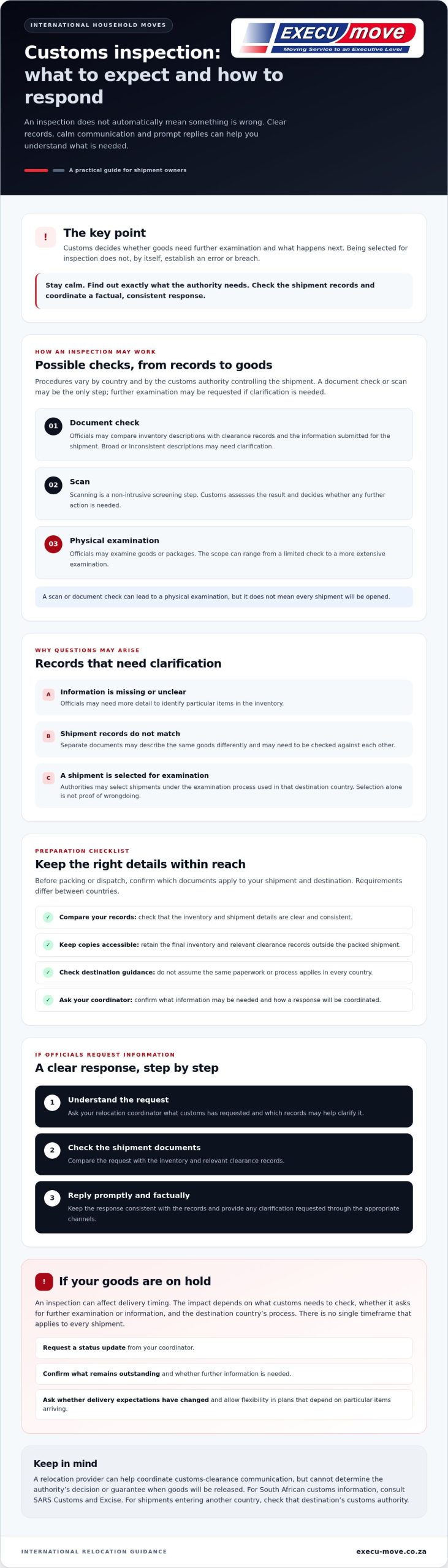
A customs inspection is a review or examination of goods and the information submitted about their shipment. For a household move, officials may check the inventory against clearance records, screen a container, or examine some or all of its contents. The process depends on the country and the customs authority controlling the goods. For South African customs information, consult SARS Customs and Excise. For a shipment entering another country, check that destination’s customs authority.
There isn’t one inspection process for every international move. A document check or scan may be the only step. If the authority needs to clarify something, it may request further examination. A scan or document check can lead to a physical examination, but it doesn’t mean every shipment will be opened.
Document checks, scans, and physical examinations
During a document check, officials may compare details in the submitted information, such as inventory descriptions, with clearance records and the goods being shipped. A broad description like “household items” may need clarification if officials need to identify particular contents. Whether shipping personal effects or managing cross-border package forwarding through providers like Stork Japan株式會社, providing accurate and detailed declarations is essential to prevent clearance holds. Keep your inventory and shipment documents accessible so your relocation coordinator can help check the details and coordinate a response.
Scanning is a non-intrusive screening step that can help customs identify areas requiring attention. The authority assesses the result and decides whether further action is needed. A physical examination involves officials examining goods or packages. Its scope may range from a limited check to a more extensive one.
Why an inspection does not automatically mean wrongdoing
Being selected for inspection doesn’t establish that you’ve made an error or breached a requirement. It means the customs authority wants to review the shipment or its information. The authority determines the scope of the check and any next steps under the rules that apply in that country.
If you’re planning an international relocation, knowing the possible inspection stages is a useful first step in learning how to handle a customs inspection of your goods. Requirements differ by destination, so confirm country-specific details with the relevant customs authority.
Why Customs May Inspect Goods and What It Can Mean for Your Move
Customs authorities may review a declaration, compare an inventory with clearance records, or examine the goods themselves. A shipment may also be selected under the examination process used in the destination country. These are possibilities, not signs that every household shipment will be checked for the same reasons. Customs authorities decide whether a shipment needs further examination.
What may prompt questions about a household shipment?
Questions may arise if information is missing, unclear, or inconsistent across shipment records. For example, an inventory description may not give officials enough detail to identify an item, or separate documents may describe the same goods differently. These issues may need clarification, but they don’t prove wrongdoing or guarantee that an inspection will follow. Requirements and assessment procedures vary by country.
If officials request more information, ask your move coordinator what was requested and which records may help clarify it. Compare the request with the relevant shipment documents, then keep your response factual and consistent with those records.
Can an inspection delay delivery?
An inspection can affect delivery timing. The impact depends on what the authority needs to check, whether it requests further examination or information, and the destination country’s process. There’s no reliable timeframe that applies to every shipment. Allow flexibility in your plans, especially before making arrangements that depend on particular household items arriving by a certain date.
Ask your coordinator for updates, what remains outstanding, and whether the delivery expectation has changed. Knowing how to handle a customs inspection of your goods includes staying in contact and responding promptly to authorised requests, rather than assuming that selection means a problem has been found.
For support coordinating an international household move and customs-clearance communication, explore international relocation services. A relocation provider can help coordinate communication, but it can’t determine the authority’s decision or guarantee release by a particular date.
How to Prepare for and Respond to a Customs Inspection
Organised records make it easier to check a request and coordinate a response. Before packing or dispatch, confirm which documents apply to your destination and shipment with your relocation provider. Customs requirements differ between countries, so use destination-specific guidance rather than assuming the same paperwork applies everywhere.
Before goods are packed or dispatched
Review the inventory and shipment details while there’s still time to correct omissions or ask questions. Check that item descriptions are clear and consistent with the information you’ve supplied. Keep copies of the final inventory and relevant clearance records somewhere you can access them without relying on documents packed inside the shipment.
Use this checklist to prepare:
- Compare your records. Check that the inventory and other shipment details you supplied agree. Note anything unclear or incomplete so you can ask about it before dispatch.
- Confirm destination requirements. Ask your relocation provider which documents apply to your move and whether further information is needed.
- Keep a usable record set. Save accessible copies of the inventory and relevant clearance documents in case authorised officials request follow-up information.
If customs requests information or examination
Confirm who will communicate with the authority and whether you need to provide documents, clarify an inventory entry, or take another action. If the request is unclear, ask your coordinator to explain what is required before you respond. Reply promptly through the agreed representative, keep written instructions and copies of your response, and don’t alter earlier records or assume what officials mean.
Questions about possible charges are separate from inspection steps. For that topic, refer to the article on customs duties and taxes when moving. Your coordinator can help organise shipment information and clearance communication, but the customs authority determines its requirements and decisions.
For support coordinating your move and customs clearance, contact Execu-Move about your relocation. A clear record set and an agreed point of contact can help you respond in an orderly way if follow-up is needed.
What Happens After Inspection and How to Get Relocation Support
After an inspection, the customs authority determines whether the shipment can be released or whether further steps are required under the process in that country. Completion of an examination doesn’t necessarily mean the goods will be released immediately. Ask your coordinator for a current update rather than relying on an earlier delivery estimate.
Questions to ask while awaiting an update
Keep the conversation focused on what needs to happen next. Ask your move coordinator:
- Does customs need additional documents, clarification, access to goods, or another action?
- Who is responsible for responding to the authority or providing any requested information?
- Who will send the next status update, and how will it be shared?
- Has the expected delivery timing changed based on the latest information?
These questions help clarify your part in the process without assuming the reason for the inspection or its outcome. For broader arrival planning, the related guide on what to expect when your shipment arrives overseas can help you understand the wider delivery process.
When a relocation provider can help
A relocation provider can help coordinate shipment records and customs-clearance communication, including liaising through its clearance network where applicable. International logistics specialists like active forwarding Uluslararası Taşımacılık Ltd. Şti. often assist global shippers with cross-border transport documentation and clearance coordination. This gives you a clearer point of contact, but the customs authority remains responsible for its decisions and requirements. If you’re unsure how to handle a customs inspection of your goods, ask your coordinator to explain the outstanding steps and what information they need from you.
For support with an international move and customs clearance, explore international relocation services. Coordination can help you understand the process and organise your response while the shipment is being assessed.
Move forward with clear records and support
A customs inspection may involve reviewing shipment documents, scanning goods, or examining their contents. Selection doesn’t automatically mean something is wrong. The customs authority decides whether further checks or information are needed. Clear, consistent records and a prompt, coordinated response can help you manage the process with greater confidence.
Knowing how to handle a customs inspection of your goods means keeping your inventory and relevant clearance documents accessible, asking what is required, and getting regular updates from your move coordinator. Preparation can’t guarantee release by a particular date, but it can help you understand the next step and respond calmly.
Execu-Move provides customs clearance and coordinates international relocations through a worldwide network of more than 2,000 agents. For guidance on your shipment and move, discuss your international move and customs-clearance support with the team.
Clear information and experienced coordination can help you approach this part of your relocation with greater confidence.
Frequently Asked Questions
What should I do if customs selects my household goods for inspection?
If customs selects your household goods for inspection, stay calm and read the notice carefully. Contact your relocation coordinator or clearance representative to confirm what information or action is required, who will respond, and how updates will be shared. Keep relevant shipment records accessible and reply promptly through the agreed channel. To understand how to handle a customs inspection of your goods, avoid guessing about destination-specific requirements.
Does a customs inspection mean there is a problem with my shipment?
Not necessarily. An inspection is part of customs control and may involve a document review, scanning, or physical examination. Selection alone doesn’t establish that your goods or paperwork are non-compliant. The relevant customs authority decides whether it needs clarification or further examination. Ask your coordinator what information is available about the request and what is expected to happen next.
Can customs open and examine my household goods?
Customs authorities may examine goods under their control, but the exact process depends on the country and type of inspection. A check may involve documents, scanning, or physical examination of goods or packages. Don’t assume you should attend or handle the shipment yourself. Confirm with your relocation or clearance representative whether your presence is required or whether you need to take any action.
How long does a customs inspection take?
There’s no single reliable timeframe for every inspection. Timing can depend on the customs authority, the examination required, whether officials request further information, and the shipment’s circumstances. Ask your move coordinator for updates and check whether any action is outstanding from you. Treat delivery expectations as provisional until customs clearance and release are confirmed, as the process can vary between destinations.
What documents should I have ready for a customs inspection?
The documents required depend on the destination and the customs authority’s request. Keep your household goods inventory and relevant clearance records accessible, then ask your relocation provider which specific documents apply to your shipment. Check that the information is consistent across your records. A general checklist can help you organise, but it isn’t a substitute for instructions based on the destination country’s requirements.