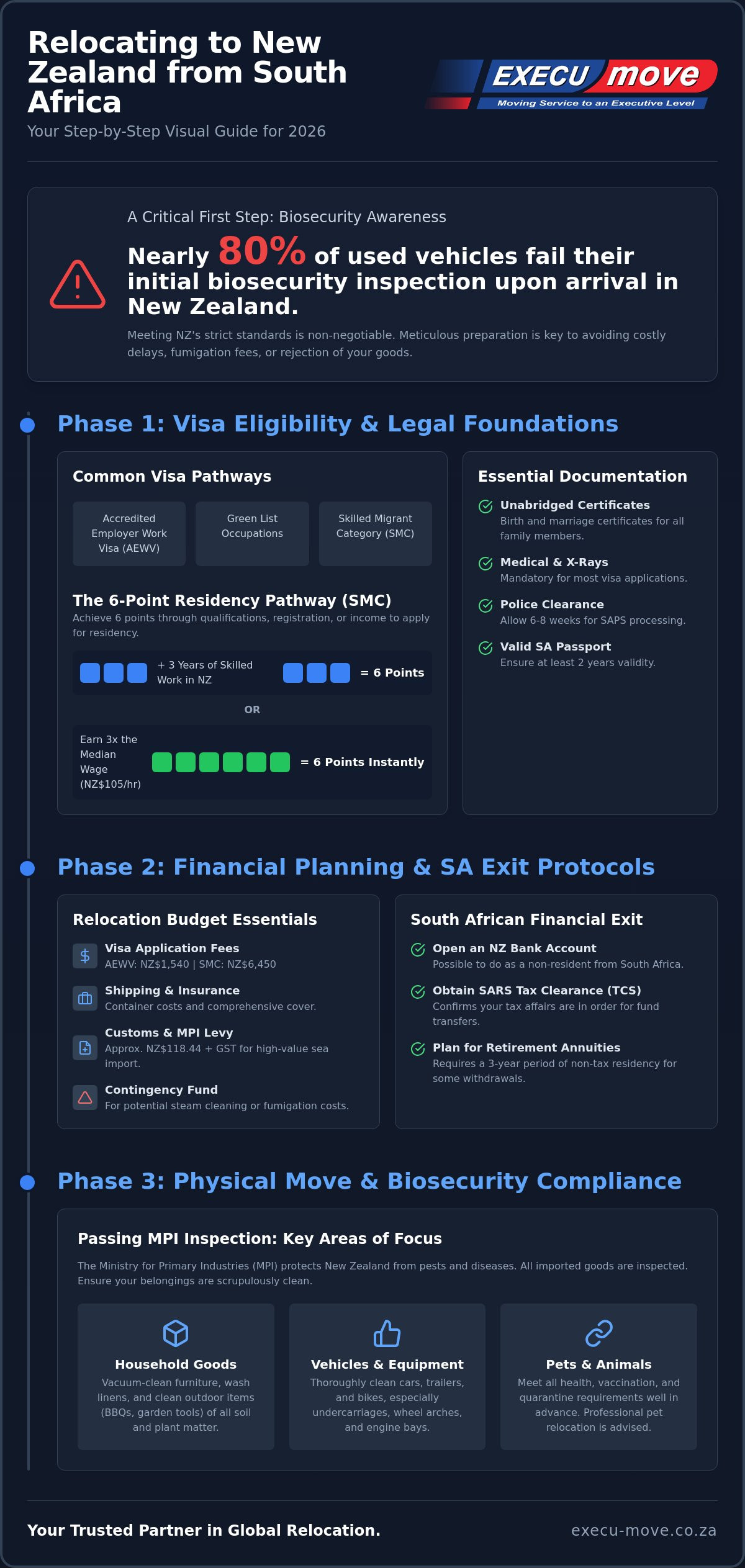
Did you know that nearly 80% of used vehicles fail their initial biosecurity inspection upon arrival in New Zealand? For many families moving to New Zealand from South Africa, this statistic is a sobering reminder that a successful relocation involves much more than just packing boxes. It’s about meeting some of the world’s strictest entry standards while managing the emotional and financial weight of a life-changing transition.
You’re likely feeling the pressure of navigating the 2026 visa point systems, worrying about the safety of your pets during the long haul, or fearing that your furniture might be rejected by NZ Biosecurity. It’s completely natural to feel anxious when so many variables, like the new Clean Car Standard charges or the updated Skilled Migrant Category fees, are at play. This guide provides a comprehensive, step-by-step roadmap to help you navigate the legal, financial, and logistical complexities of your move to Aotearoa. We have compiled a definitive timeline to ensure your belongings pass customs and your family settles into their new life with absolute peace of mind.
Key Takeaways
- Identify the most suitable visa pathway for your profession and understand how the 2026 points system impacts your residency timeline.
- Navigate the complexities of South African Reserve Bank regulations and financial exit protocols to ensure your relocation budget remains secure.
- Discover how to streamline moving to New Zealand from South Africa by selecting the most efficient shipping methods for your household volume.
- Prepare your belongings to meet the Ministry for Primary Industries (MPI) biosecurity standards to avoid costly delays or rejections at the border.
- Learn the essential health and safety requirements for transporting pets and vehicles to ensure they arrive safely and comply with New Zealand regulations.
Phase 1: Visa Eligibility and Legal Foundations
Before you even think about packing a single box, you must establish your legal right to live and work in Aotearoa. The structure of New Zealand immigration policies has become increasingly focused on attracting highly skilled professionals who can fill specific economic needs. For families moving to New Zealand from South Africa in 2026, the most common pathways are the Accredited Employer Work Visa (AEWV), the Green List occupations, and the Skilled Migrant Category (SMC) Resident Visa.
As of March 2026, the median wage threshold is set at NZ$35.00 per hour. This figure is the baseline for most work visa applications. The AEWV is often the first step, with a standard processing time of approximately seven weeks. It’s a reliable route, provided you have a job offer from an employer who has already secured accreditation from Immigration New Zealand. We recommend waiting until your visa is approved before you finalise the dates for your international furniture removals to avoid the stress of shifting timelines.
The New 6-Point Residency Pathway
The Skilled Migrant Category now operates on a simplified 6-point system that rewards professional registration, high-level qualifications, or significant income. You only need six points to apply for residency. For instance, earning three times the median wage (NZ$105.00 per hour) grants you the full six points immediately. Alternatively, if you claim three points for a Bachelor’s degree, you’ll need to complete three years of skilled work in New Zealand to reach the threshold. It’s a methodical process that requires a clear long-term strategy for your family’s future.
Essential Documentation Checklist
Gathering your paperwork early is the best way to mitigate the anxiety of moving to New Zealand from South Africa. Administrative delays in South Africa are common, so start your applications for official documents as soon as you decide to relocate. You should prepare the following:
- Unabridged Certificates: You’ll need unabridged birth and marriage certificates for all family members.
- Medical Clearances: Full medical examinations and chest X-rays are mandatory for most visa types.
- Police Clearance Certificates: These are required for everyone over 17. Allow at least 6 to 8 weeks for processing through the SAPS.
- Financial Planning: Budget for application fees, which are currently NZ$1,540 for the AEWV and NZ$6,450 for the SMC Resident Visa.
Ensure your South African passport is valid for at least another two years. Having these documents ready before you receive an Invitation to Apply (ITA) will keep your transition smooth and predictable.
Phase 2: Financial Planning and South African Exit Protocols
Establishing your financial foundation is just as critical as your visa approval. Moving to New Zealand from South Africa involves a complex interplay between the South African Reserve Bank (SARB) and the New Zealand banking system. You aren’t just moving your life; you’re moving your capital. This requires meticulous planning to avoid unnecessary delays or penalties at the border or with the tax man.
Start by opening a New Zealand bank account as a non-resident. Most major banks in Aotearoa allow you to do this from abroad. This step is essential because it allows you to transfer your initial settlement funds safely before you even board your flight. Having an active account ready helps you hit the ground running with rental deposits and daily expenses once you arrive.
Budgeting for Your Relocation
It’s not just about the plane tickets. You have to account for shipping container costs, insurance, and potential customs duties. For a detailed breakdown of these expenses, see our International Moving Costs from South Africa: The 2026 Comprehensive Budgeting Guide. Don’t forget the hidden fees that often catch families off guard. New Zealand’s Ministry for Primary Industries (MPI) is incredibly strict. You will need to budget for the combined Customs and MPI levy, which for a high-value sea import is approximately NZ$118.44 plus GST. If your goods require steam cleaning or fumigation upon arrival due to biosecurity risks, those costs will be for your account.
Financial Migration and SARS Clearance
Navigating the South African Revenue Service (SARS) is often the most complex part of the exit process. You must obtain a Tax Compliance Status (TCS) for emigration purposes. This document confirms to the SARB that your tax affairs are in order before you transfer significant funds abroad. It’s vital to understand the difference between physically moving to New Zealand from South Africa and formally ceasing your tax residency. Ceasing residency has specific implications for your worldwide income and capital gains tax.
Professional advice is indispensable when handling your South African retirement annuities and investments. In 2026, the regulations around accessing these funds require a three-year period of non-tax residency before certain withdrawals can be made. Planning for this timeline now will prevent financial strain later. While you focus on the complex tax paperwork, letting a specialist handle your international furniture removals can free up the mental energy you need for these high-stakes financial decisions.
Phase 3: Logistical Checklist for International Furniture Removals
Once your visa is in hand and your financial exit is planned, the focus shifts to the physical transition of your household. Moving to New Zealand from South Africa requires a methodical approach to logistics. The process begins with a comprehensive home survey to determine the exact volume of your shipment. This volume is measured in Cubic Metres (CBM), and it’s the primary factor that dictates your shipping costs. Whether you’re taking the contents of a sprawling four-bedroom home or just a few cherished heirlooms, an accurate CBM calculation prevents surprises when the final invoice arrives.
During the survey, a consultant will walk through your home to identify items that require special care. This is the time to decide what stays and what goes. Every item you choose to ship must be accounted for on a detailed Valued Inventory. This document is essential for both marine insurance and New Zealand customs clearance. You must be specific. Instead of writing “kitchenware,” list “boxed dinner sets” or “small appliances.” Precision here reduces the likelihood of your container being flagged for a manual inspection, which can be both time-consuming and costly.
Shipping Methods: FCL vs. Groupage
You have two primary choices when it comes to sea freight. A Full Container Load (FCL) provides you with a dedicated 20ft or 40ft container. A 20ft container typically holds the contents of a standard three-bedroom home, while a 40ft container is better suited for larger family residences or those shipping a vehicle alongside their furniture. FCL is the fastest shipping method because the container is sealed at your home and sent directly to the port.
For smaller households or individuals, groupage is a highly cost-effective alternative. In this scenario, your goods share container space with other clients moving to the same destination. You only pay for the volume you occupy. While groupage is easier on the budget, it does require a bit more patience. Transit times are longer because the container only sails once it’s fully consolidated. Typically, you should allow for several weeks of transit from South African ports like Durban or Cape Town to reach major New Zealand hubs.
Professional Packing Standards
The journey across the Indian and Pacific Oceans is physically demanding. Your belongings will encounter varying temperatures, high humidity, and the constant motion of the sea. Professional packing and wrapping are non-negotiable for this type of transit. High-quality materials, such as double-walled corrugated cardboard and specialised moisture-absorbing silica gel, are used to prevent damage from sea-salt air and condensation.
Attempting a DIY pack for an international move is a significant risk. Most insurance providers will reject claims for “Packed by Owner” (PBO) boxes because they cannot verify the standard of the internal wrapping. Our professional teams are trained to international standards, ensuring that fragile antiques, electronics, and bulky furniture are secured for the long haul. This meticulous attention to detail is what provides the peace of mind you need when moving to New Zealand from South Africa. By trusting experts to handle the heavy lifting, you can focus on the emotional side of saying goodbye to your South African home.
Phase 4: New Zealand Biosecurity (MPI) and Customs Compliance
New Zealand is an island nation with a fragile ecosystem, making its border controls among the strictest in the world. When you’re moving to New Zealand from South Africa, your shipment will be scrutinised by the Ministry for Primary Industries (MPI). Their primary goal is to prevent the introduction of invasive pests and diseases that could devastate the local agricultural sector. Understanding these requirements early is the only way to avoid the heartbreak of having cherished items seized or destroyed at the port of entry.
The process involves more than just a paperwork check. Every container is subject to a biosecurity screening. If you’re bringing items made of cane, bamboo, or untreated wood, they must be declared. Similarly, any dried flowers, seeds, or animal products are strictly regulated. To manage this risk, you must complete an Unaccompanied Personal Effects (UPE) declaration. This document is a legal statement of what’s inside your shipment. Accuracy is paramount. Discrepancies between your declaration and the physical inspection can lead to significant fines and delays.
Biosecurity Readiness: Cleaning and Fumigation
Have your garden tools, bicycles, and camping gear been thoroughly scrubbed? Any item that has come into contact with South African soil is a high-risk category for MPI. Lawnmowers, hiking boots, and outdoor furniture must be completely free of dirt, seeds, and insects. In many cases, MPI requires specialised steam cleaning for these items to ensure they meet New Zealand’s entry standards.
We provide professional steam cleaning and fumigation services as a standard part of our relocation process. This proactive approach ensures your goods are compliant before they even leave South African shores. By treating these items at the point of origin, we mitigate the risk of expensive decontamination fees in New Zealand. Our team understands exactly what the inspectors are looking for, providing you with a steady hand through a potentially overwhelming process.
Customs Duties and Concessions
The good news is that most families moving to New Zealand from South Africa qualify for a concessions scheme. This allows you to import your household goods and personal effects GST and duty-free. To qualify, you must have lived outside of New Zealand for at least 21 months and have owned and used the items for at least 12 months before your arrival.
Managing the intersection of MPI inspections and customs clearance requires meticulous attention to detail. We handle the submission of all necessary permits and declarations on your behalf, ensuring that your transition into Aotearoa is as smooth as possible. While the regulations are strict, they are manageable with the right expertise. Our goal is to ensure your furniture arrives safely and clears the border without unnecessary stress or hidden costs.
Phase 5: Relocating Pets and Vehicles to New Zealand
The final stage of your transition involves the members of your household that don’t fit into a cardboard box. For many families, moving to New Zealand from South Africa is only complete once the family dog or the reliable SUV has safely arrived. However, these categories are subject to some of the most rigorous health and safety checks in the world. Because South Africa is not classified as rabies-free, the protocols for animals are particularly stringent, requiring a methodical approach that begins months before your departure date.
Arrival logistics in Aotearoa are designed to protect the local environment and road safety standards. This means your cat and your car will both face mandatory “quarantine” or inspection periods. While the paperwork might seem daunting, understanding the specific 2026 requirements for permits and certifications will ensure a smooth reunion on the other side. We focus on providing a steady hand through these complex processes, allowing you to focus on settling into your new community.
Pet Transport: From SA to NZ
If you’re planning on bringing your pets, you must start the process at least six months in advance. New Zealand’s Ministry for Primary Industries (MPI) requires a specific sequence of vaccinations, microchipping, and rabies titration blood tests. Once these are complete, you must apply for an MPI import permit, which currently costs NZ$268.24. It’s a non-negotiable requirement that helps maintain New Zealand’s high biosecurity standards.
Upon arrival, all cats and dogs from South Africa must undergo a mandatory 10-day stay at an MPI-approved quarantine facility. Spaces at these facilities are limited and often book up months in advance, so securing a spot early is vital. Our specialised pet transport coordination handles the intricate timing of flights and facility bookings. We ensure your pets are cared for according to international welfare standards, giving you peace of mind during their journey across the hemispheres.
Vehicle Transport
Before you decide to ship your car, it’s essential to evaluate its compliance with New Zealand’s 2026 standards. As of January 1, 2026, a Clean Car Standard (CCS) charge is applied to imported vehicles based on their CO2 emissions. You should also account for the 15% GST applied to the total value of the vehicle, including shipping and insurance costs, unless you qualify for a specific immigrant concession. For a deeper look at these logistics, read our guide on Professional Vehicle Transport in South Africa: The Complete 2026 Relocation Guide.
Once your car arrives, it must pass a structural inspection and an entry certification process. This check ensures the vehicle meets frontal impact and braking standards. Expect to pay between NZ$600 and NZ$900 for these initial biosecurity and compliance checks. If your vehicle has any traces of South African soil, it will require additional cleaning at your expense. By using our vehicle transport services, you ensure that your car is professionally prepared to meet these high entry standards, reducing the risk of failure at the first hurdle.
Securing Your Future in New Zealand
Success in moving to New Zealand from South Africa depends on the harmony between your legal eligibility and your logistical readiness. By now, you understand that navigating the 2026 visa pathways and SARS exit protocols is only half the battle. The physical transition requires meticulous attention to New Zealand’s strict biosecurity standards and the technical demands of international sea freight. Whether you’re shipping a family heirloom or the family dog, every detail matters during this life-changing transition.
Execu-Move acts as your steady hand throughout this complex journey. Our expertise in MPI compliance and professional packing to international standards ensures your belongings are protected and legally compliant. We offer secure storage and specialised pet and vehicle transport to cover every aspect of your relocation, ensuring you don’t have to manage the anxiety of customs clearance alone. Please request a free international removal quote from Execu-Move to begin your transition with confidence. Your new life in Aotearoa is waiting, and we’re here to help you get there safely.
Frequently Asked Questions
How long does it take to ship furniture from South Africa to New Zealand?
Sea freight shipments typically take between 8 and 12 weeks to arrive at New Zealand ports. This timeline depends on whether you choose a dedicated Full Container Load (FCL) or a shared groupage service. While FCL is faster because it sails directly, groupage requires extra time for consolidation. You should also account for approximately one to two weeks for customs clearance and biosecurity inspections once the vessel docks.
Can I take my wooden furniture to New Zealand?
Yes, you can bring wooden furniture provided it is free of wood-boring insects and organic debris. New Zealand’s Ministry for Primary Industries (MPI) is particularly vigilant about untreated wood, cane, and bamboo. Items that have been used outdoors, such as garden benches, often require professional steam cleaning or fumigation before they leave South Africa. This proactive step ensures your belongings meet strict biosecurity standards and avoids costly delays at the border.
What items are prohibited from entering New Zealand?
Prohibited items include fresh food, honey, biological specimens, and specific types of seeds or plants. New Zealand’s biosecurity laws are designed to protect its unique ecosystem from invasive species. You should also avoid packing items with high biosecurity risks, such as untreated animal products or used camping gear that still carries traces of soil. If you’re unsure about a specific item, it’s safer to declare it or leave it behind.
Do I have to pay GST on my used household goods?
Most migrants qualify for a GST concession that allows them to import used household goods duty-free. To qualify, you must have lived outside New Zealand for at least 21 months and have owned the items for at least 12 months. If you don’t meet these specific criteria, a 15% Goods and Services Tax (GST) will be applied to the total value of your goods, including the cost of shipping and insurance.
How much does it cost to move to New Zealand from South Africa in 2026?
Total relocation costs depend on your family size, shipping volume, and the specific visa pathway you choose. For example, the Accredited Employer Work Visa (AEWV) fee is currently NZ$1,540, while the Skilled Migrant Category (SMC) Resident Visa costs NZ$6,450. When moving to New Zealand from South Africa, you must also budget for international shipping, pet quarantine, and vehicle compliance checks. A tailored quote is essential for an accurate financial plan.
Can I ship my car to New Zealand from South Africa?
You can ship your vehicle provided it complies with New Zealand’s frontal impact, braking, and 2026 emission standards. All imported vehicles are subject to a Clean Car Standard (CCS) charge based on their CO2 output. Additionally, you’ll need to pay for a biosecurity inspection and entry certification upon arrival, which usually costs between NZ$600 and NZ$900. Professional cleaning before shipping is highly recommended to ensure it passes the initial MPI inspection.
What is the quarantine period for dogs moving from South Africa to NZ?
Dogs arriving from South Africa must stay in an MPI-approved quarantine facility for a minimum of 10 days. This mandatory period allows officials to monitor your pet for any signs of exotic diseases. Because South Africa is not rabies-free, you must follow a strict six-month preparation timeline involving vaccinations and blood tests. Ensure you book your quarantine space and apply for your NZ$268.24 import permit well in advance of your flight.
How do I handle my South African bank accounts when I move?
You may keep your South African bank accounts open, but you must inform your bank of your change in tax residency. This is a critical step when moving to New Zealand from South Africa to ensure compliance with South African Reserve Bank (SARB) regulations. You’ll need to obtain a Tax Compliance Status (TCS) from SARS to transfer significant funds abroad. Opening a New Zealand bank account before you arrive will also help you manage initial settlement costs.