
What if the most expensive mistake in your international relocation isn’t what you pack, but how you send it? Facing an overseas move often leaves you wrestling with tight deadlines, unpredictable cargo volumes, and mounting logistics expenses. When you’re choosing between air freight and sea freight, it feels as though you must sacrifice either your savings or your peace of mind just to get your life set up abroad.
You already know that waiting months for personal belongings is deeply disruptive, yet paying an exorbitant premium for rapid delivery can quickly derail your moving budget. It is entirely possible to strike the right balance. You’ll discover how to balance transit speed, cargo volume, and moving budgets when relocating abroad, giving you complete clarity over chargeable volumetric weights, safety trade-offs, and customs procedures. This guide breaks down the essential logistical calculations and dual-mode strategies you need to coordinate a seamless, stress-free international move.
Key Takeaways
- Understand how air transit prioritises critical timelines within days, while sea freight delivers unmatched capacity for complete household removals across oceans.
- Demystify the financial impact of chargeable volumetric weight in aviation versus overall cubic metre space in ocean shipping containers.
- Apply a structured, step-by-step auditing framework when choosing between air freight and sea freight to balance arrival urgency against long-term accommodation costs.
- Discover the practical advantages of a hybrid moving model that dispatches immediate survival essentials by flight whilst bulk furniture journeys smoothly by sea.
Air Freight vs Sea Freight: Understanding the Core Differences
How quickly do you need your home assembled on foreign soil? That fundamental question sits at the heart of choosing between air freight and sea freight. Put simply: air cargo delivers unmatched transit speed measured in days, whereas ocean shipping secures immense carrying capacity at scale. Each pathway demands different handling routines, packaging standards, and operational considerations.
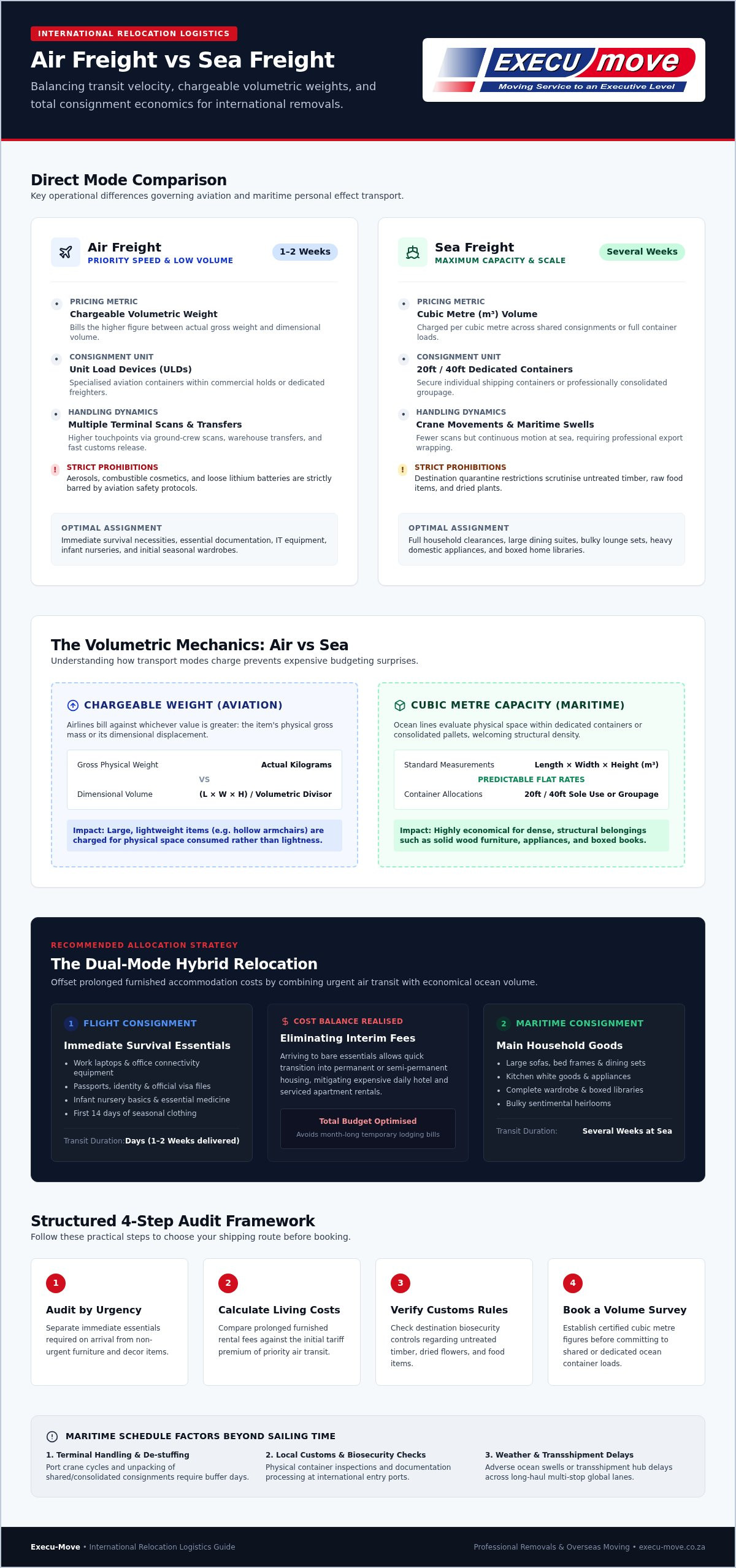
Cargo handling frequency directly influences your risk profile. While air transit encounters multiple terminal scans, transfers, and warehouse handoffs, maritime containers face continuous ocean swells and port crane movements. Selecting between these freight transport modes requires matching your delicate heirlooms and structural furniture to the physical forces they’ll experience en route.
The Mechanics of International Air Cargo for Personal Effects
Air cargo travels inside specialised Unit Load Devices (ULDs) within the holds of commercial aircraft or dedicated freighters. Strict aviation safety protocols prohibit combustible cosmetics, household aerosols, and loose lithium batteries. This swift mode is designed for immediate necessities:
- Critical remote work equipment and essential documentation
- Seasonal wardrobes and infant nursery requirements
- High-value personal items requiring accelerated customs release
How Ocean Freight Operates for Full Household Consignments
Ocean freight handles the physical backbone of an overseas move. Your possessions are packed securely into dedicated 20-foot or 40-foot containers, or consolidated efficiently alongside other consignments. Working alongside an experienced partner like Execu-Move for your international relocation ensures your goods are professionally wrapped for long-haul maritime routes.
Ocean transport easily accommodates dense dining tables, large lounge suites, domestic appliances, and bulky sentimental pieces. It forms the most dependable platform for whole-house moves across long distances.
Comparing Cost, Transit Time, and Volume Dynamics
The core mathematical reality of choosing between air freight and sea freight comes down to dimensional space: air cargo bills against volumetric displacement, whereas ocean transit prices primarily against sheer cubic capacity. Knowing how these measurements work saves you from unexpected relocation expenses.
Reviewing recognised international shipping guidelines highlights how different carrier networks account for physical presence. While airlines penalise lightweight, expansive items, ocean vessels welcome structural density. Balancing these metrics ensures your goods arrive without exhausting your relocation budget.
Demystifying Chargeable Weight Versus Cubic Metres
Aviation logistics relies on a chargeable weight formula that evaluates actual gross mass against physical dimensions, billing whichever figure is higher. A large, feather-light lounge chair consumes valuable aircraft hold space, meaning you pay for its volume rather than its lightness. Ocean shipping, by contrast, charges per cubic metre across shared or full containers. It offers vastly superior economics for dense furniture, heavy appliances, and boxed libraries.
Realistic Transit Timelines and Port Congestion Factors
Speed remains the defining advantage of air transport. Air consignments generally clear border checks and reach your destination home within one to two weeks. Ocean freight requires an entirely different operational perspective:
- Maritime voyages typically span several weeks at sea depending on global routes.
- Terminal handling, container de-stuffing, and local customs inspections add necessary buffer days.
- Weather delays or transshipment hub transfers can stretch projected schedules.
Factoring interim temporary housing costs against sea freight savings is essential. If you need clarity on which method best matches your timeline, the team at Execu-Move can help you evaluate your consignment inventory.
How to Decide Between Air and Ocean Transit for Your Move
Making the right logistical call requires looking beyond simple shipping tariffs. When you are choosing between air freight and sea freight, your daily living arrangements abroad dictate the true economics of your move. A structured decision framework keeps your timeline practical and your budget intact.
- Audit by true urgency: Separate essential items required on arrival from non-essential furniture and decor.
- Calculate interim living expenses: Compare prolonged furnished rental fees against the premium of air transit.
- Verify destination customs restrictions: Check strict quarantine policies governing untreated wood, dried plants, and food products.
- Book a professional volumetric survey: Establish exact cubic dimensions before committing to a shipping method.
Evaluating Urgency, Housing Arrangements, and Settling-In Timelines
Living out of suitcases in temporary accommodation adds up rapidly. If your family must rent serviced apartments for two months awaiting an ocean vessel, those lodging fees might eclipse what you save on sea freight. Corporate professionals stepping straight into office roles require their tech tools immediately. Families moving with young children often need familiar bedding and school items right away to re-establish routine without emotional strain.
Environmental Footprint and Carbon Efficiency Considerations
Sustainability plays a decisive role for many expatriates. Ocean shipping generates significantly fewer carbon emissions per tonne-kilometre than air cargo, making maritime routes the responsible choice for reducing personal environmental impact. Expert packing and consolidated loading further optimise space inside shipping containers, ensuring energy efficiency across vast transit distances.
Every household has distinct logistical priorities. You can request a comprehensive pre-move assessment with our moving specialists to review your inventory and identify the most efficient route forward.
Implementing a Hybrid Relocation Strategy for Overseas Moves
Who says you have to limit yourself to a single mode of transit? When choosing between air freight and sea freight, many relocating families discover that the most effective strategy isn’t an either-or choice. A multimodal hybrid solution splits your household effects into two distinct consignments, synchronising rapid lifestyle continuity with overall shipping budget management.
Under this approach, dedicated packing teams arrive on moving day to wrap, label, and manifest both consignments concurrently. Your vital day-one effects head straight to the airport terminal, whilst your primary furniture and boxed housewares load securely into a maritime container for the long-haul ocean route.
Curating Your Priority Air Freight Relocation Kit
An effective air consignment functions as an extended transition capsule. Focus strictly on compact items that make your new residence immediately habitable:
- Professional IT hardware, office monitors, and primary business tools
- Core kitchen essentials, kettle sets, and daily linen supplies
- Children’s comfort blankets, educational materials, and favoured toys
Leave heavy mattresses, appliances, and dense book collections for the ocean vessel. Crucially, always keep original personal identification, passports, and title deeds on your person rather than inside freight manifests.
Coordinating Multimodal Logistics with a Single Relocation Partner
Managing two separate logistics carriers yourself often creates double customs documentation and fragmented arrival schedules. Selecting an experienced specialist to handle your complete international relocation solutions ensures coordinated manifest preparation across both air and ocean routes.
A unified global network spanning over 2,000 international moving agents ensures both consignments clear customs without administrative hold-ups. Secure origin and destination warehouse facilities provide temporary holding capacity, allowing you to align container delivery directly with lease signings and home handover dates.
Chart Your Course to a Confident International Move
Mastering your overseas relocation begins with realistic planning. Successfully choosing between air freight and sea freight comes down to separating your genuine day-one necessities from long-term household furnishings. While flights bridge immediate arrival gaps, maritime transit delivers the carrying capacity required to relocate your broader home sustainably and cost-effectively.
You don’t have to tackle complex international customs regulations or volumetric calculations alone. With access to a vetted global network spanning over 2,000 international moving agents, door-to-door customs clearance, and specialised export packing, your treasured possessions remain in expert hands from packing day to final delivery. When you’re ready to design your ideal relocation schedule, request an international moving quote to begin your transition overseas with total confidence.
Frequently Asked Questions
Can I send liquid toiletries, aerosols, or batteries via international air freight?
No, international civil aviation rules strictly classify perfume, hairspray, flammable toiletries, and standalone lithium-ion power banks as hazardous cargo. These goods risk confiscation or severe transit delays during security screening. Keep everyday cosmetics in your personal flight baggage, or pack compliant household consumables safely inside your ocean container instead.
How much faster is air freight compared to international sea freight for household removals?
Air consignments typically reach destination residences within one to two weeks, including terminal export handling and local import clearance. By contrast, ocean shipping generally spans anywhere from four to eight weeks, depending on global maritime trade routes, transshipment hubs, and port terminal schedules. Flight cargo offers the obvious speed advantage for strict deadlines.
Is sea freight safe for fragile antique furniture and high-value decorative heirlooms?
Yes, maritime transit is safe when goods receive professional export wrapping and proper container blocking. Seasoned international movers protect ornate timber, crystal cabinets, and artwork using multi-layered bubble blankets, corrugated card sleeves, and custom timber crating. This specialist protection absorbs rough open-sea swell movement and prevents shifting across deep voyages.
What is volumetric weight and why does it make air freight expensive for furniture?
Volumetric weight is an aviation pricing metric that charges based on physical dimensions rather than actual weight on a scale. Aircraft hold capacity is limited by space, not just payload tonnage. When choosing between air freight and sea freight, bulky items like dining chairs or sofas take up disproportionate volume, triggering heavy cubic surcharges.
Can I coordinate an air shipment and a sea container through the same relocation company?
Yes, booking through an accredited global mover allows you to manage both legs seamlessly under a unified shipping manifest. When choosing between air freight and sea freight, a single partner coordinates simultaneous packing day collections, manages destination border documentation, and aligns delivery schedules to match your precise move-in date.