
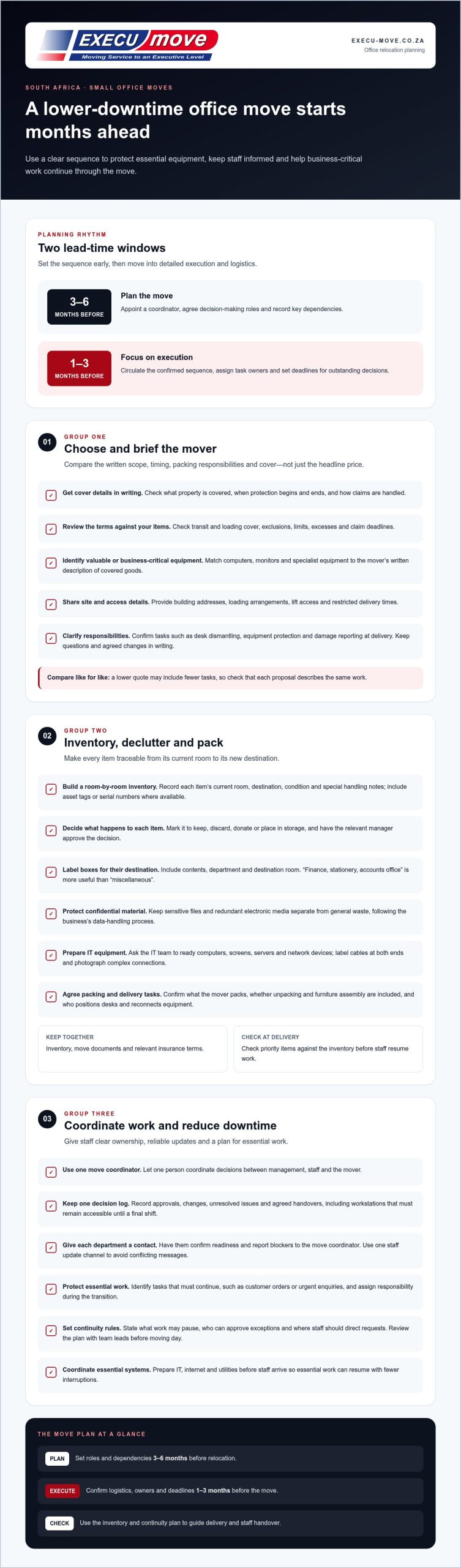
The most effective way to move a small office in South Africa with less downtime is to plan early, protect essential equipment and coordinate the move around business-critical work. Begin planning 3-6 months before the relocation, then focus on execution and logistics 1-3 months before the move. These lead times give you room to organise the details that keep staff and customers connected.
Moving a small office in South Africa can feel disruptive, even when the team and premises are small. Keep the process manageable by tracking what is moving, labelling items for their new destination, protecting documents and IT equipment, and preparing essential systems before staff arrive. A clear sequence also helps everyone understand what happens next.
This guide explains how to select an insured mover, prepare an accurate inventory, pack securely and coordinate the move across South Africa. You’ll also find practical ways to reduce downtime, from planning the transfer of networks and phone systems to scheduling the move when it is less likely to interrupt daily operations.
Key Takeaways
- Compare movers by the insurance cover relevant to your office assets, and make sure the move plan clearly sets out what is being handled.
- Create an itemised inventory, remove what the business no longer needs, and label packed items by department and destination.
- Coordinate IT, internet and utilities before moving day so staff can resume essential work with fewer interruptions.
- For moves between South African cities, plan around route, access and delivery logistics as well as the needs of each office location.
Insurance and mover selection
Before appointing a mover, confirm the liability cover that applies to your office relocation in South Africa. Ask for the details in writing, including what property is covered, when protection begins and ends, and how claims are handled. A verbal assurance alone won’t show whether the arrangements suit the furniture and equipment being moved.
Review the terms against the items in your move. A desktop computer, server, filing cabinet and boardroom table have different values and handling needs. Check whether cover includes transit and loading, and note any exclusions, limits, excesses and claim deadlines. An excess is the amount the business may need to pay towards an eligible claim.
Use these steps to compare the proposed cover and moving plan:
- List valuable or business-critical items, such as computers, monitors and specialist equipment.
- Match the inventory to the mover’s written description of covered goods.
- Identify items that need special handling and record their condition before packing.
- Keep copies of the inventory, move documents and relevant insurance terms together.
- Confirm who records damage at delivery and how the business should report it.
When choosing a mover, consider whether they can plan around office schedules and access requirements. Share the building addresses, loading arrangements, lift access and any restricted delivery times. A move from a shared office building, for example, may require coordination with building management. Clear information helps the mover plan the sequence and avoid preventable delays.
Compare written proposals by scope, timing, packing responsibilities and cover, not just the headline price. Check that each describes the same work, such as dismantling desks or protecting equipment. A lower quote may include fewer tasks, so compare like for like. Keep questions and agreed changes in writing to ensure the final plan reflects your business’s needs.
For a small office relocation, appoint one person to coordinate decisions between management, staff and the mover. Agree on the scope and cover before confirming the move date. This gives the team time to document valuable assets, resolve gaps and clarify responsibilities before items leave the premises.
Inventory, decluttering and packing
Start with a room-by-room inventory, then decide what to move, store or remove. List each requirement in the written scope, including packing, storage or furniture assembly, so the moving plan is clear.
Office Inventory
Record each desk, chair, cabinet and electronic item, along with its current room and intended destination. Include asset tags or serial numbers where available, the item’s condition and any special handling notes. For example, mark a shared printer for the reception area rather than listing it simply as “printer”. This gives staff and movers a clear reference during loading and delivery.
Use the inventory to check items at the new office. Assign a staff member to update the list if equipment is added, removed or redirected. Keep a separate record of confidential files and high-value equipment, with access limited to the people coordinating the move.
Decluttering Before Packing
Review the inventory with each department before packing starts. Mark every item to keep, discard, donate or place in storage, then have the relevant manager approve the decisions. This helps prevent unwanted furniture and outdated paperwork from taking up space at the new premises.
Keep confidential records and redundant electronic media separate from general office waste. Follow your business’s data-handling process for documents and devices containing sensitive information. Clear desks, cupboards and shared storage areas in sequence so staff can continue using workspaces that have not yet been packed.
Packing and Unpacking Services
Agree on whether packing covers all contents or only furniture and selected equipment. Label each box with its contents, department and destination room. “Finance, stationery, accounts office” is more useful than “miscellaneous”. Confirm whether unpacking and furniture assembly are included, and decide who will position desks and reconnect equipment.
Ask the IT team to prepare computers, screens, servers and network devices before packing. Label cables at both ends and photograph complex connections. Protect sensitive documents and data according to the business’s security procedures. For mechanical items such as shredders or adjustable desks, follow the manufacturer’s handling instructions and secure loose parts. At delivery, unpack priority items first and check them against the inventory before staff resume work.
Moving coordination and downtime reduction
When moving a small office in South Africa, coordinate decisions as carefully as the transport. Assign an owner to each task and agree on handover points.
Moving Coordination
Keep one decision log for approvals, changes and unresolved issues. Give each department a contact who can confirm readiness and report blockers to the move coordinator. If a team needs a workstation kept accessible until its final shift, for example, record the requirement and agreed handover. Use one staff update channel so employees aren’t relying on conflicting messages or outdated instructions.
Reducing Business Downtime
Identify work that must continue during the move, such as processing customer orders or responding to urgent enquiries. Assign responsibility for each task and tell staff where to direct requests during the transition. A continuity plan can also state which work may pause and who can approve exceptions. Review it with team leads before moving day, then update staff if timings change.
Office Move Planning Steps
Begin planning 3-6 months before the relocation. Use this period to appoint a coordinator, agree decision-making roles and record key dependencies. Focus on execution and logistics 1-3 months before the move. At that stage, circulate the confirmed sequence, assign task owners and set deadlines for outstanding decisions. Give each department a clear way to flag a delay before it affects another team.
Booking Lead Time
Book once the move date, approximate scope and access requirements are clear enough to plan. Share fixed business commitments, such as a scheduled client presentation, so the move sequence can account for them. Before moving day, reconfirm arrival and handover arrangements with the people responsible at each site. Keep a named contact available to resolve changes promptly.
Office removals across South Africa
For a move between South African cities, plan around the route, building access and each site’s operating needs. Confirm the sequence at both addresses before setting expectations with staff.
Building rules vary by premises and business activity. Ask building management about loading access, lift bookings, entry requirements and permitted moving times. Update any permits and licences needed for the new location.
The cost of moving a small office in South Africa depends on factors such as distance, the volume of furniture and equipment, access at each building, packing requirements and storage needs. A detailed inventory and site information help define the scope and make quotes easier to compare.
Include address updates in the relocation schedule. Notify banks, postal services and relevant regulatory bodies, then update business records and customer communications with the new details.
For a move across provinces, map the handover from collection to delivery. An office relocating from Johannesburg to Durban, for example, needs a clear collection plan, destination access arrangements and an agreed sequence for placing items. Share opening hours and contact details for both sites with the move coordinator so questions can be resolved without delaying delivery.
Check the practical differences between the old and new premises before moving day. A city-centre building may have different delivery access from a business park, while a smaller destination office may need staged placement to keep exits and work areas clear. Ask department leads to identify priority workstations and essential equipment, then mark their destinations clearly on the plan.
Keep the move documents together: the inventory, site contacts, access instructions, delivery sequence and revised address list. This gives staff one reference point if plans change. For a coordinated relocation between South African offices, discuss your office move requirements and the logistics that matter at each location.
Execu-Move: International Furniture Removals
Execu-Move can coordinate the practical needs of an office relocation. Domestic Furniture Removals supports the transport of office furniture and equipment within South Africa. Full Packing and Wrapping helps prepare items for transit, while Secure Storage can accommodate goods that cannot yet be moved into the new premises.
For a business relocating abroad, Execu-Move’s International Furniture Removals service supports moving office contents across borders. The plan depends on the route, the items being moved and access timings at each location. Share your requirements and priorities to organise the relocation as a coordinated project.
Contact Execu-Move to discuss your office relocation requirements.
Set Your Office Move in Motion
Moving a small office in South Africa is an opportunity to shape your next workspace around how your team works. A considered plan can make the transition easier to manage, from preparing the new premises to getting daily operations underway.
Execu-Move provides Domestic Furniture Removals for local office moves and International Furniture Removals for relocations across borders. Full Packing and Wrapping can help prepare office contents for transit. Choose the support that suits your plans and share your requirements with the relocation coordinator.
Your next step is to discuss the route, timing and scope of the move. Contact Execu-Move to plan your office move and take the next step with a clear plan for your team.
Frequently Asked Questions
How do I compare office moving companies in South Africa?
Compare how each company communicates and manages changes on moving day. Ask for the name and contact details of the person coordinating the move, plus the process for reporting delays or resolving a disagreement about an item. A useful comparison also considers whether the proposed sequence accounts for your business’s opening hours and any client-facing commitments during the move.
What should I check before hiring a South African office moving company?
Check that the agreement names the correct business, move addresses, agreed dates and the person authorised to approve changes. Review the terms for rescheduling, cancellations and recording additional work. Agree how keys or access cards will be transferred, who can sign for delivery and how your team will document missing items after the move.
What insurance covers office furniture and equipment during a move in South Africa?
Review the policy schedule for the insured business, covered property and settlement basis. Check whether payment is based on repair, replacement or depreciated value, and whether leased equipment is included. Confirm the excess and the deadline and documents required for a claim. For high-value items, retain purchase or lease records to support the declared value.
How can I safely pack and transport computers and office equipment?
Keep essential access items with the staff member who uses them instead of packing them with general equipment. These may include a laptop, security key, headset or specialist adapter needed to sign in and work. Remove detachable computer accessories, store them together by workstation and label them clearly so each set reaches its intended user.
What are the risks of moving an office, and how can I avoid downtime?
Customers may lose contact with your business if delivery instructions or public contact details still point to the old premises. Before moving, prepare a customer notice and update relevant website pages, email signatures and supplier delivery records. At the new location, display clear visitor directions and tell staff where to direct enquiries. These steps help avoid confusion while the team settles in.