
What if a relocation becomes difficult not because of the move itself, but because no one knows which costs are covered or who approves them? A corporate moving policy template gives South African employers a consistent framework for setting out relocation eligibility, support and responsibilities. It can cover work-related domestic or international moves, whether temporary or permanent, and clarify what employees can expect before arrangements begin.
It’s reasonable to want a policy that supports employees while keeping decisions clear and manageable for the business. Define who qualifies, which expenses may be covered, how approval and reimbursement work, and how the policy will be reviewed. This guide explains what an employee relocation policy includes, how to set its scope, and how to administer and update a template. It also gives practical examples of covered moving and travel expenses, helping employees and managers understand and follow the process.
Key Takeaways
- Set clear policy boundaries for temporary housing, relocation benefits and covered expenses so employees and managers understand what support applies.
- Define eligibility using consistent criteria, such as business need, role and the circumstances of the move, and document the approval process.
- Spell out which moving and travel costs may be covered, how employees submit expenses, and when they need approval.
- Review the policy regularly and use a coordinated relocation plan to manage office moves, furniture removals and packing.
Why a Corporate Moving Policy Matters
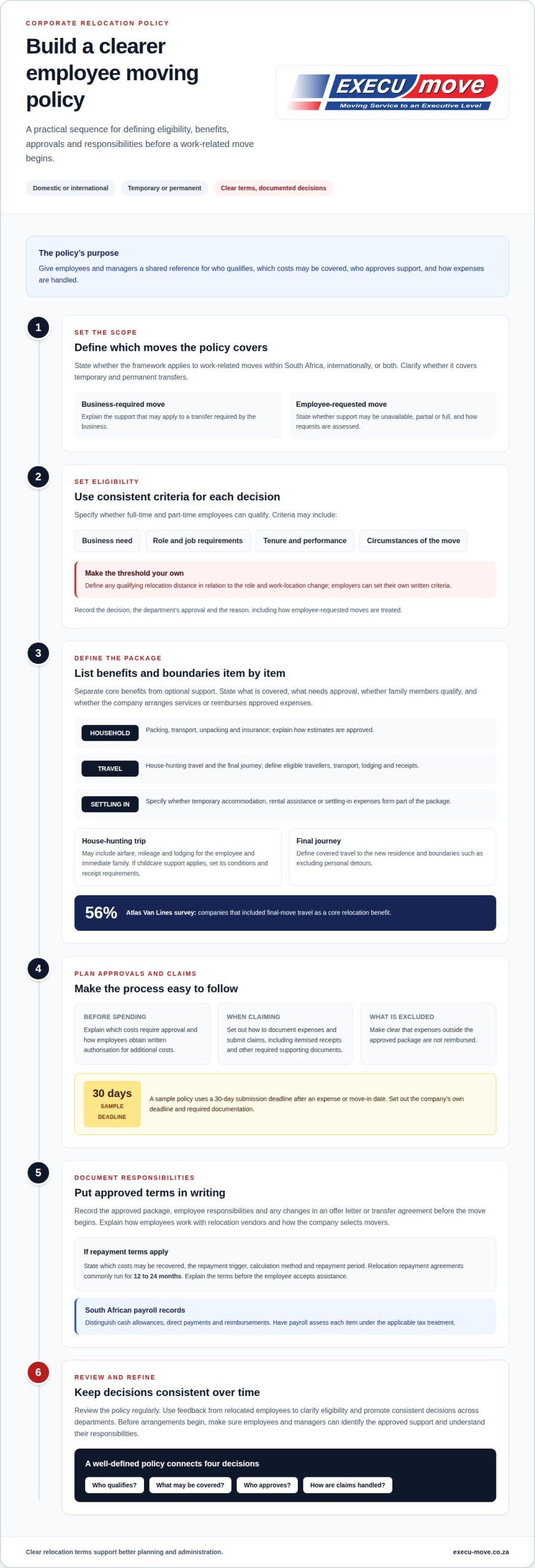
A relocation policy sets out how an organisation manages work-related moves. It clarifies who qualifies, which costs are covered, and who approves support. A corporate moving policy template gives employers a starting structure for these decisions. Its scope can include temporary or permanent transfers within South Africa or internationally.
Define whether eligibility applies to full-time and part-time employees offered relocation support. Explain how business-required moves differ from employee-requested relocations. For example, an employer might offer a package for a transfer while assessing an employee-requested move separately. Clear terms help employees understand the decision and its limits.
Describe temporary housing by specifying which accommodation costs qualify, how employees access support, and how long it applies. State whether the company arranges accommodation or reimburses approved expenses. For example, an employee waiting for a long-term rental could use temporary housing during the settling-in period if the package allows it.
List relocation benefits individually rather than making a broad promise of assistance. A package may cover household-goods transport, packing, travel, temporary accommodation, or help finding suitable housing. Explain which expenses need approval, what documentation employees must submit, and whether support extends to family members. These details make covered moving expenses easier to administer.
For a transfer between South African work locations, the policy can define eligible employees, approved travel, household-goods transport, and temporary housing in one place. HR can assess the request against consistent criteria, document the approved package, and explain the employee’s responsibilities before the move begins.
Distinguish core benefits from optional support. A company might cover essential moving expenses for a business-required transfer while requiring approval for extra services. Recording the decision in an offer letter or transfer agreement gives the employee and employer a shared reference for planning and reimbursement.
Employee Eligibility for Relocation Assistance
Set eligibility criteria based on business need, role, job requirements, tenure, performance, and the circumstances of the move. State whether full-time and part-time employees qualify and how employee-requested relocations are treated. Support for an employee-requested move may be unavailable, partial, or full. Record each decision, the department’s approval, and the reason.
Define a qualifying relocation distance in relation to the role and change in work location. Employers can set their own threshold rather than adopting one from a foreign sample policy. For example, an employee transferred to another work location may qualify if the move meets the company’s written criteria. An employee moving by choice could receive different support.
For South African payroll administration, distinguish cash allowances, direct payments, and reimbursements in the records. Have payroll assess each item under the applicable tax treatment rather than treating every form of support alike.
An employer may be legally obligated to meet relocation terms included in an employment contract or offer letter. Put the approved package, employee responsibilities, and any changes in writing before the move begins.
Write repayment clauses in plain language. Identify recoverable costs, the repayment trigger, calculation method and repayment period. Relocation repayment agreements commonly run for 12 to 24 months. For example, if an employee voluntarily resigns during the stated period, the agreement should explain how repayment is calculated. Share these terms before the employee accepts assistance.
For moving companies and relocation vendors, explain how employees obtain approval and which additional costs need written authorisation. A policy can require itemised expenses and set out the company’s process for selecting licensed, insured movers. Review the programme regularly, using feedback from relocated employees to clarify eligibility criteria and promote consistent decisions across departments.
Covered Moving and Travel Expenses
List every reimbursable expense in the package, then explain approval and documentation requirements. Household-goods costs may include packing, shipping, and insurance. For example, an employee transferring to a new work location can submit an approved moving expense with supporting documents for assessment against the policy.
House-hunting travel can include airfare, mileage, and lodging for the employee and immediate family. If childcare support applies during these trips, define eligible costs, approval steps, and receipt requirements. For example, an employee travelling to view homes could submit approved travel and childcare expenses together, making reimbursement easier to assess.
Separate house-hunting travel from the final journey to the new residence. State whether the package covers airfare, mileage, or lodging, and which family members qualify. For a family relocating elsewhere in the country, the policy could cover their journey to the new location while excluding personal detours. Clear boundaries help employees plan the trip.
- Household goods: Specify whether packing, transport, unpacking and insurance are covered, and how estimates receive approval.
- Travel: Define eligible travellers, transport types, lodging and required receipts for each trip.
- Other costs: State whether temporary accommodation, rental assistance or settling-in expenses form part of relocation assistance.
Set out how employees document expenses and submit claims. A sample policy uses a 30-day submission deadline after an expense or move-in date. In practice, specify the company’s own deadline and the required itemised receipts. An employee who follows the process can submit a complete claim for review; expenses outside the approved package are not reimbursed.
Atlas Van Lines survey: 56% of companies included final-move travel as a core relocation benefit.
Administering and Reviewing a Corporate Moving Policy
A South African corporate relocation policy can be drafted as an editable DOCX and issued as a PDF after approval. A corporate moving policy template should have a named owner and clear version details, so HR can identify the current policy and retire outdated copies.
Set a consistent approval route. The employee’s direct manager and HR should assess requests against business needs and budget. Before arrangements begin, record the approved package in a signed agreement. Require HR and senior management approval for written exceptions, creating a clear record of any changes.
- Set the scope: Define eligible employees, qualifying moves, and how the policy applies to temporary or permanent transfers.
- List benefits: Set out temporary housing, eligible travel, packing, household-goods transport and other relocation expenses.
- Explain claims: Specify approval requirements, itemised receipts and expense reports that follow company rules.
- Protect records: Limit access to employee relocation details and store approvals, receipts and agreements securely.
For example, an employee relocating for a new role receives approved temporary housing and packing support. HR records the package, the manager confirms the business need, and the employee submits itemised receipts under the stated process. This creates a consistent record for reimbursement and later review.
Review the policy once each year and use feedback from relocated employees to identify unclear steps or recurring exceptions. If employees repeatedly need different travel arrangements, revise the relevant clause and approval route. A corporate moving policy template is easier to administer when updates are dated, shared during onboarding, and applied consistently.
Execu-Move: Office and Corporate Relocations
Execu-Move provides furniture removals and full packing and wrapping for office and corporate relocations. For a business moving between offices in South Africa, these services can bring furniture handling and packing into one relocation plan. Execu-Move also provides international furniture removals for moves across borders.
Start by defining the move’s scope: which office furniture is travelling, where it is going, and what needs packing. This helps shape the removal and packing requirements around the company’s plans. For example, a business relocating one department can identify that team’s furniture and packed items as a distinct part of the wider office move.
Full packing and wrapping can help prepare furniture for transport, while furniture removals handle its movement between locations. Including both needs in the company’s relocation plan makes it easier to set responsibilities and align the move with approved benefits.
- Domestic furniture removals: For company moves between locations within South Africa.
- International furniture removals: For moving furniture across borders.
- Full packing and wrapping: For preparing furniture and belongings as part of the move.
These services are relevant when a company needs support for an office move or employee relocation. The employer can use its policy to define eligible expenses and approvals, while the moving plan sets out the required removal and packing work. This distinction connects the employee’s approved benefits with the practical movement of furniture.
For support with a company move, contact Execu-Move.
Frequently Asked Questions
What are the typical components of a relocation package?
A relocation package may combine practical moving support with benefits that help employees transition. Alongside household-goods transport and travel, an employer might include temporary accommodation, settling-in assistance, or support for family needs. For example, an employee with children may need a different package from someone moving alone. The written offer should identify each benefit and its conditions.
Who will benefit from this policy?
Employees asked to move for business can use the policy to understand available support and responsibilities. It also gives managers and HR a consistent basis for decisions. For example, when a role requires a permanent move, a written policy can clarify which benefits apply and how they are approved. Employees considering a transfer can then assess the practical impact before accepting.
What should a corporate employee relocation policy include?
A useful policy should explain eligibility, approval authority, benefit options, claim requirements, and how changes are handled. Include a contact role for employee queries and a process for recording exceptions. Define key terms such as “dependent” or “temporary accommodation” so teams interpret them consistently. A corporate moving policy template can organise these clauses, but employers should adapt it to their own arrangements.
What are typical corporate relocation allowances and cost limits in South Africa?
Each employer sets its own relocation allowances and limits, rather than relying on one standard amount for every move. A company can base its allowance on the approved package, distance, household requirements, and whether accommodation or travel is included. State whether support is a fixed allowance or reimbursement of approved expenses, and explain how employees should document claims.
How should a company approve and document employee relocations?
Use a written record that connects the business reason, approval decision, and agreed benefits. The employee’s manager can document the role requirement, while HR records the approved terms and any exception. Keep the signed offer or transfer agreement with expense approvals and claims. For example, if a transfer date changes, record the revised arrangements so reimbursement decisions refer to the same terms.
What relocation benefits are common for domestic versus international moves?
Both types of move may include household-goods transport, packing, travel, and temporary accommodation. International packages may also need to account for customs clearance, destination-related arrangements, and a longer settling-in process. For a domestic transfer, travel and delivery of belongings may be the main practical needs. Employers can tailor benefits to the destination and the employee’s approved circumstances.