
Did you know that most people relocating to South Africa shouldn’t actually pay a cent in import taxes on their household goods? It’s a common worry that your life’s possessions will be held at the port until you’ve settled an exorbitant, unexpected bill. We understand the anxiety that comes with complex SARS documentation and the fear that your belongings might be handled poorly during a random inspection. The reality is that understanding customs duties when moving to South Africa is less about calculating costs and more about meticulously proving your eligibility for legal exemptions.
You deserve a transition that’s defined by calm efficiency rather than administrative chaos. This 2026 guide will show you exactly how to navigate the current regulations to ensure you qualify for duty-free entry. We’ll explore the specifics of the 407.06 rebate, provide a clear checklist of required documents, and offer the professional insights you need to ensure your move is compliant and cost-effective. Let’s replace that confusion with a steady, well-informed plan for your new beginning.
Key Takeaways
- Discover how to legally avoid customs duties when moving to South Africa by correctly applying for the 407.06 rebate item for household goods.
- Understand the critical distinction between a detailed packing list and a valued inventory to prevent delays during the SARS clearance process.
- Identify which items, such as alcohol or goods owned for less than six months, are restricted or require additional permits before shipping.
- Gain clarity on the mandatory documentation needed for a compliant relocation, including the P1.160 declaration and specific visa requirements.
Understanding Customs Duties for Personal Effects in South Africa
When we talk about customs duties when moving to South Africa, we’re referring to the taxes the South African Revenue Service (SARS) levies on goods entering the country. For most families, the goal isn’t to pay these fees, but to prove that your shipment consists of used household effects rather than commercial imports. Understanding how to manage customs duties when moving to South Africa is essential for a smooth arrival. SARS acts as the gatekeeper for every container, ensuring that all items meet the legal criteria for entry. The primary trigger for most exemptions is your residency status; having your permanent residence or work permit in order is the first step toward a tax-free move.
The Difference Between Duty and VAT on Imports
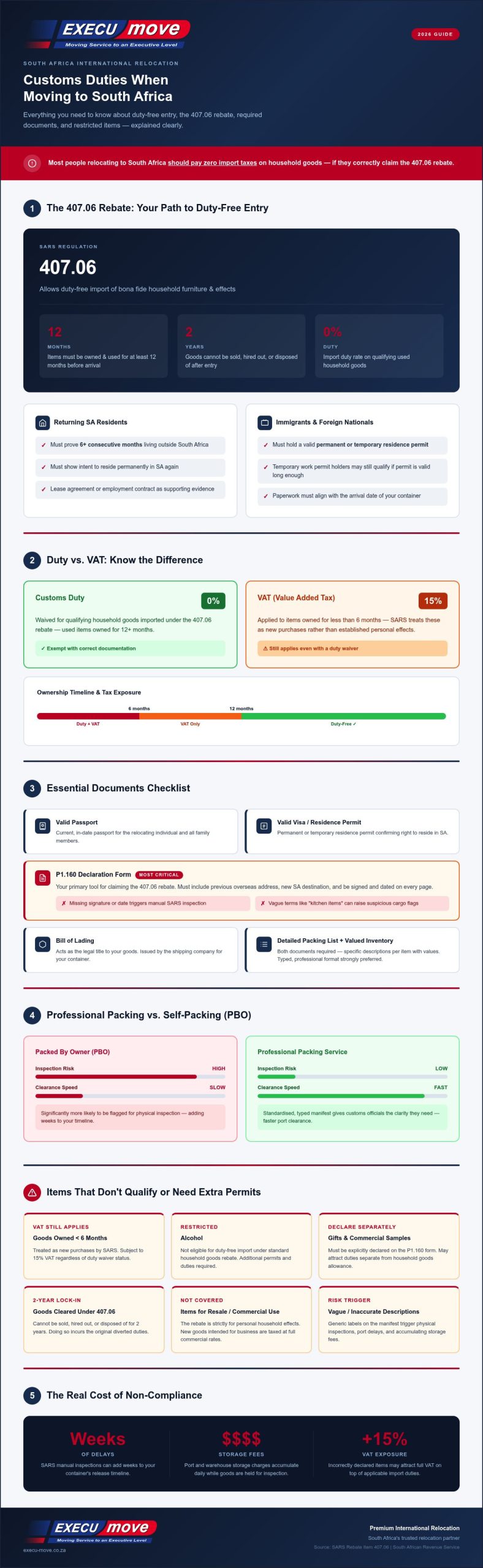
It’s vital to distinguish between customs duty and Value Added Tax (VAT). While you might qualify for a duty-waiver on used goods, VAT remains a separate consideration. Within the framework of Taxation in South Africa, a standard VAT rate of 15% is common. For those relocating, SARS typically applies this 15% VAT to items owned for less than six months, as these are viewed as new purchases rather than established personal effects.
Why Customs Compliance Matters for Your Relocation
Inaccurate paperwork creates more than just a minor hurdle. It presents a genuine risk to your budget and timeline. Non-compliance often results in exhaustive physical inspections, port delays, and heavy storage fees. Our international relocation services are designed to mitigate these risks through meticulous pre-clearance. We handle the complex SARS interface so you can focus on settling into your new home with confidence.
The 407.06 Rebate: How to Qualify for Duty-Free Entry
What is the secret to avoiding heavy costs? The answer lies in Rebate Item 407.06. This specific regulation allows you to bypass most customs duties when moving to South Africa, provided your shipment consists of bona fide household furniture and effects. To qualify, you must have owned and used these items for at least 12 months before your arrival. SARS is strict about this timeline to prevent people from using a move to import new goods for resale. Any items cleared under this rebate cannot be sold, hired out, or otherwise disposed of for two years after entry without paying the diverted duties. You can find more detail on the official requirements for importing personal effects and household goods on the SARS website.
Criteria for Returning South African Residents
If you’re a South African returning home, you must prove you’ve been living outside the Republic for an unbroken period of at least six months. SARS requires evidence of your intent to reside permanently in South Africa again. This often involves providing documentation like a local lease agreement or an employment contract. It’s a methodical process, but it ensures your life’s work returns home with you safely.
Rules for Immigrants and Foreign Nationals
Foreign nationals, including contract workers and immigrants, must hold a valid permanent or temporary residence permit to access these allowances. Even if you’re on a temporary work permit, you can often still import your goods duty-free if the permit is valid for a sufficient duration. The key is ensuring your paperwork aligns perfectly with the arrival of your container. If you’re feeling overwhelmed by these regulations, our team at Execu-Move can help clarify your specific status.
Essential Documentation and the Inventory Process
How do you ensure your shipment moves through the port without friction? It starts with the right paperwork. You’ll need your passport, a valid visa, and the Bill of Lading, which acts as the title to your goods. However, the most critical document is the P1.160 Declaration. This is where you officially declare your status to SARS. Accurate descriptions are paramount. Vague terms like “kitchen items” can raise suspicious cargo flags, leading to costly physical inspections. You must provide both a detailed packing list and a valued inventory. This level of detail is supported by U.S. Embassy guidance on South African customs, which highlights the necessity of transparent documentation.
Completing the P1.160 Declaration Form
The P1.160 form is your primary tool for claiming the 407.06 rebate. Ensure you list your previous overseas address and your new South African destination clearly. A common mistake is failing to sign every page or omitting the date of arrival. These small errors often trigger manual SARS inspections, adding weeks to your timeline. Be precise about declaring any items that might attract customs duties when moving to South Africa, such as gifts or commercial samples.
The Value of Professional Packing for Customs
Boxes marked “Packed by Owner” (PBO) are significantly more likely to be flagged for inspection. Customs officials prefer a manifest generated by a professional team. Our full packing services provide a standardised, professional inventory that speeds up the clearance process. A clear, typed manifest gives officials confidence in the contents of your container. If you want to ensure your documentation is audit-ready, consult with our relocation experts to streamline your move.
Navigating Restricted Items and Professional Clearance
Not all household goods are treated equally by SARS. Certain items fall into the restricted category, meaning they require additional permits or may attract customs duties when moving to South Africa if specific allowances are exceeded. Alcohol and tobacco are the most common examples; they’re strictly limited and must be declared separately. Additionally, any item owned for less than six months is typically viewed as a new purchase and will be subject to tax. If you’re planning vehicle transport, you’ll need an import permit from ITAC and a Letter of Authority (LOA) from the NRCS. Similarly, pet transport involves a complex web of veterinary health certificates and state-issued import permits that must be secured well in advance.
Prohibited Items: What to Leave Behind
Some items are strictly forbidden and should never be included in your shipment. Attempting to ship these can lead to the seizure of your container and heavy fines. Please ensure your manifest is free of:
- Firearms, explosives, and ammunition without specialized police permits.
- Live plants, seeds, bulbs, or raw timber.
- Narcotics and certain habit-forming drugs.
- Counterfeit goods or pirated content.
Why Professional Customs Clearance is Essential
Coordinating with SARS requires a deep understanding of local port logistics. An experienced relocation partner acts as your steady hand, managing the interface with customs agents and being present during physical inspections. We handle the technical queries regarding HS codes and rebate eligibility so you don’t have to. This professional oversight ensures your belongings are protected and that your entry into South Africa is defined by calm efficiency rather than administrative delays. With the right team behind you, you can move forward with total confidence, perhaps even looking ahead to educational travel opportunities with International Student Experiences for your school or college group.
Moving across borders is a monumental life event that shouldn’t be overshadowed by administrative stress. By understanding the 407.06 rebate and preparing your P1.160 documentation with precision, you’ve already taken the most important steps toward a tax-free entry. Successfully managing customs duties when moving to South Africa depends on meticulous inventory management and proving your residency status to SARS with total clarity.
As accredited international moving specialists, we provide expert customs clearance coordination and a comprehensive door-to-door service to ensure your belongings arrive safely. You don’t have to face the complexities of port logistics alone. Our team acts as your steady hand, managing every detail with the calm efficiency you deserve during this transition.
Ready to begin your journey? Request a free international relocation quote from Execu-Move today and let us handle the heavy lifting. We look forward to welcoming you home to South Africa with the peace of mind that comes from professional care.
Frequently Asked Questions
Do I have to pay customs duty on my used furniture when moving to South Africa?
You typically don’t have to pay customs duties when moving to South Africa on your used furniture if you qualify for the 407.06 rebate. This exemption applies to immigrants, returning residents, and contract workers who have used their goods for at least one year. You must prove your intention to reside permanently in the country. If these criteria are met, your household effects enter duty-free and VAT-free.
What is the 12-month rule for importing household goods to South Africa?
The 12-month rule specifies that you must have owned and used your household goods for at least one year before shipping them. SARS enforces this regulation to ensure that the items are genuine personal effects rather than new commercial imports. Any items purchased less than six months before your move will likely attract VAT and duties. Keeping purchase receipts or proof of ownership helps verify this timeline during the clearance process.
Can I import my car to South Africa duty-free as part of my move?
Importing a vehicle duty-free is more restrictive than household furniture. While some returning residents may qualify for a one-car exemption under specific conditions, most imports require an ITAC permit and an NRCS Letter of Authority. You’ll likely face customs duties and VAT based on the vehicle’s value if you haven’t owned it for the required period. It’s essential to secure all permits before the vehicle leaves its port of origin, and partnering with an experienced provider like AutoPlex Transport Company can ensure your vehicle is safely delivered to the shipping terminal for its international voyage.
The customs clearance process usually takes between seven and 14 working days once your container arrives at the port. This timeline depends on the accuracy of your documentation and whether SARS selects your shipment for a physical inspection. Having a professional relocation partner manage your manifest helps prevent avoidable delays. We coordinate directly with port authorities to ensure your belongings move through the system as efficiently and safely as possible.
Are there duties on wine or alcohol collections when relocating?
Yes, wine and alcohol collections are subject to customs duties when moving to South Africa because they fall outside the standard household effects rebate. SARS sets strict limits on the quantity of alcohol you can import duty-free. Any volume exceeding these allowances requires a separate declaration and the payment of excise duties and VAT. It’s often more cost-effective to limit your collection or prepare for these specific additional costs beforehand.