
A relocation budget works best when it reflects the employee’s move and the employer’s agreed support. Employee relocation packages in South Africa can use allowances, flexible budgets or direct payment for approved services, with the right structure shaped by the move and the employee’s circumstances.
For employers and employees, the key question is what support covers and how it works in practice. Clear terms set expectations before either side commits.
This article explains how to plan relocation support, define allowances and organise payments. It also shows how to include a household move in the wider proposal, making the next steps easier to manage.
Key Takeaways
- Build a corporate mobility programme around the role, the employee’s circumstances and the support the employer intends to fund.
- Use a relocation proposal to map the move’s requirements and clarify what the employer and employee are each responsible for.
- Compare a defined allowance with a flexible budget to understand how each approach can shape spending choices.
- Consider direct invoicing for agreed moving services to connect employer payments more closely to the relocation plan.
Corporate mobility programmes
In South Africa, employee relocation packages vary depending on whether someone is hired locally, transferred internally or recruited internationally. Employers can tailor support to the move type, destination and household needs.
Relocation support for local hires
A local hire moving between South African cities may need help with household goods, travel and temporary arrangements. Someone taking a Cape Town role from Johannesburg, for example, has different moving needs from someone already living nearby. Employers should specify which expenses they will fund, who approves them and whether support is paid as an allowance or arranged directly.
Set out the destination and scope of the move in the offer. A domestic relocation may require different arrangements for a cross-province household move than for a short-distance move. List the covered services and the employee’s responsibilities in writing, so both sides understand the package before the role is accepted.
Transfer and expatriate package differences
An internal transfer may involve moving between offices, such as from Durban to Johannesburg. The package can reflect the employer’s relocation policy and the employee household’s practical needs. An expatriate assignment involves an international move to or from South Africa, so the proposal should distinguish household moving support from other employment arrangements.
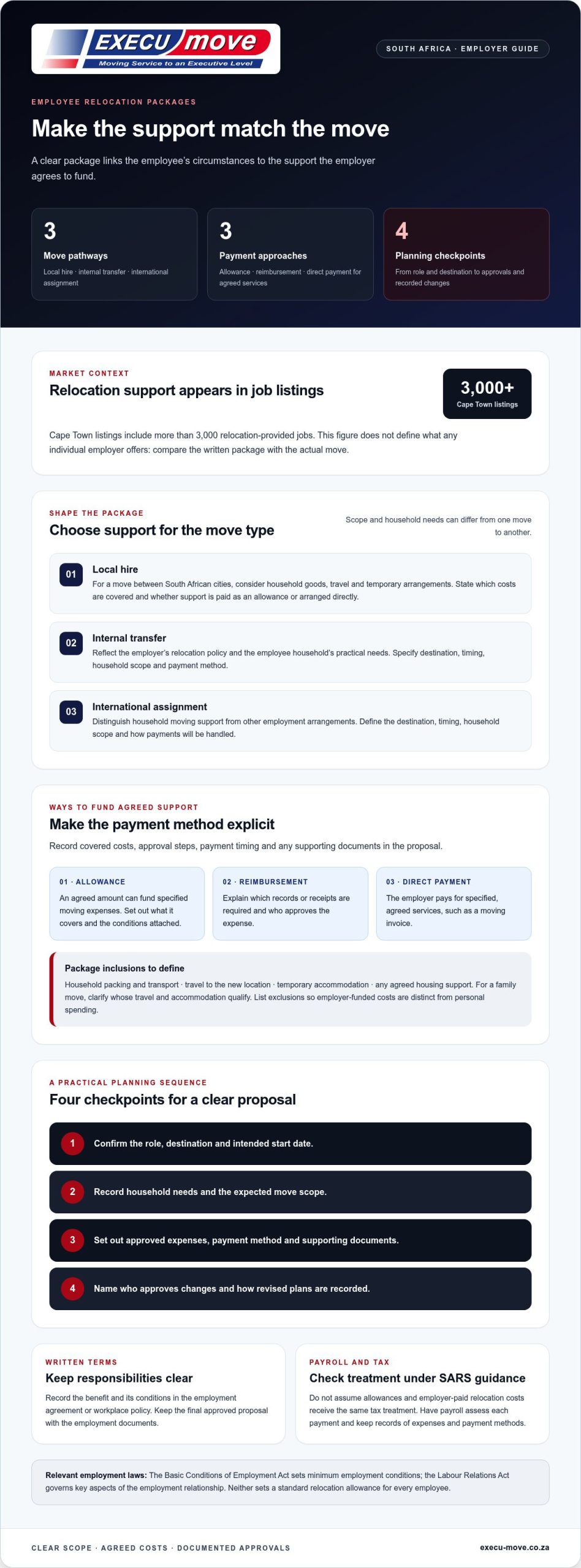
For either move, spell out the destination, timing, household scope and payment method. Cape Town listings include more than 3,000 relocation-provided jobs, making relocation support a visible part of some job opportunities. That figure doesn’t define what any individual employer offers. Compare the written package with the move itself, rather than assuming every role includes the same support.
To shape a programme, employers can first group moves by type, then define eligible support for each group. Next, record approval steps and payment arrangements in the employee’s proposal. For a domestic move, the domestic relocation service can be considered when household goods need to move between South African locations. A clearly scoped policy gives managers a consistent framework while allowing proposals to reflect each employee’s actual move.
Employee relocation proposals and move planning
A relocation proposal should link the employment terms to a practical move plan. South African law sets employment protections, while the specific relocation benefit should be recorded clearly in the employment agreement or workplace policy.
Labour laws and relocation expenses
The Basic Conditions of Employment Act sets minimum employment conditions, and the Labour Relations Act governs key aspects of the employment relationship. The Department of Employment and Labour administers these laws. They do not set a standard relocation allowance for every employee, so the offer or workplace policy should define any benefit and its conditions. State whether support is paid as an allowance, reimbursed against records or paid directly for agreed services. For tax treatment, employers should refer to SARS guidance and classify payments correctly through payroll.
Before signing, compare the proposal with the written employment terms. Confirm who approves expenses, what records are required and how an agreed benefit is handled if the role or move changes. Keep the final version with the employment documents.
Relocation risks and common pitfalls
A vague start date can leave an employee arranging housing before the move schedule is settled. Unclear scope can also lead to disagreements about packing, transport or temporary storage. Specify the destination, household scope, payment method and approval contact in the proposal. For a move from Durban to Pretoria, for example, identify the approved moving services.
Another risk is making the same assumptions for every employee. A local move and an international family relocation can involve different needs. Include a review step for changes to the destination, household requirements or timing, and make the latest approved proposal available to the employee, manager and payroll team.
Use a practical planning sequence:
- Confirm the role, destination and intended start date.
- Record the employee’s household needs and expected move scope.
- Set out approved expenses, payment method and supporting documents.
- Name who approves changes and how revised plans are recorded.
For a move within South Africa, connect the written plan to the actual household move. A domestic relocation plan can help define the practical scope for an employee moving between cities.
Employer-funded relocation allowances
An allowance can fund agreed moving expenses, while direct employer payments cover specified services. Employee relocation packages in South Africa should state the payment method, covered costs and tax handling in writing.
Relocation costs to negotiate
Before accepting a South African job offer, list the expenses the employer will fund and how each will be paid. Include household moving, packing, travel, temporary accommodation and any agreed housing support. Clarify, for instance, whether the employer pays a moving invoice or reimburses the employee after receiving receipts. Record the approval steps, payment timing and process for changes to the move.
Typical package inclusions
A relocation package can combine an allowance with direct payment for agreed moving services. Possible inclusions are packing and transport for household goods, travel to the new location and short-term accommodation while the employee arranges a longer-term home. For a family move, specify whose travel and accommodation expenses qualify. List exclusions too, so the employee can distinguish employer-funded costs from personal spending.
Do not assume an allowance and employer-paid relocation costs receive the same tax treatment. For employee relocation packages in South Africa, the employer should have payroll assess each payment under applicable SARS guidance and keep records of the expense and payment method.
Housing, moving and travel benefits
Housing support may be an agreed contribution or temporary accommodation, while moving support can cover specified household goods and related services. Travel benefits might cover the employee’s journey to the new location; for a family move, clarify which dependants are eligible. State the covered journey, accommodation period and moving scope in the proposal. For example, distinguish a temporary stay from ongoing rent or home-purchase costs.
Before accepting the offer, compare the written package with the move plan. Describe each benefit as an allowance, reimbursement or direct payment, and keep relevant invoices and receipts together. This gives the employee, employer and payroll team a clear record of approved costs and their treatment.
Flexible relocation budgets and direct employer invoicing
Employers can base relocation funding on named services or give employees more choice. With direct invoicing, the employer pays an approved supplier for an agreed service rather than providing funds for the employee to manage.
A flexible budget may suit an employee whose needs differ from the original estimate. For example, a household moving from Durban to Cape Town might prioritise packing and transport, while another employee may need temporary storage. A defined-services allowance instead assigns funding to specified items. Either way, the proposal should state what the budget covers and how changes are approved.
Direct invoicing can clarify how payment works for a specific service. The employer approves the work, receives the invoice and pays the supplier through its agreed process. The employee should know which services are covered, who authorises changes and which personal expenses remain their responsibility. An invoice for household packing, for instance, does not approve unrelated accommodation costs.
Before choosing a method, divide the move into practical cost categories:
- Household packing, transport and delivery.
- Temporary storage linked to the move schedule.
- Employee or family travel, where included in the policy.
- Other agreed services, with clear approval and payment steps.
Then select a funding method for each category. An employer might pay a moving invoice directly and offer a flexible allowance for smaller eligible expenses. Record who owns the budget, which documents are required, how payments are made and what happens to unused funds. This helps the employee understand the arrangement and gives payroll a clear payment record.
For a corporate move involving household goods, align the invoicing plan with the required moving scope and schedule. Discuss a corporate relocation plan to explore how the practical move requirements can fit the employer’s process.
Crown says employee relocation allowances may cover specified services or be fully flexible. This distinction helps employers choose the level of employee choice: specified services tie the allowance to named items, while a fully flexible allowance gives employees more room to direct funds toward their relocation needs. Whichever approach is chosen, setting out the terms clarifies how the allowance is intended to work.
Execu-Move: International Furniture Removals
Execu-Move can coordinate the household move within an employee relocation plan. Its International Furniture Removals and Domestic Furniture Removals cover moves across borders and within South Africa. Full Packing and Wrapping and Secure Storage Solutions can also meet specific practical needs.
Turn to Execu-Move when the destination, household contents and employer-funded scope are clear enough to plan the move. The moving requirements can then be aligned with the agreed payment method, whether the employer arranges services directly or funds them through its relocation budget.
For an international move, include household goods and packing requirements in the relocation plan. For a move within South Africa, clarify the collection and delivery locations and any storage needs.
Contact Execu-Move or visit execu-move.co.za to discuss support for an employee move.
Make the next move a considered one
Use the relocation plan to improve the employee’s experience. Before the move begins, agree who will coordinate updates, how the employee can raise practical concerns and when the plan will be reviewed. After arrival, ask for focused feedback on what worked and where difficulties arose. This can help refine future employee relocation packages in South Africa and keep support aligned with the needs of each role and household.
For employers, the next step is to turn the agreed approach into a clear working plan. Employees should understand how the support relates to their move and whom to approach with questions. Discussing the household move can bring those requirements into focus.
Contact Execu-Move about relocation to discuss your move and take the next step with confidence.
FAQs
How can employees compare relocation support between job offers?
Look beyond the allowance amount. Consider how well the support fits the move, how much coordination you will handle yourself and what happens if plans change.
What should happen if a move is postponed or cancelled?
The employer’s policy should explain who needs to be notified, how approvals work and what happens to unused funds or booked services. Clarifying this process early helps both sides manage changes consistently.
How can employers improve a relocation programme over time?
After each move, ask the employee and relevant managers to identify practical gaps, such as unclear responsibilities or difficult handovers. Use their feedback to refine the policy and make future relocation decisions more consistent.