
Why pay for an entire 20-foot steel container when you only plan to move a curated selection of cherished furniture and personal keepsakes? Opting for shared container shipping South Africa is often the most economical route for an international move, yet it is completely understandable to feel anxious about cargo safety, port handling fees, and consolidation transit delays. Entrusting your household possessions to shared ocean freight should never mean compromising on care or certainty.
Discover how shared container shipping works from South Africa, comparing costs, transit timelines, and container options to make the right choice for your household. In this 2026 guide, we provide a clear financial and operational framework comparing shared groupage with sole-use shipping containers. You’ll gain practical criteria to calculate your shipment volume alongside the confidence that your personal effects receive professional export wrapping, secure timber crating, and meticulous customs clearance throughout the relocation journey.
Key Takeaways
- Discover how shared container shipping South Africa works to help you pay only for the space your cargo occupies, balancing cost savings against consolidated transit schedules.
- Compare shared residential groupage against dedicated sole-use containers across cubic volume, port handling procedures, and transit timelines to pinpoint the ideal solution for your move.
- Master a proven four-step preparation workflow to calculate your shipment volume accurately and navigate vital export declarations alongside international timber packaging standards.
- Learn how to evaluate international removal specialists based on professional export wrapping standards and vetted overseas partner networks that handle foreign customs and final delivery.
Understanding Shared Container Shipping from South Africa
Consolidated sea transit offers a practical, secure pathway for households relocating overseas with partial contents. Rather than funding an underfilled steel unit, shared container shipping South Africa allows multiple families to share container volume, dividing the primary ocean freight charges proportionately. Because ocean transit serves as the backbone of modern freight transport, it remains the most dependable, budget-friendly medium for relocating South Africans who want to preserve their cherished furniture without bearing the full expense of a dedicated vessel.
How Container Sharing and Consolidation Work
The consolidation journey begins long before your cargo reaches the docks. Possessions undergo detailed barcoded inventorying and tailored export wrapping before safe assembly at a secure central logistics depot. To ensure total physical integrity during the voyage, items receive customised timber crating or heavy-duty palletisation, creating distinct physical barriers between individual consignments. Once loaded securely into compartmentalised containers, goods sail overseas, where trusted destination agents de-consolidate each consignment for final import clearance and scheduled residential delivery.
Groupage vs Commercial LCL Freight
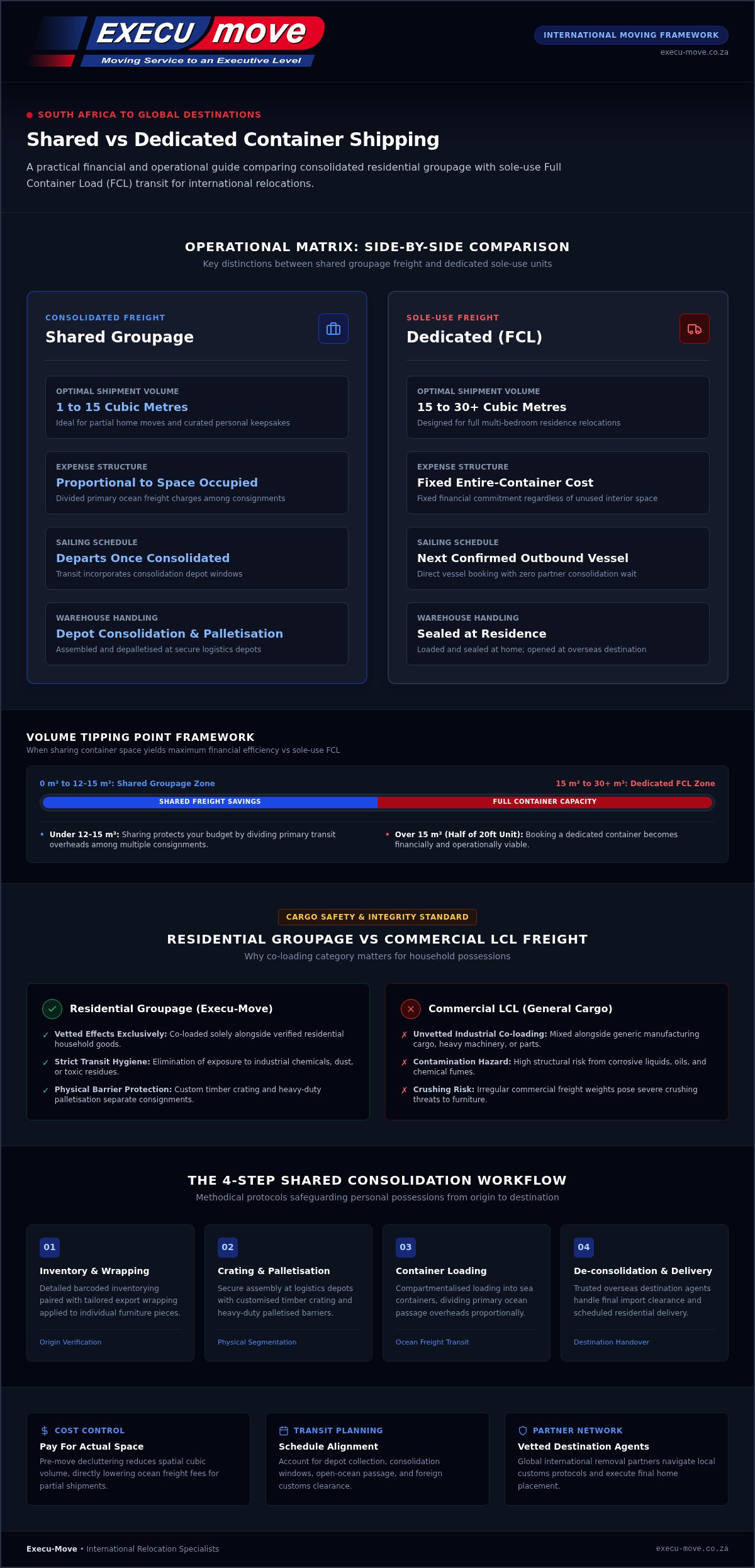
Many shippers confuse residential groupage with standard commercial Less than Container Load (LCL) freight. Standard commercial LCL co-loads private effects alongside generic industrial cargo, heavy machinery, or corrosive liquids, drastically increasing the risk of structural crushing and toxic contamination. In contrast, arranging residential groupage through an established international relocation partner guarantees that your consignment shares space exclusively with vetted household goods, upholding strict hygiene, stability, and transit protection from origin to destination.
Shared vs Dedicated Containers: Side-by-Side Comparison
Deciding between sole-use Full Container Load (FCL) freight and consolidated groupage hinges on balancing your cargo volume against schedule urgency. An exclusive container grants total control over loading and sailing schedules, but shared container shipping South Africa offers immense financial relief when you are not relocating an entire multi-bedroom residence. Understanding these structural differences prevents unnecessary expenditure on surplus container space.
| Operational Metric | Shared Groupage Container | Dedicated Container (FCL) |
|---|---|---|
| Optimal Shipment Volume | 1 to 15 cubic metres (partial home) | 15 to 30+ cubic metres (full home) |
| Sailing Schedule | Departs once consolidated | Books directly onto the next vessel |
| Warehouse Handling | Consolidated and depalletised at depots | Sealed at residence, opened at destination |
| Expense Structure | Proportional to exact space occupied | Fixed cost for the entire container |
Volume Thresholds: When Does Sharing Make Financial Sense?
Small shipments, ranging from a few heirloom pieces to a modest apartment, achieve substantial savings via consolidation. If your total volume remains below 12 to 15 cubic metres, sharing container space protects your budget by dividing standard ocean transit overheads among multiple consignments. Once personal effects exceed half of a twenty-foot unit, booking a sole-use container often becomes more viable. Review our detailed budgeting resource on international moving costs from South Africa to compare container volume tipping points.
Transit Timelines and Departure Flexibility
Dedicated containers sail on the next confirmed outbound vessel because they require no waiting period for partner cargo. Shared containers depend on route consolidation, meaning transit includes depot collection, consolidation windows, open-ocean passage, and deconsolidation before final customs processing. Importers returning home must also review established South African import requirements to prevent avoidable port health or customs holds. If you need clarity on which shipping method suits your upcoming timeline, our team at Execu-Move can assess your inventory and recommend the most practical freight mode.
Preparing Your Shipment: Volume, Packing, and Customs Protocols
Preparing personal effects for consolidated sea transit requires methodical planning. Because shared container shipping South Africa involves multi-consignment handling, meticulous packing and strict regulatory compliance protect your belongings across open ocean passages.
Accurate Cubic Volume Calculation and Decluttering
Every cubic metre counts when sharing container space. Sea freight charges directly reflect spatial volume, making pre-move decluttering essential. Discarding bulky, low-value items drastically lowers overall freight expenses. A qualified relocation consultant conducts an accurate pre-move survey, precisely cataloguing room dimensions and identifying pieces that require dismantling prior to collection.
Export Packing Standards and Timber Crating
Ocean voyages subject cargo to ambient moisture, atmospheric pressure shifts, and continual vessel motion. Standard domestic cartons cannot withstand maritime journeys. Professional crews apply multi-layered export wrapping, using high-density bubble wrap, heavy corrugated paper, and reinforced corner protectors. Fragile heirlooms, mirrors, and delicate screens receive custom-built, ISPM-15 certified heat-treated timber crates to meet strict international agricultural packaging standards.
Navigating Customs Clearance and Prohibited Items
Clear documentation prevents cargo impoundment and costly port storage penalties. Exporters must submit itemised inventories alongside mandated declarations, including the DA 304 export form and the mandatory online South African Traveller Management System declaration. Aligning your documentation with official South African customs regulations ensures seamless processing before loading. Remember that biosecurity rules strictly prohibit soil-encrusted garden tools, perishable foods, and hazardous liquids. To avoid unexpected border delays, connect with Execu-Move to review your itemised manifest and export clearance strategy.
Selecting a Professional International Removal Partner in South Africa
Choosing the right mover determines whether your consolidation experience is effortless or exasperating. When arranging shared container shipping South Africa, you need a partner with proven tenure, comprehensive maritime transit insurance, and established global alliances to safeguard your effects across thousands of nautical miles.
Key Questions to Ask Before Booking a Shared Container
Before signing any freight agreement, interrogate the provider’s operational workflow. Clarify how warehouse staff protect your inventory during intermediate staging, and ensure cargo handling includes comprehensive marine transit risk coverage.
- How are consignments segregated, inventoried, and secured within the consolidation depot?
- Does destination service cover customs clearance, residence delivery, unwrapping, and packaging debris removal?
Exploring dedicated international relocation services helps clarify what level of end-to-end accountability your shipment receives.
Coordinating Relocations with Execu-Move
Execu-Move delivers seamless nationwide coordination across South Africa, taking complete responsibility for your consignment from initial consultation to final delivery. Our experienced packing teams handle export wrapping, custom timber crating, secure storage, and mandatory customs documentation. Backed by a global network of over 2,000 vetted overseas partners, we coordinate destination clearance, transport, and careful in-home setup. Through clear communication and methodical logistics, shared container shipping South Africa becomes a structured, stress-free experience.
Take the Next Step Toward Your Overseas Move
Shared container shipping South Africa provides an efficient, economical bridge between leaving home and settling into your new destination when your cargo doesn’t warrant a full container. By accurately calculating your shipment volume and insisting on export-grade protective wrapping and certified timber crating, you protect both your relocation budget and your cherished possessions.
Partnering with a seasoned removalist transforms a complex overseas transition into a structured, predictable journey. Execu-Move offers over two decades of proven experience coordinating international departures nationally. Our end-to-end solutions encompass professional packing, secure transit storage, and customs clearance, supported by a global network of over 2,000 vetted overseas partners who manage your delivery abroad.
Begin your transition with complete peace of mind. Request your tailored international moving quote from Execu-Move today and step forward into your new chapter with confidence.
Frequently Asked Questions
How does shared container shipping differ from a dedicated container?
Dedicated containers grant you exclusive use of a steel unit that seals at your door and sails immediately. In contrast, shared container shipping South Africa consolidates multiple household consignments into a single container. You only pay for the precise cubic volume your goods occupy rather than the entire box. While groupage requires waiting for consolidation, it’s a major cost-saver for partial relocations without sacrificing transit security.
How long does shared container shipping take from South Africa?
Transit times typically range from eight to sixteen weeks depending on your overseas destination and consolidation schedule. Because the container must be safely filled with compatible household effects before dispatch, origin staging takes longer than dedicated freight. Once at sea, ocean passage mirrors regular maritime schedules. Destination deconsolidation, customs inspections, and final home delivery add another two to three weeks to the timeline.
Are my household goods safe when sharing a shipping container with others?
Yes, personal effects remain completely secure when managed by a professional relocation specialist. Qualified crews pack all items using export-grade wrap, seal smaller cartons onto sturdy pallets, and crate fragile heirlooms in ISPM-15 certified timber. Consignments are strictly barcoded and compartmentalised inside the container. This deliberate physical separation prevents mixing, shifting, and transit damage throughout open maritime passages.
How are shared container shipping costs calculated for international moves?
Costs for shared container shipping South Africa are calculated primarily on total volume in cubic metres, alongside the final destination country. Professional surveyors calculate exact space requirements during a pre-move assessment. Additional considerations include custom timber crating for fragile items, required collection logistics, and destination delivery access. You avoid paying for empty container space, ensuring your overall investment matches only the physical cargo transported.
Can I include vehicles or pets in a shared container shipment from South Africa?
No, pets and vehicles can’t travel inside a shared household container due to safety, biosecurity, and international maritime regulations. However, Execu-Move coordinates specialised pet transport using climate-controlled air transit, as well as dedicated vehicle transport solutions. These specialized services run alongside your furniture relocation, ensuring your family pets and motor vehicles arrive at your foreign destination safely through legitimate, regulated transit channels.