
Are you bringing your household belongings into South Africa after living abroad? The customs process depends on your circumstances and the goods you’re importing. Understanding what you need to know about customs duties and taxes starts with checking the rules that apply to your shipment before it is arranged.
Some returning South African residents may qualify for relief on used household effects, subject to specific conditions and documentation. Eligibility isn’t automatic, and the rules for household goods differ from those for items such as vehicles, alcohol and tobacco.
This guide explains the difference between customs duties, taxes and clearance charges, what may affect an assessment, and how to prepare for clearance into South Africa. It also outlines questions to ask about paperwork and responsibilities so you can plan your move with clearer expectations.
Key Takeaways
- Understand the difference between government duties and taxes and service charges for moving or clearance.
- Check how destination rules, item descriptions, ownership history and declared values may affect the customs assessment.
- Prepare a clear inventory and confirm which supporting documents and declarations the destination country requires before shipping.
- Ask your mover who coordinates clearance and paperwork, while remembering that customs authorities make the final decisions on charges and release.
What customs duties and taxes mean for an international household move
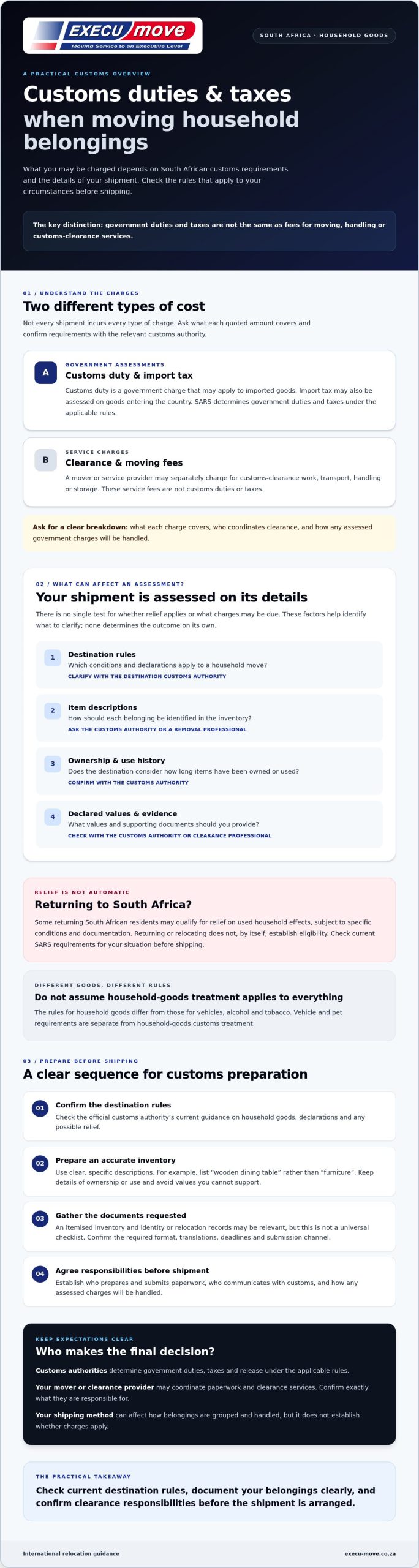
Bringing household belongings into South Africa can involve government assessments as well as charges for moving and clearance services. Whether you owe anything depends on South African customs requirements and the details of your shipment. To understand what you need to know about customs duties and taxes, first separate charges set by the authorities from fees for services arranged as part of your move.
Customs duty is a government charge that may apply to imported goods. Import tax is a tax that may be assessed on goods entering the country. Clearance charges are service fees for work involved in preparing or processing a shipment for release. For current South African requirements, consult the South African Revenue Service (SARS) customs and excise guidance.
Customs duties, taxes, and clearance fees: what is the difference?
Not every shipment incurs every type of charge. SARS determines government duties and taxes under the applicable rules. A mover or service provider may separately charge for customs-clearance work, transport, handling or storage. These service fees are not customs duties or taxes. Ask what each quoted charge covers, and confirm destination-specific requirements with the relevant official customs authority.
Why household goods are assessed differently from shipment to shipment
An assessment may depend on the goods, their descriptions, the purpose of import and the owner’s circumstances. Used belongings do not automatically qualify for duty or tax relief. If you are a returning South African resident, check current SARS requirements for your specific situation before shipping. Rules and documentation may differ for other importers and types of goods.
The shipping method can affect how belongings are grouped and handled, but it does not establish whether charges apply. If you’re considering a shared shipment, consult the shared container shipping guide and clarify how the arrangement affects your shipment information and clearance coordination.
What determines customs duties and taxes on household goods?
There is no single test for deciding whether household goods qualify for relief or what charges may apply. Check the destination’s current rules against your individual circumstances. The factors below can help you identify what to ask, but none determines the outcome on its own.
| Factor | What to clarify | Who to ask |
|---|---|---|
| Destination rules | Which declarations and conditions apply to a household move? | Destination customs authority |
| Item descriptions | How should each item be identified in the inventory? | Customs authority or removal professional |
| Ownership and use history | Does the destination consider how long items have been owned or used? | Customs authority |
| Declared values and evidence | What values and supporting documents should be provided? | Customs authority or clearance professional |
Can returning residents or people relocating qualify for relief?
Some destinations provide relief in particular circumstances, but eligibility, conditions and evidence requirements vary. Returning to a country or moving there permanently does not, by itself, establish that relief applies. For an example of how one country sets its own guidance, consult the US Customs and Border Protection Customs Duty Information. This guidance applies to the US, not South Africa or other countries. Confirm your position with the relevant authority before shipping.
How item descriptions and declared values affect assessment
Prepare a clear, accurate inventory. Use specific descriptions, such as “wooden dining table” rather than “furniture”, and avoid values you cannot support. Customs may ask for evidence, but acceptable evidence and valuation rules depend on the destination. Vehicle and pet requirements are separate from household-goods customs treatment. Discuss inventory and clearance responsibilities early with a mover experienced in international relocation.
How to prepare documents and check potential customs charges
Good preparation starts before you book the shipment. Use this sequence to clarify what you need to know about customs duties and taxes for your destination:
- Confirm the destination rules. Check the official customs authority’s current guidance on household goods, declarations and possible relief. For a move to the UK, consult the government’s guide to Moving personal belongings to the UK.
- Prepare an inventory. List belongings clearly and consistently. Keep a copy of item descriptions, any requested values and details about ownership or use.
- Gather the documents the destination requests. An inventory and identity or relocation documents may be relevant, but requirements vary. Confirm what applies to your circumstances.
- Agree responsibilities before shipping. Establish who prepares and submits paperwork, who communicates with customs, and how any assessed charges will be handled.
Which paperwork might customs request?
Possible document examples include an itemised inventory and identity or relocation records. These are not a universal checklist. Confirm the required format, whether translations are needed, any deadlines and the submission channel with the destination authority and your clearance provider. Check that details match across forms and shipment records so you can respond clearly if questions arise.
Questions to ask before confirming a moving or clearance service
Ask who completes and submits each document, who handles communication with customs, and who is responsible for paying charges assessed by the authorities. Request a clear breakdown of what the moving quote includes and which transport, handling, storage or clearance services may be billed separately. Include possible customs-related costs in your overall move plan rather than assuming they are part of the removal charge.
Discuss documentation and clearance responsibilities while planning your international relocation. Execu-Move coordinates international furniture removals and customs clearance, helping you clarify the process before shipping.
Choosing customs clearance support for an international move
Customs clearance is one part of a coordinated international household move. A mover can help organise shipment information, documentation and communication with relevant destination agents, but customs authorities determine which charges apply and make decisions about clearance. Keep that distinction in mind when considering what you need to know about customs duties and taxes.
What a customs clearance partner can coordinate
Before choosing a provider, ask practical questions about how the process will be managed:
- What experience do you have coordinating household shipments to my destination?
- How do you work with destination agents, and who will update me about paperwork or queries?
- Who prepares and submits documents, and what information must I provide?
- Which services are included in the quote, and what may be charged separately?
Clear answers establish who is responsible for each step and help you prepare for requests. They also avoid the assumption that a mover controls customs assessments, exemptions or processing times.
Plan your next steps before the shipment leaves
Before confirming arrangements, check the destination’s current rules, describe your shipment accurately, confirm whether your circumstances may affect eligibility, and agree who handles documents and any assessed charges. Requirements can change, so verify country-specific guidance with the relevant customs authority before shipping.
Execu-Move provides international furniture removals and customs clearance, coordinating moves through a worldwide agent network. Discussing your shipment and clearance responsibilities early can help you plan with greater clarity, without assuming a particular customs outcome.
If you’re ready to review your move details or request a quote, contact Execu-Move about your move.
Plan your move with customs in mind
Customs charges aren’t the same for every shipment. The destination’s rules, your circumstances and the details of your goods can all affect what is assessed. The key points in what you need to know about customs duties and taxes are to distinguish government charges from moving and clearance service fees, check current requirements with the relevant customs authority, and prepare accurate shipment information before your goods leave.
Start early by confirming which documents are required, keeping descriptions and records consistent, and agreeing who will prepare paperwork, communicate with destination agents and explain any separate service charges. A mover can coordinate the process, but customs authorities make decisions about charges and clearance.
Execu-Move offers international furniture removals and customs clearance, coordinating moves through a worldwide network of more than 2,000 agents. For support discussing your shipment and its clearance arrangements, discuss your international move with Execu-Move. Gather your shipment details and contact Execu-Move to discuss your move and request a quote.
Frequently Asked Questions
Are customs duties and taxes charged on household goods when moving abroad?
They may be, but charges depend on the destination country’s rules and your circumstances. Some countries offer relief for qualifying household goods, but used belongings are not automatically exempt. Customs duty and import tax are government assessments, while clearance or handling fees are service charges. Check the destination customs authority’s current guidance to understand what may apply to your shipment.
Can I avoid customs duties when moving my personal belongings?
You may qualify for relief in some destinations, but there is no universal exemption for personal belongings. Eligibility can depend on factors such as your reason for moving, the goods’ ownership or use history, and whether you complete the required declarations. Confirm the current rules and application process with the destination customs authority before shipping. Don’t assume relief applies until your circumstances have been checked.
How are customs duties and taxes calculated on a household shipment?
There is no single calculation method that applies in every country. The destination authority may consider its import rules, the type and description of each item, declared values, ownership or use history, and the reason for import. Relevant factors and valuation rules differ by destination. For what you need to know about customs duties and taxes, consult official guidance rather than relying on a general estimate.
What documents might customs require for an international household move?
Requirements vary, but possible examples include a detailed inventory, identity documents and records supporting your relocation circumstances or item ownership. These are examples to verify, not a standard mandatory list. Ask the destination customs authority or your clearance provider which documents are needed, in what format and by what deadline. Keep information consistent across forms and shipment records so you can respond clearly to queries.
Does a removal company pay customs duties and taxes on my behalf?
Not automatically. A removal company may coordinate customs clearance and explain the paperwork process, but the customs authority determines applicable charges and clearance decisions. Before booking, confirm who prepares and submits documents, who communicates with customs, who is responsible for paying assessed duties or taxes, and which clearance services are included in the quote. Agreeing these responsibilities in advance helps avoid confusion during the move.