You have spent months meticulously packing your household and planning every detail of your move, but could a single digital form bring your progress to a standstill at the port of entry? Since 1 July 2026, the mandatory SARS Traveller Declaration has become a non-negotiable requirement for every person entering or leaving South Africa. It is a significant shift from the old paper-based methods; it is also perfectly natural to feel a sense of unease about navigating new digital systems while managing the physical demands of a relocation.
We understand that the last thing you need during a life-changing transition is the stress of potential fines or customs delays. This guide is designed to provide the clarity you need to master the South African Traveller Management System (SATMS) and ensure your crossing is seamless and compliant. We will explore the 24-hour submission window, explain the current duty-free thresholds, and clarify how your personal effects are treated under these updated regulations. By the end of this article, you will have a clear roadmap for a successful, delay-free arrival.
Key Takeaways
- Understand the transition to the South African Traveller Management System (SATMS) and why the digital SARS Traveller Declaration is now a mandatory requirement for all international moves.
- Learn the importance of the 24-hour submission window to ensure your entry or exit remains compliant and free from unnecessary customs delays.
- Identify the specific differences between declaring personal effects in your accompanied luggage and the formal customs clearance process for your household furniture.
- Gain clarity on the digital QR code system and how to present your successful submission at air, land, or sea ports of entry.
- Discover how professional logistical support can simplify the broader regulatory requirements of your international relocation beyond the individual traveller form.
Understanding the Mandatory SARS Online Traveller Declaration in 2026
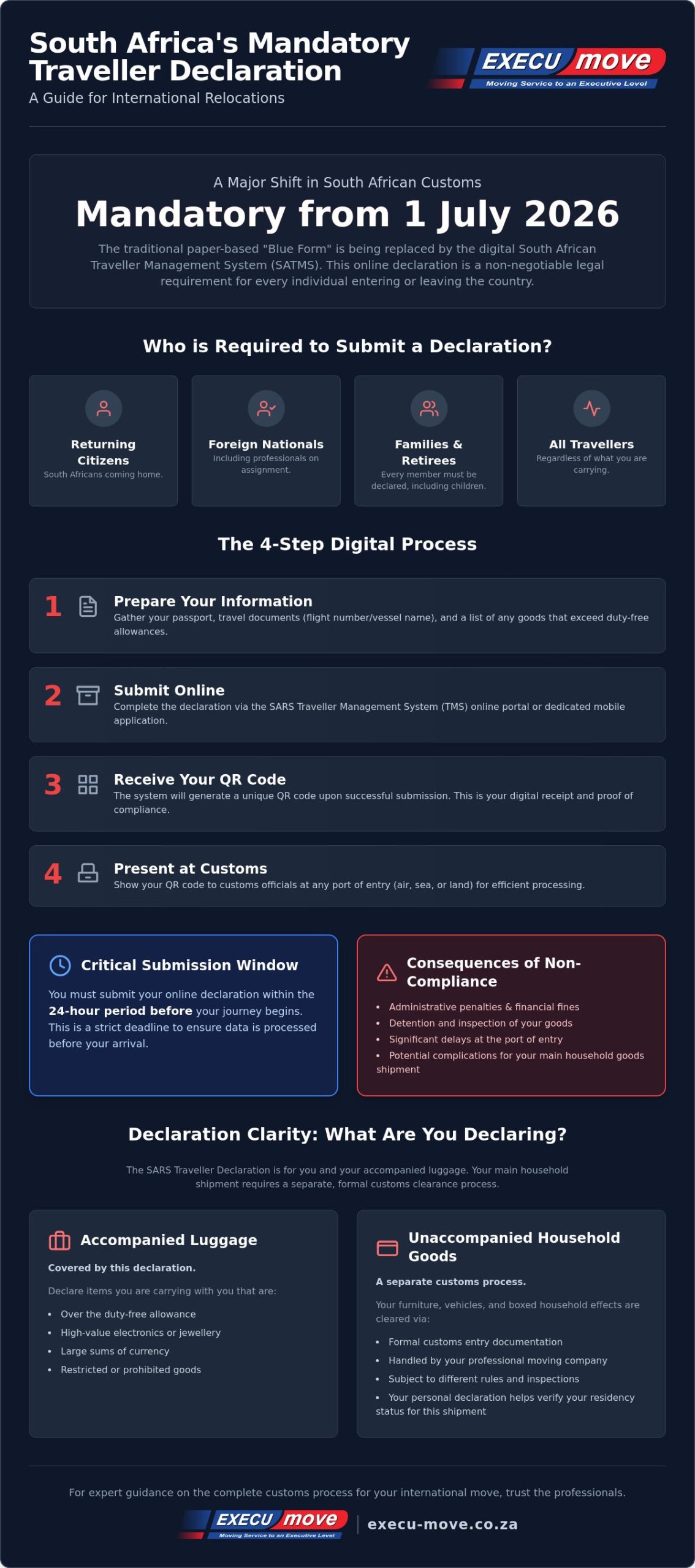
Relocating across international borders involves a mountain of logistics, from coordinating shipping containers to managing visa applications. To modernise this process and enhance border security, the South African Revenue Service (SARS) officially launched the Traveller Management System (TMS) as a mandatory requirement on 1 July 2026. This digital-first initiative effectively replaces the traditional paper-based “Blue Form” that many residents might remember from previous journeys. It is a legal obligation designed to streamline your entry or exit, ensuring that all data is captured accurately before you even reach the customs desk.
The shift to a digital SARS Traveller Declaration isn’t just about modernising paperwork; it’s part of a “whole-of-government” approach. By integrating data between different agencies, the system allows for faster risk assessment and more efficient processing of legitimate travellers. For those moving their lives to or from South Africa, this means less time spent in queues and a more transparent record of the goods you’re carrying. While the transition may feel like another task on an already long to-do list, it’s a vital step in protecting the integrity of the Republic’s borders while facilitating smoother trade and travel.
Who Exactly Needs to Comply?
Are you a returning South African citizen, a foreign national taking up a new corporate post, or a retiree seeking a change of scenery? If so, you’re required to comply. The SARS Traveller Declaration applies to every individual entering or leaving South Africa by air, sea, land, or rail. Families travelling together must ensure that every member, including children, is accounted for in the submission. Even if you’re only carrying your personal clothing and basic electronics, the law requires you to declare your status and any restricted or dutiable items through the online portal or mobile app.
The Consequences of Non-Compliance
Ignoring this digital requirement or providing inaccurate information can lead to immediate complications at the port of entry. You don’t want your first day in a new country spent in a customs interrogation room. Failure to submit the declaration within the 24-hour window before your journey can result in administrative penalties, financial fines, or the detention of your goods. Perhaps most importantly for those relocating, an incomplete declaration can cast doubt on the status of your unaccompanied household goods. Customs officials often use your personal declaration to verify your residency status, making accuracy essential for the seamless delivery of your furniture and valuables later on.
How the SARS Traveller Management System (TMS) Works
The SARS Traveller Management System (TMS) functions as a sophisticated digital bridge between your departure and your arrival in South Africa. Accessible through both desktop browsers and a dedicated mobile application, the interface is designed to be intuitive while maintaining the high security standards expected of a national revenue authority. Once you complete your SARS Traveller Declaration, the system generates a unique QR code. This code is your digital receipt; you’ll need to present it to customs officials at the port of entry, who can then instantly access your declaration data to facilitate a swifter transit through the terminal.
This digital approach allows SARS to process information in real-time, matching your declaration against your specific travel itinerary. By providing this data in advance, you’re helping to reduce physical bottlenecks at the border. If your move involves complex logistics like shipping a vehicle or relocating pets, having your personal declaration finalised early ensures that your arrival doesn’t become a point of friction. For those managing a large-scale international move, our customs clearance services can provide additional peace of mind by handling the intricate paperwork of your unaccompanied household effects while you focus on your personal declaration.
Information You Must Have Ready
Accuracy is paramount when interacting with the TMS. Before you begin the online process, ensure you have your passport and any relevant travel documents within reach. You’ll also need your specific flight number or vessel name, along with the scheduled date and port of arrival. Crucially, you must be prepared to list any items that exceed the standard duty-free allowances, such as high-value electronics, jewellery, or large sums of currency. Consulting the SARS Traveller Declaration FAQs can help you identify exactly which personal items might require specific mention to stay compliant.
When to Submit Your Declaration
Timing is everything when it comes to regulatory compliance. You should aim to submit your declaration through the portal once your travel plans are finalised but before you head to the airport or harbour. The TMS submission window is a critical 24-hour pre-travel task that must be completed to avoid delays. If your itinerary changes at the last minute, the system allows for updates, but it’s best to have the initial submission done well in advance of your boarding time to ensure a stress-free transition.
Declaring Personal Effects vs. Commercial Goods During a Move
When you are moving your entire life across borders, the line between personal belongings and declarable goods can often feel blurred. It is vital to understand that the SARS Traveller Declaration focuses on your accompanied baggage, which includes the items you bring with you on your flight or through the border post. Your household furniture and larger appliances, typically sent as unaccompanied effects in a shipping container, are processed under a separate customs clearance framework. However, these two processes are linked; a consistent declaration of your intent to relocate helps establish your eligibility for the “Used Personal Effects” rebate. This allows you to bring in household goods duty-free provided you have owned and used them for at least six months before your move.
You must be specific about high-value items in your possession, such as luxury jewellery, high-end watches, or professional-grade electronics. South African customs regulations allow for a duty-free allowance of R5,000 per person, which cannot be pooled between family members. If the value of your new or high-value goods exceeds R25,000, you will be subject to full customs duty and 15% VAT. Additionally, you are legally required to declare any currency or bearer negotiable instruments if the total value equals or exceeds R100,000. Managing these thresholds correctly is a core part of a stress-free arrival, ensuring you don’t face unexpected financial assessments at the terminal.
Managing Restricted and Prohibited Items
The 2026 regulations maintain strict controls on specific categories of goods to protect South Africa’s borders. If you are carrying chronic medications, ensure you have a valid doctor’s prescription available for inspection. Certain food items, plants, and biological materials are heavily restricted to prevent the spread of pests and diseases. For families moving with four-legged members, it’s important to remember that the traveller declaration intersects with strict veterinary protocols. We recommend consulting our specialised guide on pet transport South Africa to understand the permits and health certificates required alongside your personal customs submission.
Declaring Foreign Registered Vehicles
As of 1 June 2026, all foreign-registered vehicles must be declared through the SARS Traveller Management System before they enter or leave the Republic. This digital requirement applies whether you are importing a car permanently or bringing it in temporarily under a carnet de passages. The online declaration facilitates a more transparent tracking of vehicle movements, but the physical logistics of moving a car remain complex. For a deeper look at the technical requirements and safety standards involved, our guide on vehicle transport South Africa provides the detailed logistical support you need for a successful import.
Step-by-Step Guide to Completing Your Declaration
Completing your digital submission is a straightforward process when you approach it with the right preparation. You can access the official South African Traveller Management System (SATMS) through the SARS website or by downloading the mobile application. Once you’ve logged in, you’ll begin by entering your personal details and travel itinerary. It is essential to ensure that every field matches your travel documents precisely. The system will then prompt you to complete the “Items to Declare” section. Here, you should list any goods that exceed the duty-free allowance or fall under restricted categories, while omitting standard personal effects like used clothing or basic toiletries that are clearly for personal use.
After you have entered all necessary information, the system provides a summary for your final review. Take a moment to double check the accuracy of your flight or vessel details. Once you hit submit, you will receive your digital traveller pass via email or within the app. This pass contains the unique QR code that serves as your official record. We recommend that you save a PDF copy of your QR code to your mobile device for offline access, ensuring you can present it even if you encounter connectivity issues upon arrival. If the complexity of these regulations feels overwhelming, contact Execu-Move today to discuss how our expert team can manage the broader customs requirements for your move.
Avoiding Common Mistakes and Delays
The most frequent cause of friction at the border is a mismatch between your digital declaration and your physical documents. Ensure your passport number is entered exactly as it appears on the page, including any letters. If you truly have nothing to declare, the system still requires you to complete a “nil” declaration to remain compliant. This confirms to customs officials that you have actively assessed your belongings against the current thresholds. Rushing through these steps often leads to errors that can trigger manual audits, so give yourself the full 24-hour window to complete the task calmly.
What Happens at the Port of Entry?
When you reach the customs checkpoint, you will present your QR code to the Customs Officer. In many cases, this digital clearance allows for a rapid transit through the terminal. However, it’s important to remember that a successful digital submission does not exempt you from the possibility of a random physical inspection. SARS officials maintain the right to verify that your physical luggage matches your digital pass. In the rare event of a total system outage or if you lack internet access, paper-based exceptions still apply. Customs officials at self-service terminals or service desks will assist you in completing a manual declaration so that your entry is not delayed purely due to technical failures.
Beyond the Declaration: Professional Customs Clearance
While the digital pass in your hand signals a successful personal arrival, it represents only the first chapter of your physical relocation. It is vital to distinguish between your accompanied baggage, which you manage via the SARS Traveller Declaration, and your unaccompanied household effects. Your furniture, appliances, and large-scale personal items are processed through a formal cargo clearance system that requires meticulous documentation and coordination with port authorities. This is where the expertise of a seasoned logistics partner becomes indispensable, ensuring that your household goods are cleared under the correct rebates and arrive at your new home without unnecessary delays.
Professional movers don’t just transport boxes; they act as your primary liaison with the South African Revenue Service for your shipment. We ensure that your inventory lists, valuation certificates, and residency proofs are perfectly aligned with the data you’ve provided in your personal traveller pass. This synergy is essential for a smooth transition, especially when navigating the financial complexities of a move. To better plan your relocation, we recommend reviewing our guide on international moving costs South Africa, which provides a detailed breakdown of the 2026 budgeting requirements.
How Execu-Move Simplifies Your Relocation
We provide a steady hand during what is often a chaotic life transition. Our team manages the intricate customs documentation required for household removals, taking the weight of regulatory compliance off your shoulders. We understand the nuances of the 2026 regulatory changes and work proactively to prevent the common pitfalls that lead to goods being detained. From the initial packing and wrapping of your delicate items to the final delivery at your new residence, we prioritise your peace of mind and the safety of your belongings. Our global network of over 2,000 agents ensures that the same high standard of care is maintained on both sides of the ocean.
Your Next Steps for a Stress-Free Move
How can you prepare for a successful arrival starting today? Begin by preparing a comprehensive inventory list early in your relocation process; this will serve as the foundation for both your personal declaration and your formal customs clearance. It is also wise to consult with a relocation specialist regarding specific item restrictions that might apply to your unique situation. While the new digital requirements may seem daunting at first, they are ultimately designed to create a more efficient and transparent border experience. With the right preparation and a trusted partner by your side, your move to or from South Africa can be a remarkably smooth and rewarding journey.
Securing Your Seamless Transition to South Africa
Are you ready to turn your international relocation from a complex challenge into a managed success? Navigating the mandatory SARS Traveller Declaration is your first step toward a compliant entry. By completing your digital pass within the 24-hour window and understanding the duty-free thresholds for your belongings, you’ve already mitigated the primary risks of arrival delays. Remember that while you handle your personal declaration, the broader logistics of moving your household effects require a different level of technical expertise.
Our team of customs clearance experts is here to provide the steady hand you need throughout this transition. We offer secure storage and professional packing services to ensure your valuables are protected every step of the way. With experienced staff dedicated to international removals, we coordinate directly with port authorities so that your furniture shipment follows seamlessly behind your own arrival. Request a free quote for your international move with Execu-Move and let us simplify the journey for you. Your new life abroad is waiting; we’re here to make sure you get there with total peace of mind.
Frequently Asked Questions
Is the SARS Traveller Declaration mandatory for all travellers in 2026?
Yes, completing the SARS Traveller Declaration is a legal requirement for every individual entering or leaving South Africa as of 1 July 2026. This applies to South African citizens, permanent residents, and foreign nationals alike. The system is part of a broader initiative to digitise border security and streamline the customs process. By submitting your data electronically before you arrive, you help ensure a more efficient experience at the port of entry for everyone involved.
Can I still use the paper-based Blue Form at the airport?
No, the digital system has officially replaced the old paper-based Blue Form for the vast majority of travellers. SARS has moved to a digital-first approach to improve data integration and risk management across all borders. While paper forms may still be available in rare cases of total system failure or for individuals with absolutely no digital access, you should plan to complete your declaration online within 24 hours of your journey to avoid unnecessary delays.
What happens if I forget to complete my declaration before I land?
You won’t be denied entry solely for forgetting the online form, but you will likely face significant delays at the terminal. SARS officials are available at ports of entry to assist travellers who haven’t completed their declaration in advance. You’ll be directed to a self-service terminal to submit your data on-site before you can clear customs. To ensure a stress-free relocation, it’s always best to have your QR code ready before you board your flight or vessel.
Do I need to declare my used clothes and personal furniture?
You don’t need to declare ordinary used personal effects like clothing and toiletries intended for your own use. However, your household furniture is treated differently as it’s usually shipped as unaccompanied cargo rather than carried in your luggage. While these items don’t go on your traveller declaration, they must be processed through a formal customs clearance channel. We recommend keeping a clear distinction between what’s in your suitcase and what’s in your shipping container to ensure full compliance.
How much currency am I allowed to bring into South Africa in 2026?
You must declare any currency or bearer negotiable instruments if the total value is R100,000 or more. This includes the equivalent value in foreign currencies. This regulation is enforced by the South African Reserve Bank to monitor cross-border capital movements. Failing to declare amounts above this threshold on your SARS Traveller Declaration can lead to the forfeiture of the funds and additional financial penalties, so accuracy is essential for a smooth arrival.
What should I do if the online system is down when I try to submit?
If you encounter a technical failure with the online portal or mobile app, don’t panic. SARS has established protocols for system outages to ensure travel isn’t halted. You’ll be assisted by customs officials at the port of entry, who can help you complete your declaration at a dedicated terminal. In some cases, paper declarations are still used as a backup. The priority is to maintain border flow while ensuring all necessary data is eventually captured securely.
Does every member of my family need a separate declaration?
Yes, every individual travelling, including children and infants, must be accounted for in a declaration. Families can often submit their details together through the digital system, but the data remains unique to each person. This ensures that duty-free allowances, which are R5,000 per person and cannot be pooled between family members, are calculated correctly. Having a separate QR code or a combined family pass ready will make your transit through customs much quicker and more organised.
How does this declaration affect my unaccompanied shipping container?
Your personal traveller declaration is a separate process from the clearance of your shipping container, but they are logically linked. The data you provide when you enter the country helps establish your residency status, which is vital for claiming duty-free rebates on your household goods. While you manage your own declaration, a professional partner handles the complex customs clearance for your container. This dual approach ensures your entire relocation remains compliant with South African law from start to finish.