
Could an everyday item such as a battery, aerosol or bottle of perfume hold up your move? Knowing what movers will not pack before packing day helps you identify belongings that need a separate plan and avoid last-minute confusion.
It’s reasonable to expect household goods to be packed together, but acceptance can depend on the move, transport arrangements and destination. A domestic move within South Africa may have different requirements from an international shipment. That’s why a general list cannot tell you whether every item is suitable for your particular consignment.
This guide explains which items commonly need extra attention, why requirements vary and how to organise belongings that will travel separately. It also shows how to keep valuables, important documents and immediate essentials accessible, rather than discovering they are sealed inside a packed box. A clear inventory and set-aside area make it easier to plan your household shipment with confidence.
Key Takeaways
- What movers will not pack depends on the shipment and its transport arrangements, so treat general lists as a guide rather than a final decision.
- Sort belongings into shipment candidates, items to keep with you and items that need a separate arrangement.
- Record uncertain items, including their product names and quantities, so they can be discussed as part of your moving inventory.
- Plan pet and vehicle transport separately from household goods packing to keep each part of your move organised.
What movers will not pack: common items to separate before moving day
Restrictions depend on the move, transport method and destination. Use this checklist to identify belongings that need attention, not as a definitive list of prohibited items. Whether a particular item can be packed depends on the requirements for your shipment.
Moving companies can provide different services and follow different handling practices. A general overview of moving company services offers background, but it cannot determine what a specific shipment can carry. For a move within South Africa, domestic furniture removals still need to be planned around the requirements of the consignment.
Potentially hazardous household goods
Set aside products with warning labels or unclear contents instead of placing them with ordinary household goods. Keep each container identifiable and note the product name and quantity. This makes it easier to discuss the item accurately when your packing plan is prepared.
Perishables, plants and everyday essentials
Fresh, frozen or refrigerated food may spoil during a longer journey. Plants can also need separate planning, particularly for an international move. Don’t assume these items can travel in your household shipment. Their acceptance may depend on the route and destination requirements. Use, give away or arrange separately any food or living items that may not suit the journey.
Set aside belongings you need promptly or prefer to manage yourself, including:
- Medicines and personal care essentials
- Passports, identity papers and other important documents
- Cash, jewellery and items of sentimental value
- Clothing, chargers and day-one household essentials
Mark this group clearly and keep it accessible. Before packing starts, check that these items are outside the area for goods being packed. That simple step helps prevent essential belongings from being sealed into a box or mixed with items needing a separate arrangement.
Why packing restrictions change between domestic and international moves
The answer to what movers will not pack can change with the journey. A household move within South Africa and an overseas shipment may involve different transport arrangements, carrier requirements and destination considerations. There is no single banned-items list that applies to every consignment.
Domestic removals and international shipments are not interchangeable
For a domestic removal, packing decisions are shaped by the move plan and the requirements for that shipment. A domestic furniture removal does not automatically involve the same handling steps as an international consignment. Use the table as a planning guide, not as a guarantee that a particular item will be accepted or excluded.
| Move type | What to consider |
|---|---|
| Domestic move | Road transport and the requirements for the specific shipment may affect acceptance. |
| International shipment | Sea or air transport, routing and destination requirements may affect acceptance. |
| Customs clearance | Customs is separate from packing acceptance. The relevant process depends on the destination and shipment. |
Destination and transport mode can affect acceptance
Road, sea and air journeys involve different handling arrangements. An item considered for one transport mode cannot automatically be assumed suitable for another. International Air Transport Association guidance is relevant to air cargo, while the International Maritime Organization addresses maritime transport. Their standards and carrier requirements should be considered in the context of the actual shipment, rather than treated as one shared checklist.
For an overseas move, international relocation planning helps coordinate household packing, transport arrangements and customs clearance considerations for the destination.
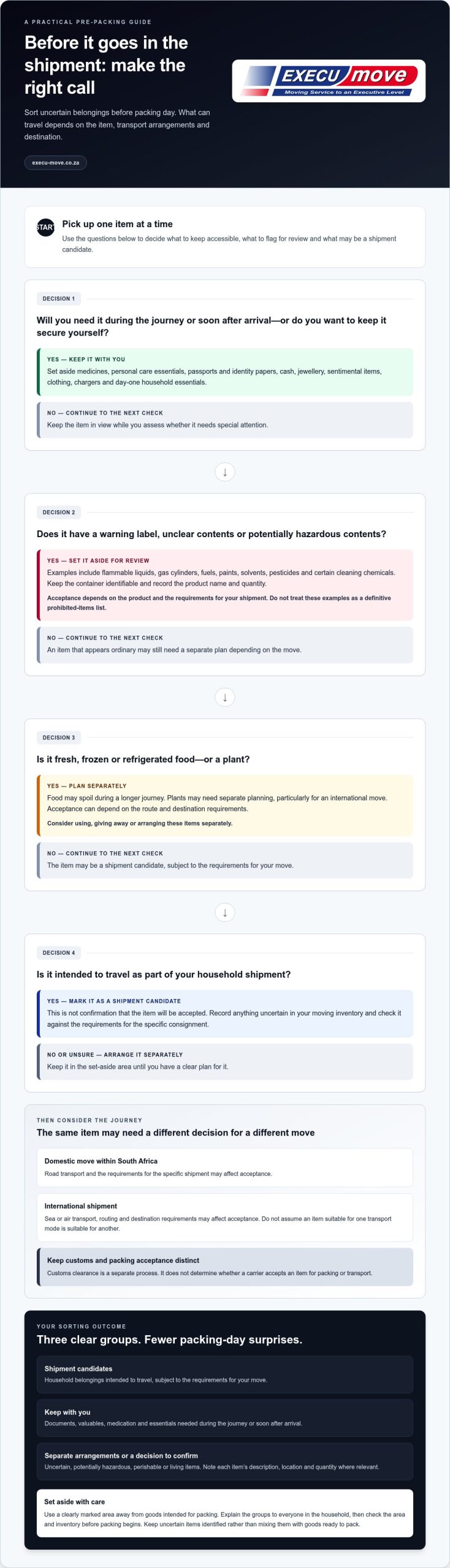
A pre-packing checklist for sorting items movers may not pack
A three-way sort turns uncertainty into a plan. Don’t wait until packing day to flag unclear belongings. For each item, record a short description, where it is and what you need to clarify. Add those notes to your moving inventory so the packing plan can be discussed in context.
- Shipment candidates: Household belongings intended to travel, subject to the requirements for your move.
- Keep with you: Personal documents, valuables, medication and essentials you’ll need during the journey or soon after arrival.
- Separate arrangements: Items that may not travel with the shipment or whose acceptance needs to be resolved.
How to prepare a clear set-aside area
Choose a defined space away from the goods intended for packing. Mark it clearly and explain to everyone in the household what belongs there. Include items you will manage personally as well as belongings awaiting a decision. Before packing begins, review the area and your notes to make sure nothing has been moved back into the shipment by mistake. Clear instructions help the packing team distinguish between the groups.
As you prepare household goods for packing, keep the plan aligned with the decisions recorded in your inventory. If an item is still uncertain, leave it clearly identified rather than mixing it in with goods ready to be packed.
What to do with belongings that are not travelling
Execu-Move provides household moving and storage solutions to help organise the belongings that form part of your relocation plan.
How to coordinate excluded items with your moving plan
Once you have identified items that may not travel, connect each one to a practical next step. An itemised inventory helps distinguish household goods intended for the shipment from belongings that need a different arrangement. For each item, include a clear description, its intended plan and any question that still needs an answer.
Prepare questions around your shipment, not a universal list
Use your inventory to discuss uncertain items in the context of your move. Note the guidance for each item and update your plan accordingly. Requirements can differ by transport mode, carrier and destination, so a general checklist cannot settle every case. For an international move, include current destination requirements in your preparation.
Customs clearance is separate from packing and carrier acceptance. Coordinating these considerations early helps keep the packing plan aligned with the shipment. Execu-Move provides relocation coordination, packing and wrapping guidance for fragile items, and customs clearance support to help organise household goods around the requirements of your move.
Keep belongings outside the shipment organised
Keep a written record of what you will carry with you, what is included in the household shipment, what is placed in storage and what will be disposed of or arranged separately. Update the record as decisions are made. Keep documents and other important personal items accessible. Belongings that are not travelling yet may be suitable for secure storage, although storage is not the right solution for every excluded item.
Keep specialist arrangements separate from household packing. Pets and vehicles have distinct transport needs, so plan them as separate parts of the relocation rather than listing them as ordinary packed household goods.
With an itemised plan in hand, you can discuss what movers will not pack in the context of your move. Request a moving quote or discuss your relocation with Execu-Move.
Turn your checklist into a confident moving plan
Knowing what movers will not pack is useful when it leads to a clear plan for your shipment. Before packing begins, turn uncertain items into specific questions and update your inventory as decisions are made. This gives you a practical basis for planning rather than relying on assumptions or a generic list.
Execu-Move coordinates domestic and international furniture removals, full packing and wrapping, and overseas relocations through a network of over 2,000 agents worldwide. This support helps bring the household packing plan into line with the arrangements for your move.
When you’re ready, request a moving quote or discuss your relocation with Execu-Move. A clear plan can make the arrangements ahead easier to manage.
Frequently Asked Questions
What items will movers usually refuse to pack?
Movers may decline goods that raise handling or transport concerns, but the decision depends on the shipment. Examples can include fuels, gas cylinders and certain household chemicals. Check product labels and note each product name and quantity so it can be discussed accurately. Don’t conceal uncertain belongings among ordinary household goods or assume a general list settles the matter.
Can movers pack cleaning products, paint, or aerosols?
Acceptance is not automatic. Cleaning products, paint and aerosols can have different contents and handling requirements, so guidance for one product does not establish that another is suitable. Keep each product identifiable and note its name and quantity. Include those details in your packing discussion before deciding whether it belongs in the household shipment.
Do international movers have different packing restrictions?
They can. Overseas shipments may involve different transport arrangements and destination requirements from a domestic move. Carrier acceptance and customs clearance are also separate considerations: acceptance for transport does not settle destination requirements. For your route, include current destination information in your planning and raise any unclear items early.
Should I pack valuables and medication for the movers?
Keep valuables and medication under your personal care rather than placing them in boxes intended for the household shipment. This gives you direct access to belongings you may need during the journey, such as daily medicines, identification or jewellery. Keep essential documents together in a secure, accessible place, and plan ahead for any medicine you may need while travelling.
What should I do with items movers will not pack?
Give each item a clear outcome: keep it with you, arrange suitable storage, dispose of it appropriately or make another separate arrangement. Add the decision to your moving notes so it is not confused with goods intended for packing. If you are unsure about an item, record its details and discuss it before packing starts. Keep unresolved belongings outside the packing area.