
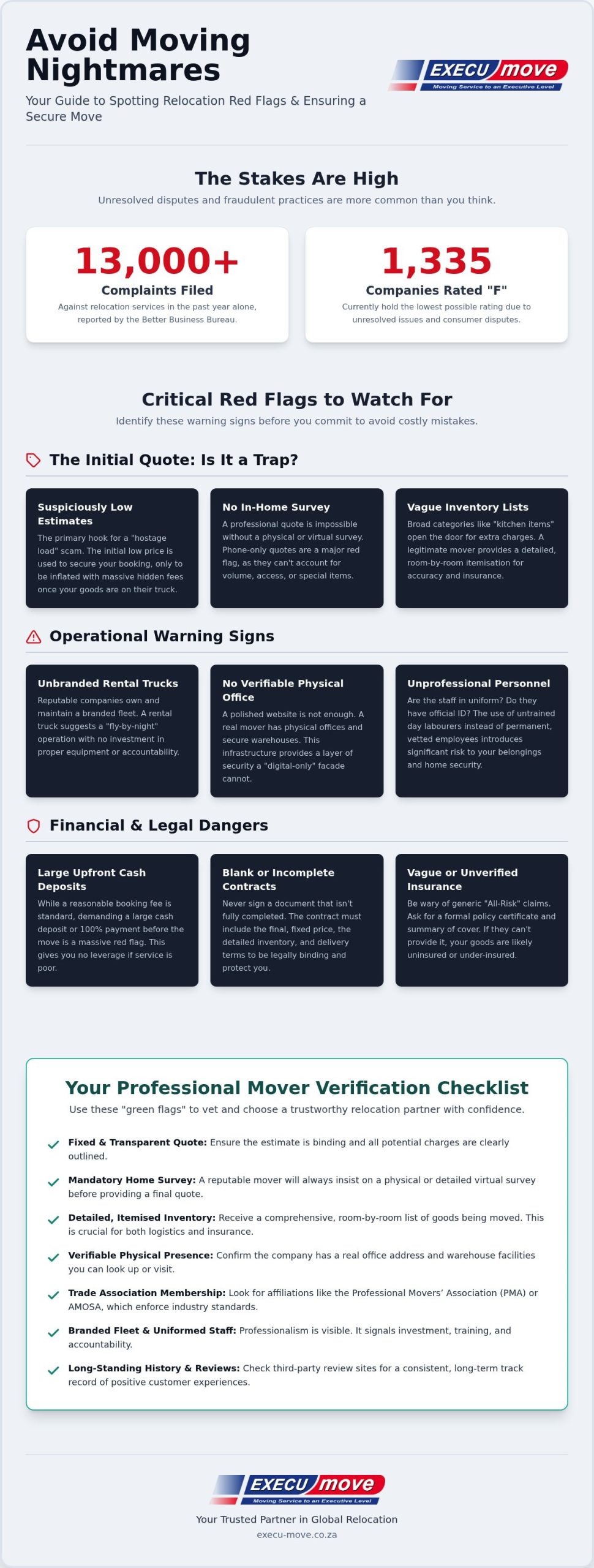
Did you know that the Better Business Bureau received over 13,000 complaints regarding relocation services this year alone? While most providers aim for excellence, a staggering 1,335 companies currently hold an “F” rating due to unresolved disputes or fraudulent practices. It’s understandable if the thought of handing over your life’s possessions to a stranger feels overwhelming, especially when you don’t know which moving company red flags to watch for. You’ve worked hard for what you own, and the last thing you need is the anxiety of hidden costs or the nightmare of “hostage” goods.
This guide is designed to replace that uncertainty with absolute confidence. We’ll show you how to identify these warning signs before you sign a contract. By the end of this article, you’ll have a clear checklist for vetting potential partners, a solid understanding of insurance validity, and the tools to distinguish a legitimate logistics expert from a rogue operator. Your peace of mind is our priority as we navigate the complexities of secure international and domestic relocation together.
Key Takeaways
- Understand why unusually low estimates are often a hook for future extortion and why a professional survey is essential for accuracy.
- Identify critical moving company red flags, such as the use of unbranded rental vehicles or the lack of a verifiable physical office.
- Protect your finances by avoiding large upfront cash deposits and ensuring all legal documentation is complete before you sign.
- Gain a step-by-step verification checklist to confirm your mover holds the necessary trade affiliations and international relocation credentials.
The Initial Quote: When ‘Cheap’ Becomes a Costly Mistake
Why does a quote that seems too good to be true often end in disaster? Identifying moving company red flags during the initial consultation can save you from significant financial loss and emotional distress. In the relocation industry, an unusually low estimate is the primary tool used in a moving scam. These rogue operators use a low price to hook unsuspecting clients, only to demand significantly more once your possessions are locked in their truck. This is frequently referred to as a “hostage load” situation. Another common tactic involves quoting based on cubic metres but then billing based on weight, creating a deliberate discrepancy to hike prices mid-move. A professional quote should be fixed and transparent, providing a clear contrast to the vague non-binding estimates that often shift on moving day.
The Red Flag of the Missing Survey
A reputable company always insists on a physical or virtual home survey. If a mover provides a quote over the phone without seeing your goods, it’s one of the major moving company red flags to avoid. Rogue movers often rush these assessments or fail to use professional volume-calculating software. A physical walkthrough allows an expert to identify access issues, such as narrow corridors or steep driveways, which directly impacts the final price. Without this level of scrutiny, your quote remains a guess rather than a guarantee.
Vague or Incomplete Inventory Lists
Poorly defined inventory sheets are a breeding ground for “miscellaneous” charges that appear unexpectedly. Legitimate movers provide a detailed, room-by-room itemisation. This level of detail is necessary for both logistical planning and insurance validity. If your inventory list is a single page with broad categories like “kitchen items” or “bedroom furniture”, your belongings are at risk. Precise documentation ensures that every item is accounted for and correctly insured throughout its journey, leaving no room for the hidden fees associated with rogue relocation services.
Operational Warning Signs: Identifying Rogue Operators
What exactly defines a rogue operator? In the South African context, these are entities that lack physical infrastructure and legal protections for the consumer. One of the most visible moving company red flags is the arrival of an unbranded rental truck on moving day. While legitimate companies maintain branded, specialised fleets designed for secure transport, rogue movers often rely on hired vehicles. This lack of ownership suggests a fly-by-night operation with no real investment in equipment or safety standards. It also makes it incredibly difficult to track your goods if the vehicle disappears.
Verification of a mover’s bricks and mortar presence is essential. Professional providers operate from dedicated facilities. Having physical offices and secure storage solutions in major hubs provides a layer of accountability that a digital storefront cannot match. Look for membership in trade organisations like the Professional Movers’ Association (PMA) or AMOSA. These affiliations act as a critical trust signal, ensuring the company adheres to strict industry standards and ethical practices. If a company cannot provide a physical address or proof of affiliation, they likely lack the assets to protect your move.
Professionalism and Personnel
Staff behaviour and appearance offer immediate clues about a company’s legitimacy. Are the relocation consultants in uniform? Do they carry official identification? Rogue operators frequently use day labourers rather than trained, permanent staff. This introduces significant risks regarding the handling of your household goods and overall site security. Choosing a partner with high domestic relocation standards ensures your move is managed by experts who are accountable to their employer.
The Digital Facade vs. Real Reviews
Don’t be fooled by a polished website. Scrutinise reviews on third-party platforms rather than just social media. Look for a consistent history over several years. Fake reviews often lack detail or appear in suspicious clusters. A long-standing history in the South African market is a strong indicator of reliability. If you are unsure about a provider’s credentials, it is always best to contact an established relocation expert for guidance.
Financial and Legal Red Flags in Removal Contracts
How do you ensure your investment is protected before the first box is packed? One of the most significant moving company red flags is a demand for a large cash deposit or 100% payment upfront. While a commitment fee is standard, legitimate movers rarely require full payment before services are rendered. Avoid signing blank or incomplete documents. A contract must include a final, fixed price and a detailed inventory to prevent the “hostage load” scenario, where scammers hold your belongings until an extra fee is paid.
Insurance coverage is another area where rogue operators often mislead clients. Be wary of “All-Risk” claims that lack backing from reputable underwriters. If a mover cannot provide a formal policy certificate or a summary of cover, your goods are likely unprotected. For those moving abroad, verifying international relocation credentials and insurance partnerships is a non-negotiable step for security.
Hidden Fees and Surcharges
Rogue movers often use “surprise” costs to inflate the final bill. These may include:
- Long-carry fees for distances between the truck and your door.
- Stair fees for multi-storey properties without lifts.
- Shuttle services if a large vehicle cannot access your street.
A professional quote pre-empts these issues through a thorough site survey, ensuring your price remains transparent and predictable.
Understanding Goods in Transit Insurance
Don’t settle for vague promises of “included” insurance. This often provides zero actual coverage in the event of a claim. You must receive a formal document detailing the scope of protection. If you are concerned about the transparency of your current quote, request a professional consultation to review your requirements with an expert relocation partner.
Vetting Your Relocation Partner: A Final Safety Checklist
How do you move from the vetting phase to a state of complete peace of mind? Before signing any agreement, ask your relocation consultant specific questions about their staff and facilities. Do they use permanent, trained employees or day labourers? Where exactly is their warehouse located? Confirming these details helps you avoid the most common moving company red flags before they impact your schedule. A successful transition to a stress-free domestic move starts with choosing a partner who values accuracy over empty promises.
International Move Specifics
Relocating overseas introduces unique logistical risks that require expert navigation. Be cautious of any provider promising “guaranteed” duty-free entry into a foreign country. Only customs officials have the legal authority to grant such status, and claiming otherwise is a significant red flag. It is essential to verify the international relocation credentials of your mover, including their network of global agents. A legitimate provider should have access to a vast, vetted network of over 2,000 agents worldwide to ensure your belongings are handled with care at every destination.
The Execu-Move Standard
At Execu-Move, our established physical offices in Cape Town, Johannesburg, and Durban provide the bricks and mortar accountability that rogue operators lack. We prioritise the safety of your household goods through professional packing and wrapping, which serves as a primary security measure against damage and loss. Our global reach ensures that your move remains secure, no matter the distance or complexity. By choosing an experienced partner with a proven history in the South African market, you eliminate the common moving company red flags that plague less established services. We focus on reducing your stress by providing clear, honest guidance throughout your entire journey.
Secure Your Future Move with Confidence
Relocating your household is a significant life transition that deserves the highest standard of care and professional oversight. By remaining vigilant against common moving company red flags, such as unusually low estimates or the absence of a physical office, you protect your possessions from the risks associated with rogue operators. Remember that a legitimate partner will always prioritise transparency, providing detailed inventory lists and verified insurance cover rather than vague promises.
With over 20 years of relocation experience and membership in elite global moving networks, Execu-Move offers a steady hand throughout this complex process. Our dedicated facilities in major South African hubs and full-service packing solutions ensure your goods remain secure from start to finish. Don’t leave your move to chance when you can partner with a seasoned expert who understands the intricacies of both domestic and international logistics. Request a professional, transparent removal quote from Execu-Move today and take the first step toward a seamless transition. We are here to ensure your journey is as calm and efficient as possible.
Frequently Asked Questions
Is it normal for a moving company to ask for a deposit?
Yes, a small commitment fee is standard to secure your moving dates. However, demanding 100% upfront in cash is one of the major moving company red flags. Legitimate movers typically require payment shortly before the move or upon delivery, depending on the specific contract terms. Always ensure you receive a formal invoice and avoid untraceable cash transactions to protect your financial interests during the relocation.
What should I do if a mover refuses to do an in-home survey?
You should seek an alternative provider immediately if a mover refuses a physical or virtual survey. Accurate quotes depend on seeing the actual volume of goods and identifying potential access challenges. A refusal suggests the company might low-ball the estimate only to hike prices later. Insisting on a survey is a non-negotiable standard for professional relocation consultants who prioritise accuracy and transparency in their logistical planning.
How do I verify if a South African removal company is legitimate?
Verify legitimacy by checking for a physical office address and membership in trade associations like the Professional Movers’ Association (PMA). Legitimate companies own branded, specialised fleets rather than relying on unmarked rental trucks. You can also research their history in the South African market. A long-standing reputation and physical infrastructure in major hubs are strong indicators of a trustworthy partner who understands domestic and international logistics.
What is a ‘hostage load’ and how can I prevent it?
A “hostage load” occurs when a rogue mover takes possession of your goods and then demands an inflated fee to release them. Prevent this by getting a fixed-price contract and a detailed inventory list before any packing begins. Never sign blank documents or agreements with vague charges. Choosing a mover with a transparent, professional reputation ensures your household goods remain safe and correctly insured throughout the entire journey.
Why is a low quote sometimes a sign of a moving scam?
An unusually low quote is often a “hook” used to attract clients before adding hidden surcharges on moving day. This tactic is one of the most common moving company red flags. Rogue operators intentionally underestimate volume to provide an attractive price, knowing they’ll demand more once the truck is loaded. A professional quote reflects the real-world costs of quality packing, transport, and secure storage solutions.