
Moving overseas is one of life’s most significant undertakings. Whether you are relocating for a new career opportunity, to be closer to family, or to embark on a new adventure, the process extends far beyond simply shipping your furniture. It is a complex logistical exercise involving meticulous planning, navigating international regulations, and ensuring the safe passage of your most cherished belongings across continents. Every step, from the initial survey to the final delivery at your new home, requires precise coordination and expert oversight.
A successful international move hinges on a seamless, integrated strategy. For South Africans planning a relocation in 2026, this means synchronising the physical logistics of your household goods with the specialised requirements for transporting pets and vehicles. This guide serves as your professional roadmap, providing clarity on the timelines, regulations, and practical steps needed to transform a potentially overwhelming process into a smooth and managed transition.
Navigating the Realities of Moving Overseas in 2026
An international relocation in 2026 is a far more intricate process than it was a decade ago. It involves moving your entire household—furniture, personal effects, vehicles, and even beloved pets—across thousands of kilometres, navigating a complex web of global shipping logistics, customs protocols, and biosecurity laws. The sheer scale and number of variables make a professional relocation service not just a luxury, but an essential component of a successful move from South Africa.
The primary hurdles—vast distances, extensive documentation, and diverse destination requirements—can quickly become overwhelming. This is where the concept of a “door-to-door” service becomes the gold standard. It signifies a single, accountable partner managing every facet of your move, from expert packing at your current residence to careful unpacking in your new one, providing a continuous chain of custody and care for your belongings.
Why 2026 Requires Advanced Planning
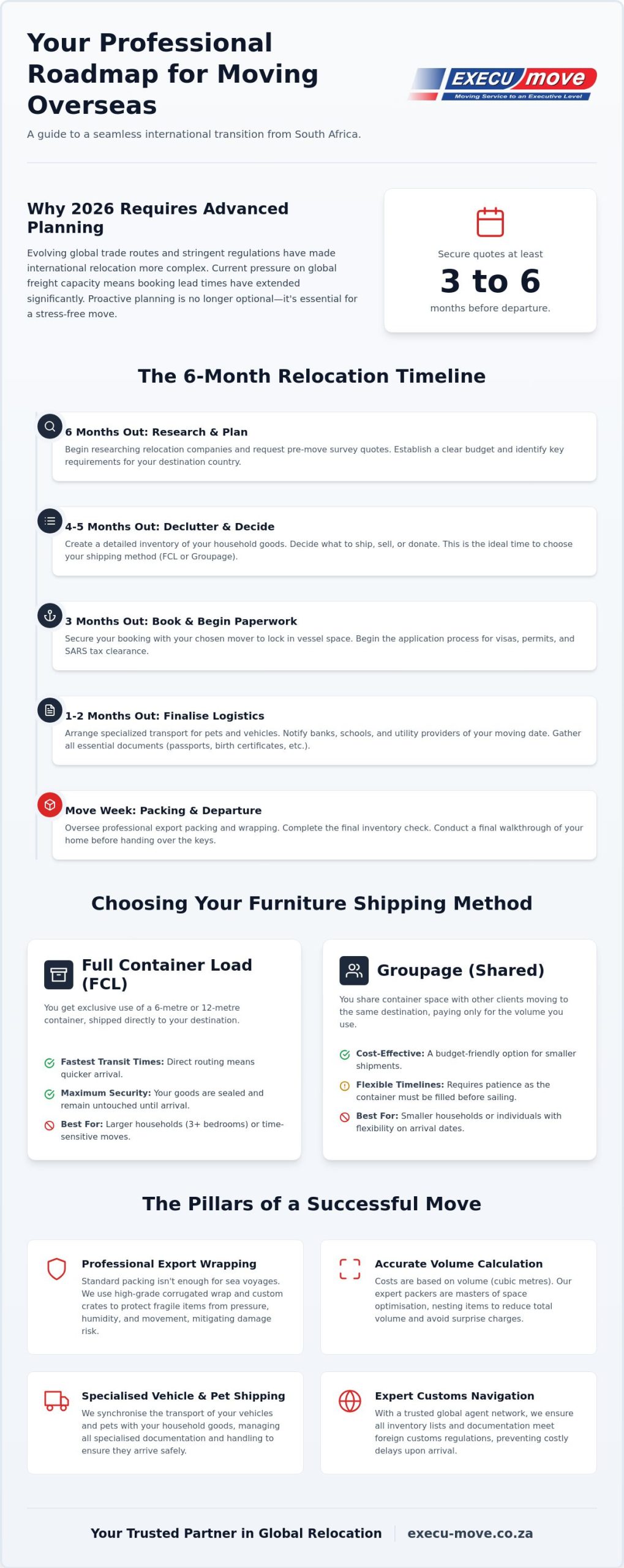
The global shipping landscape is in constant flux. Fluctuations in freight capacity, port congestion, and evolving regulations directly impact the timing and cost of your move. To navigate this environment effectively, advanced planning is non-negotiable.
- Global Freight Capacity: Demand for container space continues to influence shipping schedules. Booking your relocation well in advance is crucial to secure space on a vessel and avoid lengthy delays.
- Booking Lead Times: We strongly recommend securing a quotation and finalising your booking at least three to six months before your intended departure date. This provides the necessary buffer for documentation, pet travel preparations, and coordinating with our global agent network.
- Cost Influences: The overall international moving costs from South Africa are directly affected by dynamic factors like international fuel prices, port handling fees, and currency exchange rates. Early booking helps to lock in rates and budget more effectively.
The Role of Professional Relocation Consultants
In a complex international move, your relocation consultant is your most valuable asset. They act as your single point of contact, orchestrating every detail and providing clarity and reassurance throughout the journey. This centralised coordination is vital for managing the interconnected logistics of shipping furniture, pets, and vehicles.
Furthermore, choosing a moving company with accreditations from respected industry bodies like FIDI (Fédération Internationale des Déménageurs Internationaux) or IAM (International Association of Movers) provides an additional layer of security. These affiliations guarantee that your mover operates within a global network of vetted, high-quality agents who adhere to stringent operational and ethical standards. This network is fundamental to mitigating the risks associated with long-distance transit, ensuring your belongings are handled with the same level of professionalism at your destination as they were upon departure.
International Furniture Removals: Deciding What to Ship
One of the first major decisions you will face is what to take with you. The choice between shipping, storing, or selling your household goods requires careful consideration. While online forums often suggest that selling everything is the cheapest option, this advice frequently overlooks the high replacement cost of quality furniture, appliances, and personal items in your destination country in 2026. A professional consultant can help you conduct a realistic cost-benefit analysis.
Your shipping options will largely depend on the volume of goods you are moving:
- Full Container Load (FCL): You have exclusive use of a 20-foot or 40-foot steel shipping container. This is ideal for full household moves and offers faster transit times as the container is sealed at your home and transported directly to the port.
- Groupage (Shared Container): For smaller shipments, your goods are consolidated with other clients’ belongings in a shared container. This is a cost-effective solution, as you only pay for the space you use, though transit times can be longer due to the consolidation process.
Regardless of the method, professional export wrapping is non-negotiable. The rigours of a long-haul sea voyage—including humidity, temperature fluctuations, and movement—demand a level of protection far superior to standard domestic packing.
Professional Packing and Wrapping Standards
The materials and techniques used for domestic moves are simply insufficient for international sea freight. To protect your possessions against the unique challenges of a multi-week ocean journey, our teams use specialised, high-grade materials and proven techniques.
- Specialised Materials: This includes multi-layered, high-grade corrugated wrap, industrial-strength bubble wrap, and custom-built wooden crates for fragile or high-value items like artwork, mirrors, and antiques.
- Risk Mitigation: Every item is wrapped and packed to create a protective barrier against moisture and shock. Our professional international furniture removals service is designed to minimise risk and ensure your goods arrive in the same condition they left.
Volume Calculation and Space Optimisation
Accuracy in calculating the volume of your shipment is critical, as it forms the basis of your quotation. Our consultants are trained to assess your household goods and calculate their volume in cubic metres (m³). An accurate pre-move survey, conducted either in-person or virtually, prevents unexpected costs and ensures the correct resources are allocated for your move.
While decluttering is always recommended, professional packing itself is a form of space optimisation. Our expert crews know how to load items systematically, maximising the use of container space and often reducing the overall volume compared to self-packed boxes. This efficiency can lead to significant cost savings, particularly for groupage shipments.
Specialized Shipping: Relocating Vehicles and Pets Safely
For many South African families, moving overseas means taking everyone—including four-legged family members and cherished vehicles. The logistics for relocating pets and cars are highly specialised and must be carefully synchronised with your household goods shipment. Attempting to manage these complex processes separately can lead to stressful delays and complications.
Using an integrated service ensures that the arrival of your pets is timed with your own, and that your vehicle is ready for collection shortly after you land. This holistic approach provides invaluable peace of mind, knowing that every component of your life is being moved under one professional, coordinated plan.
Moving Pets Overseas from South Africa
Relocating a pet internationally is a detailed process governed by strict regulations to protect animal welfare and biosecurity. The requirements vary significantly by country, but the foundational steps generally include:
- Health and Identification: This involves ensuring your pet is microchipped, has up-to-date rabies vaccinations, and, for many countries, has undergone specific blood tests (like a rabies titre test) well in advance of travel.
- Travel Containers: Pets must travel in IATA-approved crates that are correctly sized to allow them to stand, sit, and turn around comfortably. Our specialists ensure the correct crate is used for your pet’s safety and comfort.
- Documentation and Permits: Each destination has its own import permit and health certificate requirements. Our dedicated team manages this complex paperwork to ensure compliance.
For detailed, country-specific regulations and a step-by-step guide, please refer to our comprehensive service for moving pets overseas from South Africa.
Vehicle Relocation and Compliance
Deciding whether to ship your car or buy a new one at your destination is a major financial decision. For high-value, classic, or sentimental vehicles, shipping is often the preferred choice. The process involves more than just loading it onto a ship; it requires adherence to strict import and biosecurity laws.
- Destination Compliance: We will help you understand the rules of your destination country regarding vehicle age, emissions standards, and modification requirements.
- Biosecurity Measures: Countries like Australia and New Zealand have exceptionally strict biosecurity regulations. All vehicles must undergo mandatory steam cleaning of the undercarriage and fumigation to remove all foreign soil, plant matter, and insects.
Our professional vehicle transport service in South Africa manages the entire process, from collection and cleaning to customs clearance and delivery.
Managing Customs Clearance and Regulatory Compliance
Navigating foreign customs is one of the most daunting aspects of an international move. Every country has its own set of rules, documentation requirements, and lists of prohibited or restricted items. A professional relocation company acts as your advocate and agent, liaising with customs departments on your behalf to ensure a smooth clearance process.
The essential documentation for clearing personal and household effects typically includes:
- Copies of passports for all family members moving.
- A detailed, itemised inventory (packing list) of all goods being shipped.
- A copy of your visa or residency permit for the destination country.
- Completed customs forms specific to your destination.
It is also important to be aware of your obligations to the South African Revenue Service (SARS) when exporting goods. Our team can guide you on the necessary declarations and procedures to ensure full compliance.
Destination-Specific Customs Nuances
While the principles of customs clearance are similar globally, the specifics vary. For example, popular destinations for South Africans like the UK, Australia, and New Zealand have different regulations regarding the importation of wood items, electronics, and foodstuffs. Most countries offer duty-free entry for used household goods, provided you have owned and used them for a specified period (typically 6-12 months) and are not importing them for resale. Accurate and detailed descriptions on your inventory are critical; vague entries like “box of kitchen items” can trigger physical inspections, leading to significant delays and extra costs.
The Importance of Transit Insurance
While we take every precaution to protect your belongings, the inherent risks of international shipping make transit insurance essential. It provides a financial safety net against unforeseen events during the long journey by sea or air. There are generally two main types of cover:
- All Risks Insurance: This is the most comprehensive cover, protecting your goods against loss or damage from a wide range of external causes.
- Total Loss Insurance: This provides cover only in the catastrophic event that the entire shipment is lost (e.g., the vessel sinks).
It is important to note that most insurance providers will only offer comprehensive “All Risks” coverage if your goods have been professionally packed by the moving company. Transit insurance should be considered a non-negotiable safeguard for your financial and emotional investment in your belongings.
Planning Your Departure: A Methodical Relocation Timeline
A well-structured timeline is the backbone of a stress-free move. By breaking the process down into manageable stages, you can stay in control and ensure all critical tasks are completed on time. We recommend beginning the planning process at least six months before your planned departure.
Key milestones in your relocation journey include the initial pre-move survey, finalising your choice of mover, booking your shipment, and completing health certifications for your pets. As your moving date approaches, our team will coordinate the “packing days,” where our professional crew will systematically pack and inventory your home. This methodical approach ensures nothing is overlooked and culminates in a smooth transition from your South African home to your new life abroad.
Three Months Before: The Logistics Lockdown
This is a critical period where foundational decisions are finalised.
- Book Your Move: Finalise your quotation for international furniture removals from South Africa and confirm your booking. This secures your place in the shipping schedule.
- Begin Pet Relocation Process: Many vaccination schedules and blood tests must be completed months before travel. Start this process immediately to avoid any delays.
- Arrange Storage: If there will be a gap between leaving your South African home and moving into your new one, arrange for secure storage for your belongings.
The Final Countdown: Moving Day and Beyond
In the final weeks and days, the physical move gets underway.
- Packing and Inventory: Our crew will arrive to pack your home. On the final day, you will conduct a final walkthrough with the crew supervisor and sign the inventory, confirming that all items have been packed.
- Shipment Tracking: Once your container is on the water, we will provide you with tracking information so you can monitor its progress across the ocean.
- Begin Your Journey: With your household goods safely on their way, you can focus on your own travel plans. To start building your customised timeline, we encourage you to contact Execu-Move for a tailored quote.
Frequently Asked Questions
- How much does it cost to move overseas from South Africa in 2026?
- Costs vary widely based on the volume of your goods (m³), your destination, the shipping method (FCL or Groupage), and any specialised services required (pets, vehicles, storage). The only way to get an accurate figure is through a professional pre-move survey.
- What items are prohibited from being shipped internationally from South Africa?
- Commonly prohibited items include flammable liquids, explosives, narcotics, perishable foods, and certain plants or animal products. Each country also has its own list of restricted items. Your relocation consultant will provide a comprehensive list for your specific destination.
- How long does it typically take for a container to reach the UK or Australia?
- Sea freight transit times vary. To the UK, it is typically 4-6 weeks on the water. To Australia or New Zealand, it is usually 6-8 weeks. These are port-to-port times; you must also factor in time for packing, customs clearance, and final delivery.
- Can I pack my own boxes for an international move?
- While you can, we strongly advise against it. Professionally packed goods are better protected and less likely to be scrutinised by customs. Furthermore, most insurance companies will not provide comprehensive “All Risks” cover for boxes packed by the owner.
- Do I need to pay customs duties on my used furniture when moving abroad?
- Generally, no. Most countries allow you to import used personal and household effects duty-free, provided you meet certain criteria, such as having owned and used the items for a minimum period (e.g., 12 months) before shipping.
- What happens if my furniture is damaged during the sea voyage?
- If you have taken out comprehensive transit insurance, you will be able to file a claim. The first step is to note any damage on the delivery paperwork and contact your relocation consultant immediately. They will guide you through the claims process.
- Is it worth shipping my car from South Africa or should I sell it?
- This depends on the car’s value, your destination’s import regulations and taxes, and the cost of a comparable vehicle there. For newer, high-value, or classic cars, shipping is often a financially viable option. We can provide a quote to help you make an informed decision.
- How do I choose between sea freight and air freight for my move?
- Sea freight is the standard and most cost-effective method for shipping household goods. Air freight is significantly more expensive and is typically only used for small, urgent shipments or to send a few essential items ahead of the main sea shipment.