What if the most stressful part of your international relocation isn’t the shipping container, but the four-legged family member waiting for their flight? Moving pets overseas from South Africa is a seven-month logistical marathon where success depends on synchronizing veterinary milestones with your furniture shipping schedule. We understand that the thought of your companion navigating international borders alone brings a unique kind of anxiety. You’re likely balancing the fear of quarantine delays with the pressure of managing household goods and vehicle transport all at once.
You deserve a transition where every detail is handled with meticulous care and professional oversight. This guide provides the clarity you need to master complex international regulations and ensures a stress-free transit for your pets. We’ll walk you through a month-by-month checklist for veterinary compliance, explain the latest 2026 state vet requirements, and show you how to coordinate your pet’s travel with your household goods for a seamless move. By the end of this guide, you’ll have the confidence to manage your relocation with the precision of a logistics expert and the heart of a pet lover.
Key Takeaways
- Establish a clear seven-month countdown to navigate complex rabies blood titre tests and mandatory waiting periods without last-minute delays.
- Understand the specialized IATA standards for crates and airline routes that make moving pets overseas from South Africa a secure, professional logistics process.
- Prioritize your pet’s safety by avoiding dangerous sedation and using proven acclimatization techniques to turn their travel carrier into a familiar sanctuary.
- Simplify your journey by synchronizing pet transport with furniture removals, ensuring a single point of contact manages every moving part of your relocation.
Navigating the Complexities of International Pet Relocation from South Africa
How do you ensure your pet’s safety when crossing oceans and continents? Moving pets overseas from South Africa is far more than a simple travel booking; it’s a specialized logistics process governed by strict global standards. Unlike a suitcase, your pet requires a climate-controlled environment, precise documentation, and a chain of custody that spans thousands of miles. While the process is complex, understanding the regulatory framework provides the foundation for a safe, predictable transition.
Many owners initially hope their companions can travel as “excess baggage” on their own flight. However, on most international routes departing from South Africa, pets must travel as manifest cargo. This isn’t a secondary option; it’s a safety-first requirement. Manifest cargo ensures that the airline’s ground crew and flight deck are fully aware of the live animal on board. This allows for monitored oxygen levels and temperature regulation in the hold, providing a level of security that excess baggage protocols simply cannot match.
The Legal Framework: IATA and IPATA Standards
The International Air Transport Association (IATA) sets the gold standard for crate safety through their Live Animals Regulations. These rules dictate everything from ventilation holes to the strength of the crate’s locking mechanism. Beyond the equipment, working with IPATA-registered agents ensures your pet enters a global network of professionals dedicated to animal welfare. This global chain of care means that from Johannesburg to London or Sydney, your pet is handled by experts who speak the same language of safety.
For those understanding pet passports and international health records, these standards provide a universal language for border officials. While some small pets might qualify for in-cabin travel on specific domestic legs, international long-haul flights from South Africa almost exclusively utilize cargo. This is often the safer choice for the animal. It avoids the noise and high-traffic stress of the passenger cabin, allowing your pet to rest in a quiet, darkened environment during the journey.
South Africa’s Export Environment in 2026
In 2026, the Department of Agriculture, Land Reform and Rural Development (DALRRD) continues to oversee all animal exports from South African shores. Their biosecurity protocols are designed to protect international borders while ensuring your pet meets the health criteria of your destination. Heightened scrutiny at borders means that even a minor clerical error can lead to significant delays. This environment makes precision in your paperwork more critical than ever before.
The State Vet acts as the final gatekeeper, providing the essential endorsement on health certificates that confirms your pet is fit for travel and compliant with all legal mandates. When moving pets overseas from South Africa, we treat these bureaucratic steps as a standardized sequence rather than a source of anxiety. We handle the coordination with DALRRD and the state vet offices, so you can focus on the emotional side of your move. With a steady hand guiding the logistics, your pet’s relocation becomes a manageable, professional operation.
A Step-by-Step Timeline for Moving Your Pets Abroad
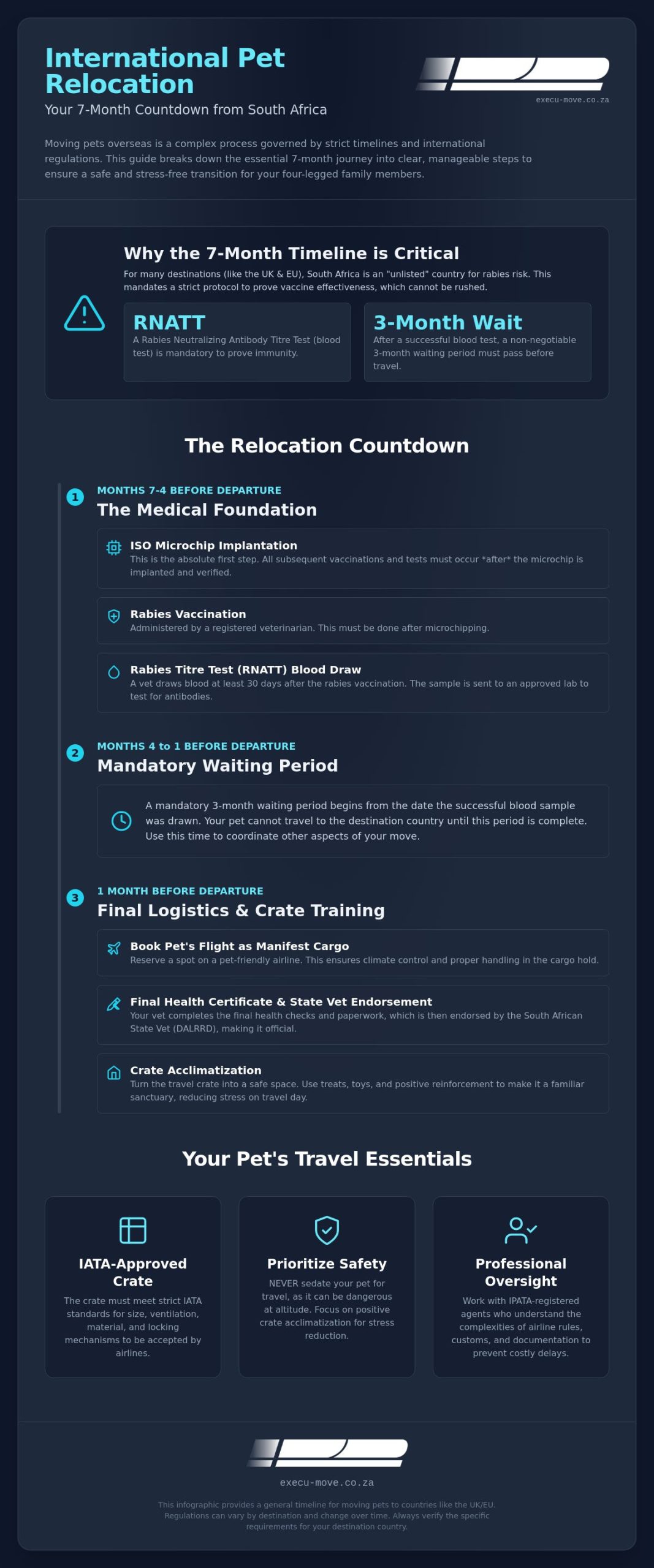
How early is too early to start planning? When moving pets overseas from South Africa, the answer is usually “yesterday.” International pet relocation is a seven-month marathon where success depends on a meticulous sequence of medical and legal milestones. Missing a single vaccination window or blood draw date can result in your pet staying behind for months while you are already in your new home. This timeline must be synchronized with your broader budget and international moving costs to avoid expensive last-minute boarding fees or flight rescheduling.
The core of this timeline is the Rabies Neutralizing Antibody Titre Test (RNATT). For destinations like the UK or the European Union, South Africa is considered an “unlisted” country. This means your pet requires a blood test to prove the rabies vaccine is effective, followed by a mandatory three-month waiting period before they can fly. If you haven’t started this process at least four months before your move, your pet will not be legally allowed to enter these regions on your arrival date.
Month 7 to 4: The Medical Foundation
Your journey begins with an ISO-compliant microchip. It’s critical that this happens before any rabies vaccinations; if the chip is inserted after the shot, the vaccination is legally void for travel purposes. Once the chip is in place, your vet will administer a primary rabies vaccination, followed by a booster 30 days later. Choosing a veterinarian familiar with international export protocols is essential here. They must record every batch number and expiry date with absolute precision. Exactly 30 days after that second vaccination, a blood sample is drawn for the RNATT and sent to a SANAS-accredited laboratory for analysis.
Month 3 to Departure: Permits and Logistics
Once you have a passing titre result, the focus shifts to paperwork and bookings. You’ll need to apply for a South African export permit from the Department of Agriculture, Land Reform and Rural Development (DALRRD), which currently carries an application fee of R440. If you’re heading to Australia or New Zealand, this is also the window to secure mandatory quarantine space, which can be booked out months in advance. For those moving pets from South Africa to Australia, the RNATT testing timeline begins a critical 180 days before departure and quarantine bookings at the Mickleham facility must be secured well ahead of time. During this time, we coordinate the cargo space on pet-friendly airlines, ensuring the flight schedule aligns with your furniture arrival.
The final ten days are the most intense. Your pet requires a final health check from a private veterinarian to confirm they are fit for travel and free of parasites. This certificate then requires the final endorsement from the State Vet. In 2026, turnaround times for these endorsements can vary by province, so having a professional partner to manage the courier and appointment logistics provides vital peace of mind. If you’re feeling overwhelmed by these moving parts, our team at Execu-Move can act as your single point of contact to ensure no deadline is missed.
Essential Requirements: Crates, Airlines, and Destination Rules
How do you choose a travel crate that feels like a sanctuary rather than a cage? When moving pets overseas from South Africa, the travel container is the most critical piece of equipment you’ll select. It isn’t just a box; it’s a life-support system designed to meet the strict IATA Live Animals Regulations (LAR). These standards ensure your pet has adequate airflow, structural protection, and enough space to remain comfortable during a long-haul flight. A mistake in crate sizing is one of the most common reasons pets are refused at the airport, making precision essential from day one.
Choosing the right airline is equally vital for a successful move. We prioritize carriers like Lufthansa, KLM, and Emirates, as they have established global reputations for handling live animals in temperature-controlled, pressurized holds. These airlines employ specialized ground staff at their international hubs to ensure pets are the last on and first off the aircraft. This minimizes time spent on the tarmac and reduces the risk of temperature-related stress. When moving pets overseas from South Africa, we only book routes that offer these specialized handling protocols.
Measuring Your Pet for the Perfect Fit
Precision is everything. A crate that’s too small will be rejected, while one that’s too large can be dangerous during turbulence. To find the right fit, you must measure your pet while they are standing in a natural position. We require three primary measurements:
- Length: From the tip of the nose to the base of the tail.
- Height: From the floor to the tip of the ears or the top of the head.
- Width: Across the widest part of the shoulders.
The pet must be able to stand up, turn around, and lie down naturally. Every IATA-compliant crate must also feature fixed water bowls that are accessible from the outside, along with a layer of absorbent bedding to maintain hygiene throughout the transit.
Navigating Breed Restrictions and Airline Policies
Does your pet have a “snub-nosed” profile? Brachycephalic breeds like Pugs, Bulldogs, and Persian cats face higher risks of respiratory distress and heat stress. Many airlines have strict seasonal restrictions or outright bans on these breeds to ensure their safety. If you’re relocating with a snub-nosed companion, we often utilize specialized crates with increased ventilation to mitigate these risks.
Destination laws also play a significant role in your planning. For instance, countries like the UK and France have strict legislation regarding breeds they consider dangerous. Even if your pet is a gentle family member, they may be barred from entry based on physical characteristics. Additionally, destinations like Australia require a mandatory quarantine period, which in 2026 can last up to 30 days. We coordinate these logistics well in advance, ensuring that your pet’s arrival at the quarantine facility is as seamless as their departure from South Africa.
Preparing Your Pet for the Journey: Stress Reduction and Safety
How do we ensure a calm journey for those who cannot understand the destination? While the logistics of moving pets overseas from South Africa are managed by experts, the emotional preparation begins at home with you. Creating a sense of familiarity and safety is the most effective way to mitigate travel anxiety. Many owners instinctively ask about sedation to help their companions sleep through the flight, but this is a dangerous misconception that we must address immediately for your pet’s safety.
Sedation is strictly prohibited by most international airlines because it suppresses the central nervous system and respiratory function; at high altitudes where oxygen levels are naturally lower, this can be life-threatening. Instead of pharmacological solutions, we rely on behavioral preparation and pheromone technology. Products like Feliway for cats or Adaptil (DAP) for dogs release synthetic calming messages that mimic those a mother provides to her young, helping your pet feel secure within their travel environment even in a new setting.
Crate Training: From Living Room to Cargo Hold
The travel crate should never be introduced on the morning of the flight. We recommend beginning the acclimatization process at least four weeks before departure. Place the crate in a high-traffic area of your home with the door securely pinned open. Start by placing high-value treats near the entrance, gradually moving their daily meals further inside until they’re eating comfortably at the very back. This positive association method transforms the crate from a confined space into a safe sanctuary.
Once your pet is comfortable eating inside, begin short intervals of closing the door while they’re distracted by a toy or meal. Slowly increase this duration over several days, remaining nearby to provide a calm, reassuring presence. By the time they arrive at the airport, the crate is no longer a foreign object; it’s a familiar piece of home. If you’re looking for professional guidance on selecting and preparing the right environment, our pet transport specialists can help you coordinate every detail of the transition.
The Day of Departure: Calm Efficiency
On the day of the flight, maintain a routine of calm efficiency. We recommend a vigorous exercise session a few hours before departure to help expend nervous energy. However, keep the final 24 hours focused on hydration rather than heavy feeding. Provide a light meal approximately six to eight hours before the flight to prevent motion sickness, but ensure they have constant access to fresh water until the final handover. This careful balance ensures they’re comfortable without being over-full during transit.
When our professional handlers arrive for the final handover, they’ll perform a meticulous check of the documentation attached to the crate. This includes verifying the health certificates, export permits, and flight labels are all perfectly aligned. This transition is handled with the same steady hand we apply to your furniture and vehicles, ensuring your companion is moved with the dignity and care they deserve. You can rest easy knowing they’re in the hands of seasoned experts who prioritize their well-being throughout the entire journey.
Why Synchronizing Your Pet and Furniture Move is the Smartest Strategy
Why struggle with three different contractors when you can rely on one steady hand? Moving pets overseas from South Africa is rarely an isolated event; it’s usually happening alongside the packing of a four-bedroom house and the shipping of the family car. Trying to coordinate a flight schedule with a shipping container arrival using separate agencies is a recipe for communication gaps and unnecessary stress. By integrating these services, you ensure that every moving part of your relocation is visible to a single, expert team that understands the full scope of your transition.
Our approach centers on the “Single Point of Contact” model. This means the same partner managing your international furniture removals is also overseeing your pet’s flight path. We coordinate your household goods shipping dates with pet flight arrivals to minimize the time you spend separated from your companions in your new country. If your furniture is delayed by port congestion or customs backlog, we can adjust pet boarding or flight dates accordingly because we have a holistic view of your entire move. This level of synchronization is even more critical if you’re also utilizing our professional vehicle transport guide to move your car across borders.
The Execu-Move Advantage: Integrated Logistics
We prioritize the emotional well-being of your pet during the “chaos phase” of the move. When our packing crews arrive to wrap and crate your furniture, the noise and disruption can be incredibly distressing for animals. We often recommend that pets are moved to a secure boarding facility or collected for their flight a day before the heavy lifting begins. This keeps them away from the bustle and ensures they remain calm before their journey. Managing customs clearance for household goods and pet permits under one roof reduces the risk of clerical errors that could lead to costly delays at your destination.
Peace of Mind: The Expert Reassurance
Relocating to a new country is a monumental life transition, and you deserve a partner who values your peace of mind as much as the safety of your belongings. A seasoned logistics expert is better equipped to handle the unexpected, such as sudden flight rerouting or airline schedule changes. We don’t just book a service; we provide a supportive partnership that guides you through every medical requirement and customs hurdle. When you’re ready to transition your entire life with confidence, you can request a comprehensive relocation quote to see how we can streamline your journey from start to finish.
Secure Your Pet’s Future with Professional Logistics
Successfully managing the complex timelines of vaccinations and blood titres is the first step toward a successful international relocation. By choosing a single partner to synchronize your pet’s flight with your furniture removal, you eliminate the stress of managing multiple vendors and significantly reduce the time your family spends apart. Moving pets overseas from South Africa in 2026 requires precision and a deep understanding of evolving biosecurity laws, but it doesn’t have to be an overwhelming experience.
With our global network of over 2000 agents and specialized expertise in customs clearance, we handle the entire process from full packing to final delivery. Whether you need vehicle transport or specialized pet handling, we act as your steady anchor in a time of change. We’re committed to providing the authoritative oversight and empathetic care your family deserves during this transition.
Request a tailored quote for your pet and furniture relocation
You don’t have to navigate this complex journey alone. We’re here to ensure that every member of your family, whether they have two legs or four, arrives safely and comfortably at your new destination.
Frequently Asked Questions
Can I fly with my pet in the cabin from South Africa?
No, on almost all international routes departing from South Africa, pets are required to travel as manifest cargo rather than in the passenger cabin. This is a safety-first regulation that ensures the flight deck can actively monitor the hold’s temperature and oxygen levels. While some domestic legs allow small pets in-cabin, international long-haul standards prioritize the secure, quiet environment of the cargo hold for your pet’s well-being.
How much does it cost to move a pet overseas from South Africa?
The total expense depends on your pet’s physical size, the destination country’s specific health requirements, and current airline cargo rates. Factors such as specialized IATA-compliant crates, mandatory rabies blood titre tests, and state vet endorsement fees all contribute to the final cost. We recommend requesting a comprehensive relocation quote that synchronizes your pet’s travel with your furniture move to optimize your overall budget and logistics.
Will my pet have to stay in quarantine when we arrive?
Quarantine requirements are entirely dependent on your destination’s biosecurity laws. Countries like Australia and New Zealand maintain strict mandatory quarantine periods, which often last up to 30 days in 2026. Conversely, the UK and most EU nations allow for immediate entry provided all rabies titre tests and three-month waiting periods have been meticulously documented and verified by the South African State Veterinarian before departure.
Is it safe for older pets to fly long distances?
Yes, senior pets can travel safely provided they receive a comprehensive “fit-to-fly” clearance from your private veterinarian. We prioritize routes with reputable airlines that offer climate-controlled environments and specialized ground handling at international hubs. For older companions, we focus heavily on crate acclimatization and hydration protocols to ensure their comfort during the long-haul transit from South African shores to their new home.
How do I get a South African export permit for my dog or cat?
You must apply for an export permit through the Department of Agriculture, Land Reform and Rural Development (DALRRD). This process involves submitting your pet’s microchip details, health records, and vaccination history for official verification. When moving pets overseas from South Africa, our team manages the coordination with DALRRD and the State Vet offices to ensure your permits are issued and endorsed within the required travel window.
What happens if my pet’s flight is delayed or cancelled?
Professional handlers take immediate custody of your pet to provide food, water, and exercise at specialized airport transit lounges or pet hotels. If a significant delay occurs, we arrange for secure boarding at a nearby facility until the next available pet-friendly flight. Our global network of over 2000 agents ensures that your pet is never left unattended and that you receive real-time updates throughout any scheduling disruption.
Do I need to buy my own crate or will the relocation company provide one?
We provide specialized, IATA-compliant crates that are specifically measured to fit your pet’s length, height, and width. While you can purchase your own, it must meet rigorous international safety standards regarding ventilation, structural integrity, and fixed water bowls. Using a crate provided by your relocation partner ensures that your pet won’t be refused at the airport due to non-compliant equipment or incorrect sizing.
Can I move my pet if they are a “snub-nosed” breed?
Yes, but snub-nosed (brachycephalic) breeds require additional safety precautions and specific airline approvals due to their unique respiratory profiles. These breeds are often restricted during periods of high temperature and may require larger crates than standard breeds to ensure maximum airflow. We only utilize airlines with the most advanced climate-control technology and specialized handling protocols to ensure a safe journey for Pugs, Bulldogs, and Persian cats.