Did you know that the most critical part of your pet’s journey to the land down under happens exactly 180 days before they ever step onto a plane? When you’re moving pets from South Africa to Australia, the margin for error is incredibly thin. Australia’s Department of Agriculture, Fisheries and Forestry maintains some of the strictest biosecurity standards on the planet. It’s completely natural to feel anxious about the complex RNATT testing timelines or the thought of your furry family member spending ten days at the Mickleham quarantine facility in Melbourne.
We agree that the process can feel like an overwhelming series of hurdles; however, it doesn’t have to be a source of constant stress. This comprehensive 2026 guide promises to simplify the Australian import requirements into a manageable, step-by-step timeline. You’ll gain the confidence that every blood test is scheduled correctly and every permit is in place. We’ll walk you through the entire relocation cycle, covering everything from IATA-compliant crates to the specific parasite treatments required for a smooth entry into your new home. Trust that with the right preparation, your pet’s arrival in Melbourne can be a quiet, well-managed event rather than a logistical crisis.
Key Takeaways
- Understand why Australia’s strict Group 3 classification for South Africa necessitates a rigorous biological timeline to protect its rabies-free ecosystem.
- Learn how to navigate the mandatory 180-day waiting period when moving pets from South Africa to Australia to ensure a seamless transition for your cats and dogs.
- Master the specific sequence of ISO-compliant microchipping and RNATT blood testing required to meet the precise Australian Department of Agriculture standards.
- Discover the essential steps for securing an Australian Import Permit and booking the mandatory stay at the Mickleham Post Entry Quarantine facility in Melbourne.
- See how synchronising your pet transport with your international furniture removals can reduce stress and ensure your family is reunited quickly in your new home.
Australia’s Biosecurity Laws: Why South Africa is a Group 3 Country
Australia is a unique island continent with a fragile ecosystem that has remained free from many of the world’s most devastating animal diseases, including rabies. To maintain this status, the Australian Department of Agriculture, Fisheries and Forestry (DAFF) enforces some of the most stringent Australia’s Biosecurity Laws found anywhere. When you are moving pets from South Africa to Australia, you are entering a system designed to mitigate every possible biological risk. South Africa is currently classified as a Group 3 country. This means that while rabies is present in local wildlife and domestic populations, the Australian authorities recognise it as being well-controlled through established veterinary protocols and surveillance.
The 180-day residency rule is a cornerstone of this process. Your pet must have lived in South Africa, or another approved country, for at least six months immediately before export. This period ensures that no latent diseases are hitching a ride across the ocean. Because of this classification, direct entry without rigorous testing is simply not an option. Every cat and dog must undergo a specific sequence of preparations to prove they are healthy enough to join the Australian community. This meticulous approach is why the timeline for moving pets from South Africa to Australia is significantly longer than moves to Europe or the United States.
The Importance of Biosecurity in 2026
In 2026, the focus on protecting Australia’s natural heritage is stronger than ever. The DAFF operates with a zero-tolerance approach to paperwork errors or missed treatments. For families relocating, non-negotiable is the operative word. If a single blood test date is off by even 24 hours, the entire process might need to be restarted. This strictness isn’t meant to be punitive; it’s a necessary shield for Australia’s unique flora and fauna. Professional coordination ensures that every biosecurity box is ticked long before your pet reaches the airport.
Eligibility: Can Your Pet Make the Move?
Before starting the clock on the 180-day timeline, you must ensure your pet is eligible for entry. Pets must be at least 84 days old, or 12 weeks, at the time of their primary rabies vaccination. If your pet has chronic health conditions, relocation is often still possible, but it requires careful management and specialised travel arrangements. You must also verify that your dog is not on the banned breeds list. Australia prohibits several breeds, including:
- Pit Bull Terriers
- Japanese Tosa
- Dogo Argentino
- Fila Brasileiro
Checking these details early prevents heartbreak and unnecessary expenses later in the journey. Most domestic cats and popular dog breeds will have no trouble meeting the eligibility criteria, provided they are in good general health.
Mandatory Health Protocols and the RNATT Process
Order is everything. Before you begin any vaccinations or blood tests, your pet must be fitted with a 15-digit, ISO-compliant microchip. This unique identifier must be scanned and recorded at every subsequent veterinary visit. If a rabies vaccination is administered before the microchip is implanted, the Australian authorities will consider that vaccination invalid. You can verify the sequence on the official Australian government guide for Mandatory Health Protocols and the RNATT Process. Once the microchip is in place, your pet requires a rabies vaccination using an inactivated or recombinant vaccine. This must be done when the pet is at least 84 days old.
The Rabies Neutralising Antibody Titre Test (RNATT) is the most critical hurdle when moving pets from South Africa to Australia. This blood test confirms that the rabies vaccination has successfully generated enough antibodies to protect your pet. The blood sample must be drawn by a government-approved veterinarian and sent to a recognised laboratory, such as the Onderstepoort Veterinary Institute in Pretoria. A successful result is defined as a titre of at least 0.5 IU/ml. This result doesn’t just prove immunity; it also starts the official 180-day countdown to entry.
The RNATT Timeline Explained
Why is there a six-month wait? The 180-day period serves as a biological buffer to ensure no symptoms of rabies develop after the blood draw. This timeline is fixed. Your pet cannot enter Australia until 180 days have passed from the date the blood was drawn for a successful RNATT. The good news is that the RNATT remains valid for 24 months from the date of the blood draw. If your pet fails to reach the 0.5 IU/ml threshold, they will need a booster vaccination and a new blood draw, which unfortunately resets the 180-day clock. Our team often suggests specialised pet transport coordination to ensure these dates are managed with precision.
Additional Tests and Treatments
Dogs require specific blood tests for Ehrlichia canis, Brucella canis, and Leishmania infantum within 45 days of departure. Cats have different requirements, focusing on vaccinations for Feline Enteritis, Rhinotracheitis, and Calicivirus. Both species must undergo rigorous internal and external parasite treatments, such as those for ticks and hydatid tapeworms, in the weeks leading up to the flight. Every pet must also receive a final health declaration and certificate endorsement from a South African state veterinarian within the days immediately preceding departure. This final signature confirms that your pet is fit for travel and meets every biosecurity requirement.
The Logistics: Import Permits, Flights, and Quarantine
How do you move from medical testing to physical transport? Once the 180-day countdown is underway, the next step is securing your Australian Import Permit through the Biosecurity Import Conditions (BICON) system. The application fee for this permit currently ranges between AUD $480 and AUD $600 per pet. It is vital to apply early. The Official Australian Government Pet Import Requirements state that the permit must be granted before your pet leaves South Africa. This document is the golden ticket that allows your cat or dog to board their flight and enter the country legally. Without it, your pet will be denied entry at the border.
When moving pets from South Africa to Australia, your pet cannot travel as excess baggage on your passenger ticket. Australian law requires all animals to arrive as ‘Manifest Cargo’. This means they travel in a climate-controlled, pressurised hold under their own airway bill. Safety is paramount during the long-haul journey. Every pet must be housed in a specialised IATA-compliant travel crate. These crates are designed to be escape-proof and provide enough space for your pet to stand, turn around, and lie down comfortably. Our team ensures these crates are fitted with appropriate bedding and water bowls to maintain comfort throughout the flight.
Life at Mickleham Quarantine Centre
All pets entering Australia must undergo a mandatory quarantine period at the Mickleham Post Entry Quarantine facility near Melbourne. The minimum stay is 10 days. This can be extended to 30 days if biosecurity concerns arise or if paperwork is incomplete. While many owners worry about the isolation, the facility is a world-class environment staffed by professional veterinarians and handlers. It is important to remember that visitation is generally not permitted during the standard 10-day stay to maintain strict biosecurity protocols. Once the quarantine period is complete, your pet is released for collection or onward travel to your new home in Sydney, Perth, Brisbane, or Adelaide. For families relocating to South Australia, you can discover Anspach Removals & Storage to help coordinate the arrival of your household goods alongside your pets.
Choosing the Right Flight Path
Most pets depart from Johannesburg or Cape Town. Common routes involve a stopover in international hubs like Singapore or Dubai, with the final destination always being Melbourne International Airport. This is because Mickleham is the only government-run quarantine facility in the country. Airlines like Qantas and Singapore Airlines have developed highly specialised pet transport services to handle these long-haul requirements with care. For a broader look at the process, you might find our guide on Moving Pets Overseas from South Africa: The Complete 2026 Relocation Guide helpful. Coordinating these flights with your own arrival ensures you are ready and waiting to receive the news of their safe landing.
A Step-by-Step 7-Month Relocation Timeline
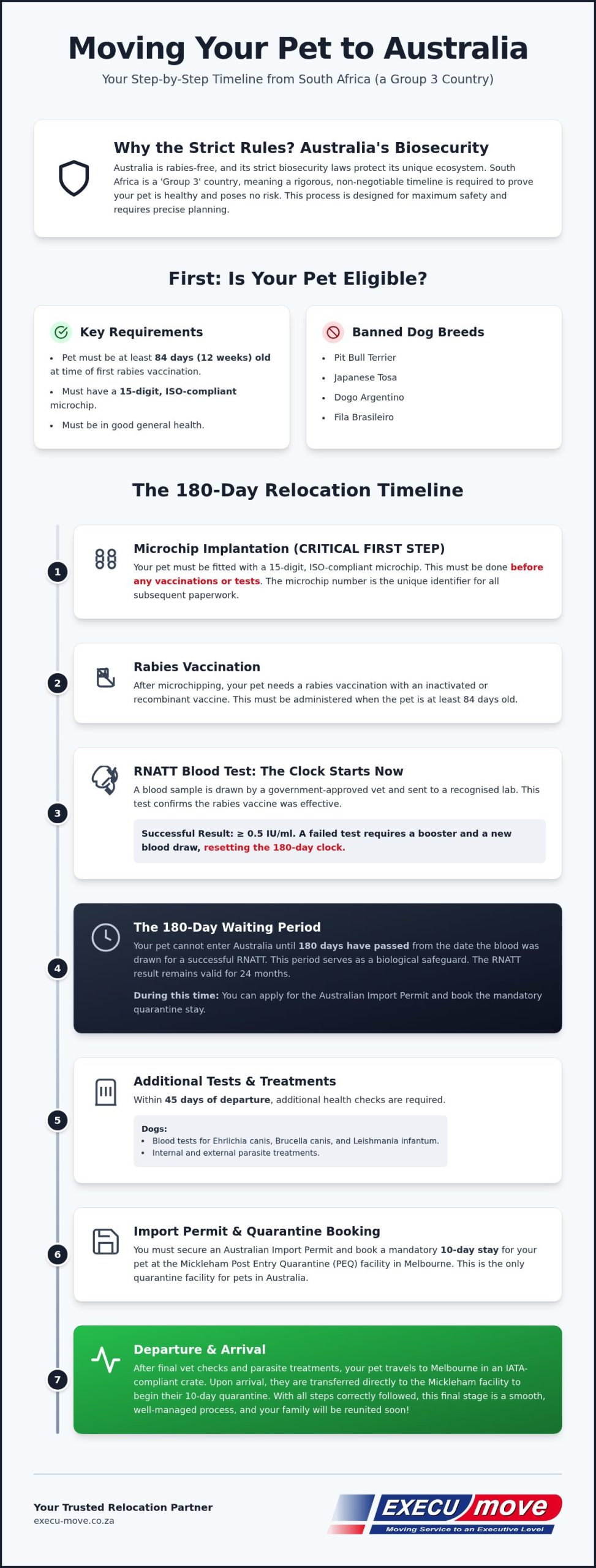
Relocation is a marathon, not a sprint. Success when moving pets from South Africa to Australia depends entirely on your ability to work backward from your desired arrival date. Because of the mandatory 180-day waiting period, you need at least seven months of active preparation. Think of this as a logistical roadmap that ensures every biological and administrative milestone is met without panic. Following a structured calendar is the best way to mitigate the anxiety of such a significant transition.
- Month 7: Begin with the ISO-compliant microchip followed by the rabies vaccination. The chip must be implanted and scanned before the vaccination is administered.
- Month 6: Schedule the RNATT blood draw. The date the laboratory receives this sample is the ‘Day Zero’ for your six-month wait.
- Month 5: As soon as the passing titre results arrive, submit your application for the Australian Import Permit via the BICON system.
- Month 4: Reserve your pet’s space at the Mickleham Post Entry Quarantine facility. Demand for these spots is high, and they are often booked out months in advance.
- Month 1: Complete the final blood tests for dogs and begin the specific parasite treatment schedule. This month also requires the final health check and endorsement from a South African state veterinarian.
Common Pitfalls to Avoid
Errors in documentation are the leading cause of heart-wrenching delays. If the microchip number on the health certificate differs by a single digit from the scanned chip, your pet could be turned back at the border. Miscalculating the 180-day window is another frequent mistake. If your pet arrives even a day early, they will be required to stay in quarantine for the remainder of that period at your expense. Furthermore, airline staff will reject any crate that doesn’t meet strict IATA standards. This is why a meticulous approach to moving pets from South Africa to Australia is the only way to ensure a smooth reunion.
Managing Your Pet’s Stress
Your pet’s emotional well-being is just as important as the paperwork. Start crate training at least three months before departure. Place familiar bedding and favourite treats inside the travel crate so it becomes a safe haven rather than a source of fear. While you might be tempted to use sedatives, these are strictly prohibited by airlines because they can cause dangerous respiratory issues at high altitudes. Focus on natural calming techniques and ensuring your pet is well-hydrated. If you’re feeling overwhelmed by the calendar, our team can provide a tailored relocation plan to keep your move on track.
Streamlining Your Move: Coordinating Pets and Household Goods
Why treat your relocation as two separate projects? When you’re moving pets from South Africa to Australia, the most efficient approach is to synchronise their journey with your household goods. Execu-Move acts as a single point of contact, ensuring that your furniture and your furry family members arrive in a coordinated sequence. This level of oversight prevents the logistical nightmare of having your home contents arrive weeks before you’re ready to collect your pet from quarantine. We focus on the big picture so you can focus on your family’s transition.
It’s important to distinguish between the two types of clearance your belongings will face. Your personal effects undergo standard customs clearance, which focuses on duties and prohibited items. Your pet, however, enters a completely different stream managed by biosecurity officers. We manage these parallel processes so you don’t have to navigate different government departments alone. By overseeing the specialised logistics of your entire family, we provide a steady hand during what is often a chaotic period. Our goal is to ensure that when you finally unlock the door to your new Australian home, your pets are only a few days away from joining you.
The Execu-Move Specialized Pet Service
Our global reach is a significant advantage for relocating families. With a network of 2000 agents, we ensure a seamless handoff once your pet touches down in Melbourne. We don’t just book a flight. We assist with the complex documentation and help coordinate state vet appointments within South Africa to ensure every endorsement is perfect. If you’re currently planning your relocation budget, you may find our guide on International Moving Costs from South Africa: The 2026 Comprehensive Budgeting Guide a useful resource for understanding the full scope of your move. This integrated approach reduces the risk of communication gaps between different service providers.
Final Checklist for a Smooth Departure
Organisation is your best defence against last-minute stress. Ensure you have a dedicated folder for original documents, including the endorsed health certificate and the RNATT laboratory report. These must travel with the pet’s airway bill, while you should keep digital copies for your own records. We also recommend double-checking that travel crates are clearly labelled with your contact information in both South Africa and Australia. When you arrive at the cargo terminal for the final goodbye, the process is methodical and professional. Your pet will be checked in by specialised handlers who prioritise their safety and comfort above all else. This final step is the culmination of months of careful planning, bringing you one step closer to your new life together.
Embarking on Your Australian Journey with Confidence
Success in relocating your family depends on respecting the strict 180-day biological timeline and the precise requirements of Australian biosecurity. You now understand that moving pets from South Africa to Australia is a methodical process that rewards early preparation and attention to detail. By synchronising your pet’s travel with your household removal, you eliminate the risk of communication gaps and ensure a smoother reunion in Melbourne or beyond.
With over 20 years of international relocation experience and a global network of 2000 agents, we provide the steady hand you need during this transition. Our South African-based experts are intimately familiar with both local customs and Australian regulations. We invite you to Get a Specialised Quote for Your Pet and Furniture Relocation today. Your new life in Australia is waiting, and we are here to ensure every member of your family arrives safely and without unnecessary stress.
Frequently Asked Questions
How much does it cost to move a dog from South Africa to Australia in 2026?
The total cost for moving pets from South Africa to Australia depends on various factors like breed size and flight routes. You should budget for mandatory government fees, including the AUD $480 to $600 import permit and the minimum AUD $1,877 quarantine stay at Mickleham. These figures don’t include veterinary costs, RNATT laboratory fees, or the specialised travel crates required for international cargo. For larger dogs, the total investment often reaches into five-figure territory when all logistics are finalised.
Can my pet stay with me in my house during the 10-day quarantine?
No, Australia does not permit home quarantine for any pets entering from Group 3 countries like South Africa. All cats and dogs must complete a mandatory stay of at least 10 days at the government-run Mickleham Post Entry Quarantine facility in Melbourne. This rule is non-negotiable and ensures that biosecurity officers can monitor your pet’s health in a controlled environment before they enter the general community.
What happens if my pet’s RNATT results are below the required level?
If your pet’s Rabies Neutralising Antibody Titre Test (RNATT) result is below the required 0.5 IU/ml, they’ll need a booster vaccination followed by another blood draw. It is important to remember that the 180-day waiting period only begins on the date the laboratory receives a successful blood sample. Failing the test will unfortunately delay your relocation timeline, which is why we recommend ensuring your pet’s vaccinations are up to date well in advance.
Are there any dog breeds specifically banned from entering Australia?
Several dog breeds are strictly prohibited from entering Australia to protect public safety and the local ecosystem. These include the Pit Bull Terrier, Japanese Tosa, Fila Brasileiro, and Dogo Argentino. If your dog is a mix of these breeds or has a similar appearance, you may be required to provide a formal breed declaration. Always verify your dog’s eligibility before beginning the 7-month preparation process to avoid complications at the border.
How long is the actual flight for a pet moving to Australia?
The total travel time usually ranges between 18 and 24 hours, depending on your chosen flight path and layover duration. Most pets fly from Johannesburg or Cape Town with a stopover in hubs like Singapore or Dubai before landing in Melbourne. While the flight is long, pets travel in a climate-controlled cargo hold designed for their safety. Professional coordination ensures your pet is monitored during transit and handled with care during the transfer between aircraft.
Do I need to hire a pet relocation agent, or can I do it myself?
While you can theoretically manage the process yourself, the Australian government strongly encourages the use of professional pet relocation agents due to the complexity of the biosecurity requirements. A single error in the RNATT timing or an incomplete veterinary certificate can lead to your pet being denied entry or facing extended quarantine. Most families find that the peace of mind provided by an experienced partner is invaluable when moving pets from South Africa to Australia.
What is the Mickleham quarantine facility like for cats?
The Mickleham facility provides high-quality care for cats, featuring individual, climate-controlled enclosures that prioritise their comfort and safety. Cats are monitored daily by on-site veterinary staff and biosecurity officers. While you cannot visit your cat during their 10-day stay, the facility is designed to reduce stress and ensure every animal remains healthy. After the quarantine period is complete, your cat will be ready for collection or onward transport to your new home.
Can I move my pet to Australia if they have a pre-existing medical condition?
Yes, pets with pre-existing medical conditions can usually relocate to Australia, provided their condition is stable and fully disclosed during the permit application. You must provide detailed veterinary reports and ensure that any required medications are clearly labelled and accompanied by prescriptions. The biosecurity officers at Mickleham will manage the administration of medication during the quarantine period. It is essential to discuss your pet’s specific health needs with a relocation consultant early in the planning phase.